Department of Mechanical and Aerospace Engineering, Princeton University, Princeton, New Jersey, United States of America.
Department of Chemical and Biological Engineering, Princeton University, Princeton, New Jersey, United States of America.
PLoS Comput Biol. 2022 Apr 27;18(4):e1009293. doi: 10.1371/journal.pcbi.1009293. eCollection 2022 Apr.
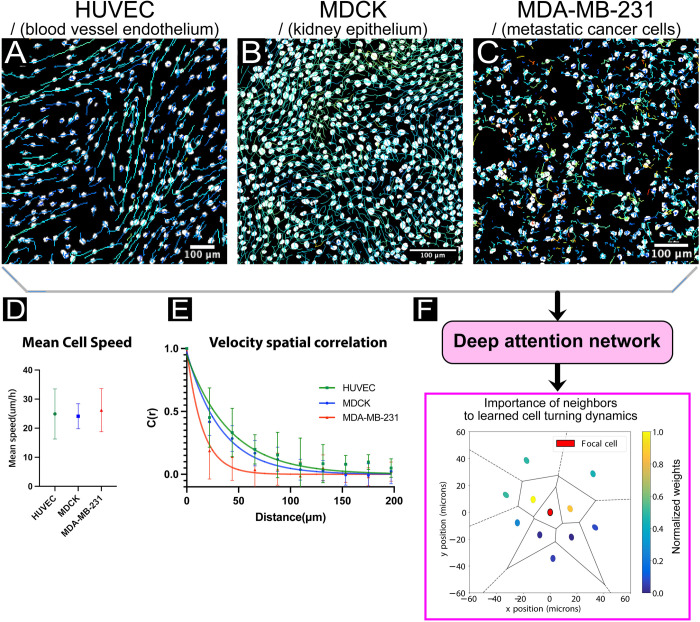
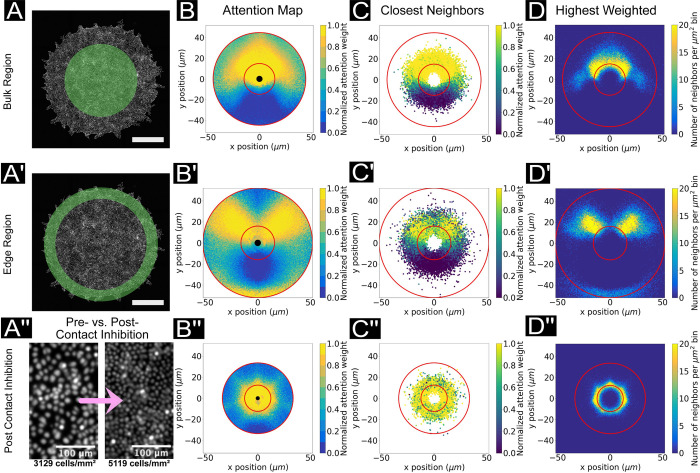
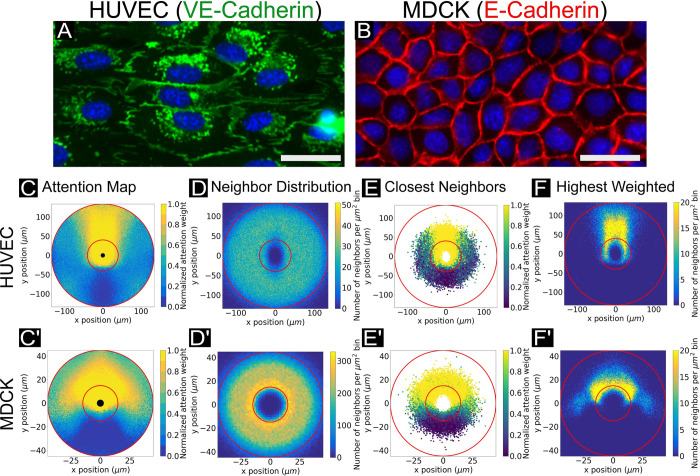
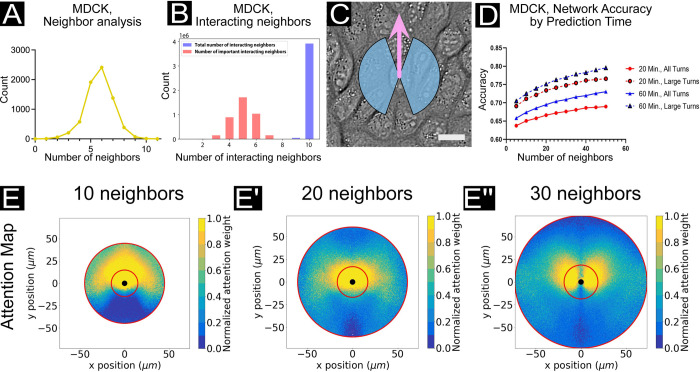
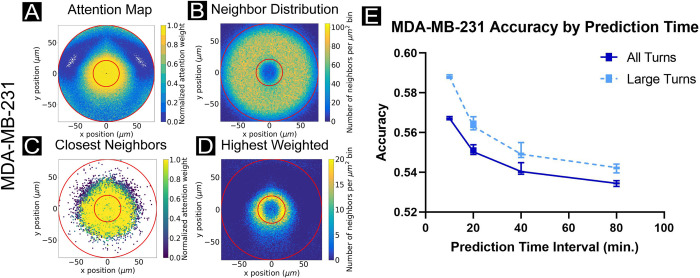
Collective, coordinated cellular motions underpin key processes in all multicellular organisms, yet it has been difficult to simultaneously express the 'rules' behind these motions in clear, interpretable forms that effectively capture high-dimensional cell-cell interaction dynamics in a manner that is intuitive to the researcher. Here we apply deep attention networks to analyze several canonical living tissues systems and present the underlying collective migration rules for each tissue type using only cell migration trajectory data. We use these networks to learn the behaviors of key tissue types with distinct collective behaviors-epithelial, endothelial, and metastatic breast cancer cells-and show how the results complement traditional biophysical approaches. In particular, we present attention maps indicating the relative influence of neighboring cells to the learned turning decisions of a 'focal cell'-the primary cell of interest in a collective setting. Colloquially, we refer to this learned relative influence as 'attention', as it serves as a proxy for the physical parameters modifying the focal cell's future motion as a function of each neighbor cell. These attention networks reveal distinct patterns of influence and attention unique to each model tissue. Endothelial cells exhibit tightly focused attention on their immediate forward-most neighbors, while cells in more expansile epithelial tissues are more broadly influenced by neighbors in a relatively large forward sector. Attention maps of ensembles of more mesenchymal, metastatic cells reveal completely symmetric attention patterns, indicating the lack of any particular coordination or direction of interest. Moreover, we show how attention networks are capable of detecting and learning how these rules change based on biophysical context, such as location within the tissue and cellular crowding. That these results require only cellular trajectories and no modeling assumptions highlights the potential of attention networks for providing further biological insights into complex cellular systems.
集体协调的细胞运动是所有多细胞生物关键过程的基础,但一直以来,人们都难以用清晰、可解释的形式来表达这些运动背后的“规则”,从而以一种对研究人员直观的方式有效地捕捉高维的细胞间相互作用动态。在这里,我们应用深度注意网络来分析几个典型的活体组织系统,并仅使用细胞迁移轨迹数据,为每种组织类型呈现潜在的集体迁移规则。我们使用这些网络来学习具有不同集体行为的关键组织类型的行为——上皮细胞、内皮细胞和转移性乳腺癌细胞,并展示了这些结果如何补充传统的生物物理方法。特别是,我们展示了注意力图,这些注意力图表明了相邻细胞对学习到的“焦点细胞”(集体环境中主要感兴趣的细胞)转向决策的相对影响。通俗地说,我们将这种学习到的相对影响称为“注意力”,因为它可以作为改变焦点细胞未来运动的物理参数的代理,这些参数是作为每个邻接细胞的函数。这些注意力网络揭示了每个模型组织特有的独特影响和注意力模式。内皮细胞对其最前方的直接邻接细胞表现出紧密聚焦的注意力,而在更扩张的上皮组织中,细胞受到相对较大的前方区域中邻接细胞的广泛影响。更多间质样、转移性细胞的注意力图揭示了完全对称的注意力模式,表明缺乏任何特定的协调或关注方向。此外,我们展示了注意力网络如何能够检测并学习这些规则如何根据生物物理背景(如组织内位置和细胞拥挤程度)发生变化。这些结果仅需要细胞轨迹且无需建模假设,这突出了注意力网络在为复杂细胞系统提供进一步生物学见解方面的潜力。