D. Papanagnou is professor and vice chair for education, Department of Emergency Medicine, and associate dean for faculty development, Sidney Kimmel Medical College at Thomas Jefferson University, Philadelphia, Pennsylvania, and a 2020 Macy Faculty Scholar, Josiah Macy Jr. Foundation, New York, New York.
K.E. Watkins is professor of learning, leadership, and organization development, Department of Lifelong Education, Administration, and Policy, University of Georgia, Athens, Georgia.
Acad Med. 2022 Aug 1;97(8):1137-1143. doi: 10.1097/ACM.0000000000004717. Epub 2022 Jul 21.
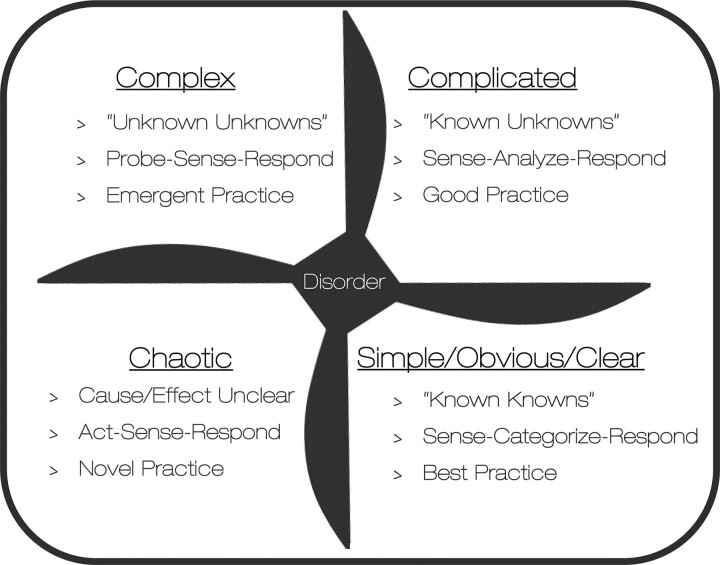
In the time of the COVID-19 pandemic, where clinical environments are plagued by both uncertainty and complexity, the importance of the informal and social aspects of learning among health care teams cannot be exaggerated. While there have been attempts to better understand the nuances of informal learning in the clinical environment through descriptions of the tacit or hidden curriculum, incidental learning in medical education has only been partially captured in the research. Understood through concepts borrowed from the Cynefin conceptual framework for sensemaking, the early stages of the pandemic immersed clinical teams in complex and chaotic situations where there was no immediately apparent relationship between cause and effect. Health care teams had to act quickly amidst the chaos: they had to first act, make sense of, and respond with intentionality. Informal and incidental learning (IIL) emerged as a byproduct of acting with the tools and knowledge available in the moment. To integrate the informal, sometimes haphazard nature of emergence among health care teams, educators require an understanding of IIL. This understanding can help medical educators prepare health professions learners for the cognitive dissonance that accompanies uncertainty in clinical practice. The authors introduce IIL as an explanatory framework to describe how teams navigate complexity in the clinical learning environment and to better inform curricular development for health professions training that prepares learners for uncertainty. While further research in IIL is needed to illuminate tacit knowledge that makes learning explicit for all audiences in the health professions, there are opportunities to cultivate learners' skills in formal curricula through various learning interventions to prime them for IIL when they enter complex clinical learning environments.
在 COVID-19 大流行期间,临床环境充满了不确定性和复杂性,医疗团队之间非正式和社交学习的重要性怎么强调都不为过。虽然人们曾试图通过描述隐性或隐藏课程来更好地理解临床环境中非正式学习的细微差别,但医学教育中的偶然学习在研究中只是部分被捕捉到。通过借用认知领域概念框架中的概念来理解,大流行的早期阶段使临床团队陷入了复杂和混乱的情况,在这种情况下,因果关系之间没有明显的联系。医疗保健团队必须在混乱中迅速采取行动:他们必须首先行动,有意地理解和做出反应。非正式和偶然学习 (IIL) 是在当下可用的工具和知识的作用下产生的副产品。为了整合医疗保健团队中出现的非正式、有时是偶然的性质,教育工作者需要理解 IIL。这种理解可以帮助医学教育者为临床实践中的不确定性伴随的认知失调做好卫生专业学习者的准备。作者介绍了 IIL 作为一个解释框架,以描述团队如何在临床学习环境中应对复杂性,并为卫生专业培训的课程发展提供更好的信息,为学习者在不确定的情况下做好准备。虽然需要进一步研究 IIL 来阐明隐性知识,以便为所有卫生专业人员的学习提供明确的信息,但通过各种学习干预措施,在学习者进入复杂的临床学习环境之前,在正式课程中培养他们的技能,为他们进行 IIL 提供机会。