Department of Respiratory and Critical Care Medicine, Shanghai Changhai Hospital, the First Affiliated Hospital of Naval Medical University, Shanghai, 200433, China.
Department of Gastroenterology, Shanghai General Hospital, Shanghai Jiao Tong University School of Medicine, Shanghai, 200240, China.
BMC Pulm Med. 2022 Apr 27;22(1):162. doi: 10.1186/s12890-022-01936-w.
The aim of this study was to explore risk factors for the prognosis of lung cancer with simple brain metastasis (LCSBM) patients and to establish a prognostic predictive nomogram for LCSBM patients.
Three thousand eight hundred and six cases of LCSBM were extracted from the Surveillance, Epidemiology, and End Results (SEER) database from 2010 to 2015 using SEER Stat 8.3.5. Lung cancer patients only had brain metastasis with no other organ metastasis were defined as LCSBM patients. Prognostic factors of LCSBM were analyzed with log-rank method and Cox proportional hazards model. Independent risk and protective prognostic factors were used to construct nomogram with accelerated failure time model. C-index was used to evaluate the prediction effect of nomogram.
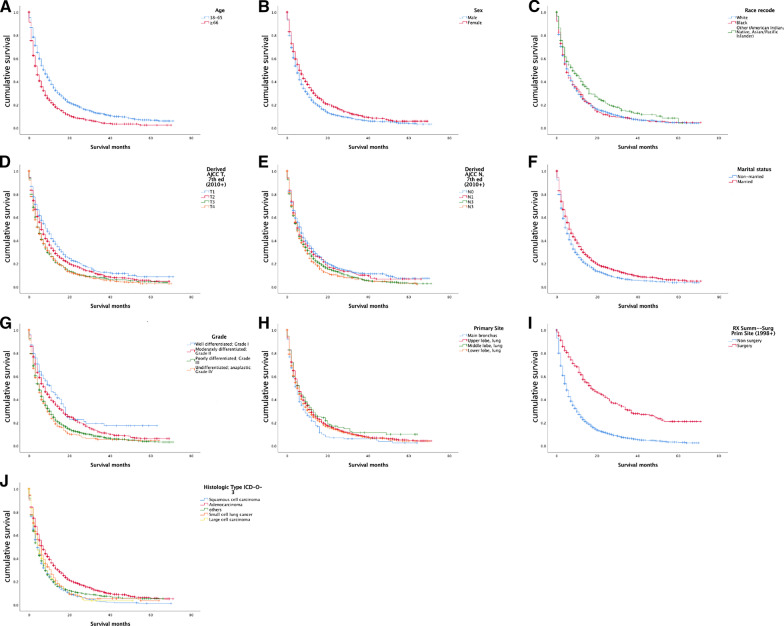
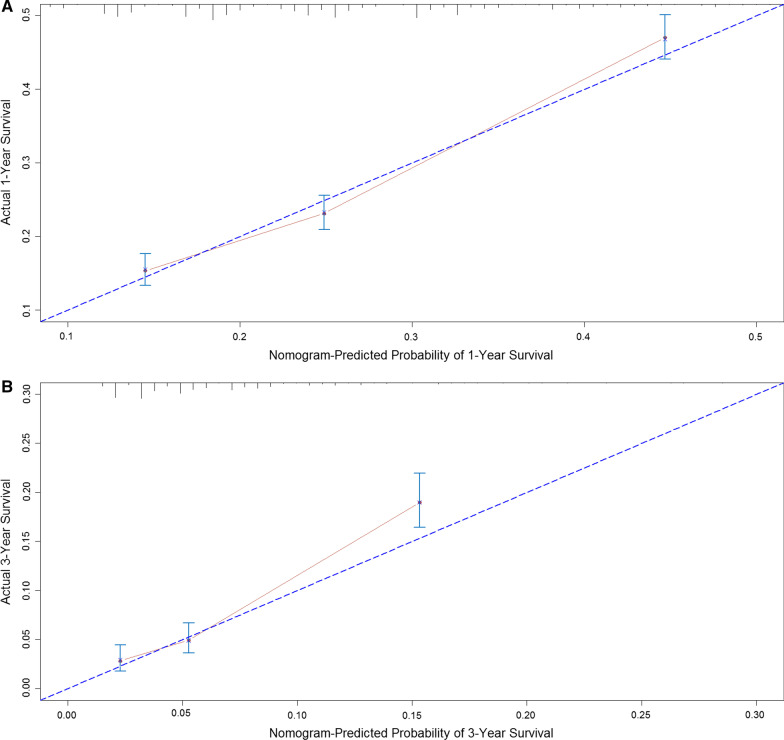
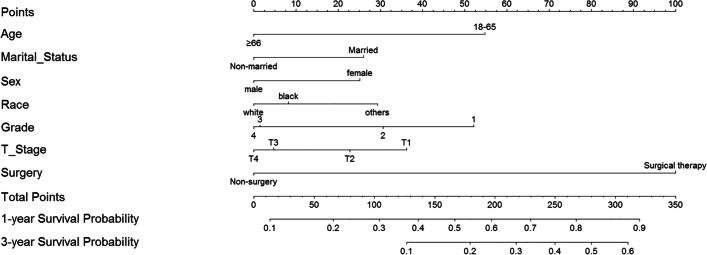
The younger patients (18-65 years old) accounted for 54.41%, while patients aged over 65 accounted for 45.59%.The ratio of male: female was 1:1. Lung cancer in the main bronchus, upper lobe, middle lobe and lower lobe were accounted for 4.91%, 62.80%, 4.47% and 27.82% respectively; and adenocarcinoma accounted for 57.83% of all lung cancer types. The overall median survival time was 12.2 months. Survival rates for 1-, 3- and 5-years were 28.2%, 8.7% and 4.7% respectively. We found female (HR = 0.81, 95% CI 0.75-0.87), the married (HR = 0.80; 95% CI 0.75-0.86), the White (HR = 0.90, 95% CI 0.84-0.95) and primary site (HR = 0.45, 95% CI 0.39-0.52) were independent protective factors while higher age (HR = 1.51, 95% CI 1.40-1.62), advanced grade (HR = 1.19, 95% CI 1.12-1.25) and advanced T stage (HR = 1.09, 95% CI 1.05-1.13) were independent risk prognostic factors affecting the survival of LCSBM patients. We constructed the nomogram with above independent factors, and the C-index value was 0.634 (95% CI 0.622-0.646). We developed a nomogram with seven significant LCSBM independent prognostic factors to provide prognosis prediction.
本研究旨在探讨单纯性脑转移肺癌(LCSBM)患者预后的危险因素,并建立 LCSBM 患者的预后预测列线图。
从 2010 年至 2015 年,使用 SEERStat 8.3.5 从 SEER 数据库中提取了 3860 例 LCSBM 病例。仅患有脑转移而无其他器官转移的肺癌患者被定义为 LCSBM 患者。采用对数秩检验和 Cox 比例风险模型分析 LCSBM 的预后因素。使用加速失效时间模型构建包含独立风险和保护预后因素的列线图。C 指数用于评估列线图的预测效果。
患者年龄 18-65 岁者占 54.41%,65 岁以上者占 45.59%;男女性别比为 1:1。主支气管、上叶、中叶和下叶肺癌分别占 4.91%、62.80%、4.47%和 27.82%;腺癌占所有肺癌类型的 57.83%。总中位生存时间为 12.2 个月。1、3 和 5 年生存率分别为 28.2%、8.7%和 4.7%。研究发现女性(HR=0.81,95%CI:0.75-0.87)、已婚(HR=0.80;95%CI:0.75-0.86)、白人(HR=0.90,95%CI:0.84-0.95)和原发部位(HR=0.45,95%CI:0.39-0.52)是独立的保护因素,而年龄较大(HR=1.51,95%CI:1.40-1.62)、高级别(HR=1.19,95%CI:1.12-1.25)和高级 T 分期(HR=1.09,95%CI:1.05-1.13)是影响 LCSBM 患者生存的独立风险预后因素。我们构建了包含上述独立因素的列线图,C 指数值为 0.634(95%CI:0.622-0.646)。我们建立了一个包含 7 个 LCSBM 独立预后因素的列线图,用于预测预后。