Cavaco Afonso Miguel, Ribeiro João, Nørgaard Lotte Stig
Department of Pharmacy, Pharmacology and Health Technologies - Social Pharmacy, Faculty of Pharmacy, University of Lisbon, Av. Prof. Gama Pinto s/n, 1649-003 Lisboa, Portugal.
Department of Pharmacy, University of Copenhagen, Universitetsparken 2, Building: 17-5-504, 2100 København Ø, Denmark.
Explor Res Clin Soc Pharm. 2021 Dec 14;5:100097. doi: 10.1016/j.rcsop.2021.100097. eCollection 2022 Mar.
Prescription drug use and the consumption of substances to enhance college students' cognitive performance, described as pharmacological cognitive enhancement (PCE), is a known phenomenon potentially impacting individuals' health. University and college students are two specific subpopulations noted to use PCE (up to 17%, on average). To our knowledge, no data have been published on the use of PCE drugs among university students at a national level in Portugal and the factors that might be associated with this usage.
The main objective was to estimate the prevalence of PCE use by Portuguese university students and to identify the PCE substances commonly used by university students, i.e., those classified as prescription drugs and other legal and nonprescribed substances, including food supplements.
The study followed a cross-sectional exploratory, descriptive design and pursued a convenience sample of students from Portuguese public and private universities (22 higher education institutions).
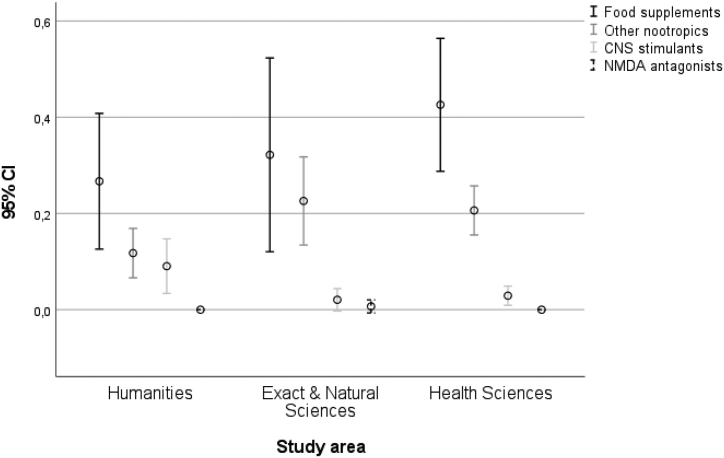
From a sample of 745 university students, 32% indicated the use of prescribed and nonprescribed substances. The most consumed substances were food supplements with CNS stimulants being the most frequent prescription-only drugs but not necessarily accessed through a medical prescription. A significant statistical association was found between substance consumption and the field of study. Health science students reported more food supplements and drug intake, allegedly under prescribed regimens, compared to humanities and exact sciences students. The study discusses the need to better understand the competitive societies that produce and support young students' outputs and the perceived 'need' for performance-enhancing substances.
One-third of the university students aimed to improve their performance by pharmacological cognitive enhancement, with a preference for food supplements dispensed in pharmacies. PCE substance consumption in higher education is thus non-negligible. The study suggests the need to improve regulations on potential inequalities in academic rankings and success and an observant attitude concerning implications that negatively affect health in the long run.
使用处方药以及服用提高大学生认知能力的物质,即所谓的药理学认知增强(PCE),是一种已知现象,可能会影响个人健康。大学生群体是使用PCE的两个特定亚群体(平均使用率高达17%)。据我们所知,葡萄牙尚未发表关于全国范围内大学生使用PCE药物的情况以及可能与此类使用相关的因素的数据。
主要目的是估计葡萄牙大学生使用PCE的流行率,并确定大学生常用的PCE物质,即那些被归类为处方药以及其他合法和非处方物质,包括食品补充剂。
本研究采用横断面探索性描述性设计,选取了葡萄牙公立和私立大学(22所高等教育机构)的学生作为便利样本。
在745名大学生样本中,32%的学生表示使用过处方药和非处方药。使用最多的物质是食品补充剂,中枢神经系统兴奋剂是最常用的仅需凭处方购买的药物,但不一定是通过医疗处方获取的。物质消费与学习领域之间存在显著的统计学关联。与人文和精确科学专业的学生相比,健康科学专业的学生报告服用更多的食品补充剂和药物,据称是按照规定的疗程服用。该研究讨论了有必要更好地理解产生并支持年轻学生成果的竞争社会以及对提高成绩物质的“需求”认知。
三分之一的大学生旨在通过药理学认知增强来提高成绩,他们更倾向于在药店购买的食品补充剂。因此,高等教育中PCE物质的消费不容忽视。该研究表明需要改进对学术排名和成功方面潜在不平等的监管,并对长期负面影响健康的因素保持警惕。