Schüller Moritz, Meister Annette, Green Mark, Dailey Lea Ann
Institute of Pharmacy, Martin-Luther-University Halle-Wittenberg Halle Germany.
Institute of Biochemistry and Biotechnology, Martin-Luther-University Halle-Wittenberg Halle Germany.
RSC Adv. 2021 Sep 8;11(47):29816-29825. doi: 10.1039/d1ra05212h. eCollection 2021 Sep 1.
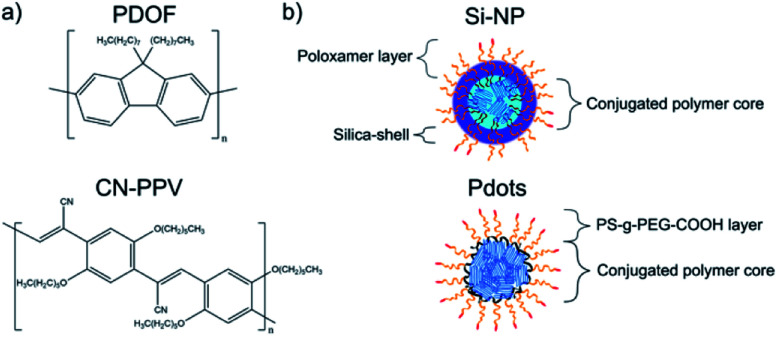
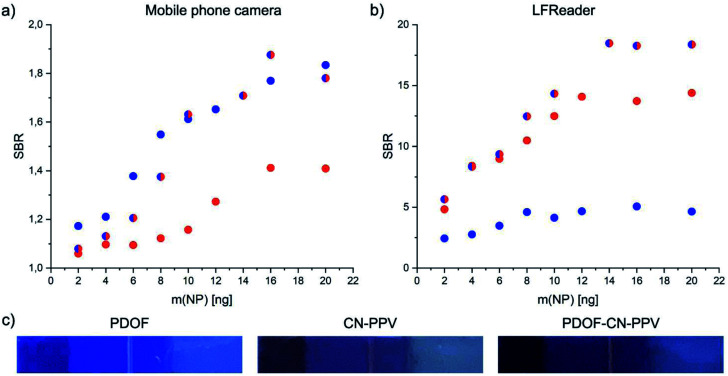
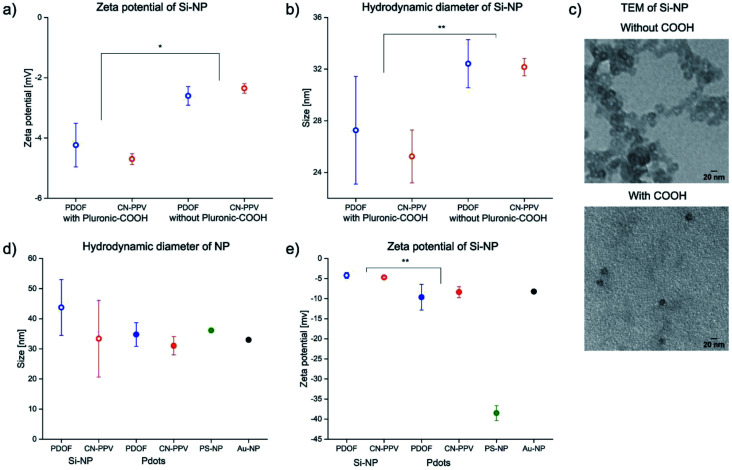
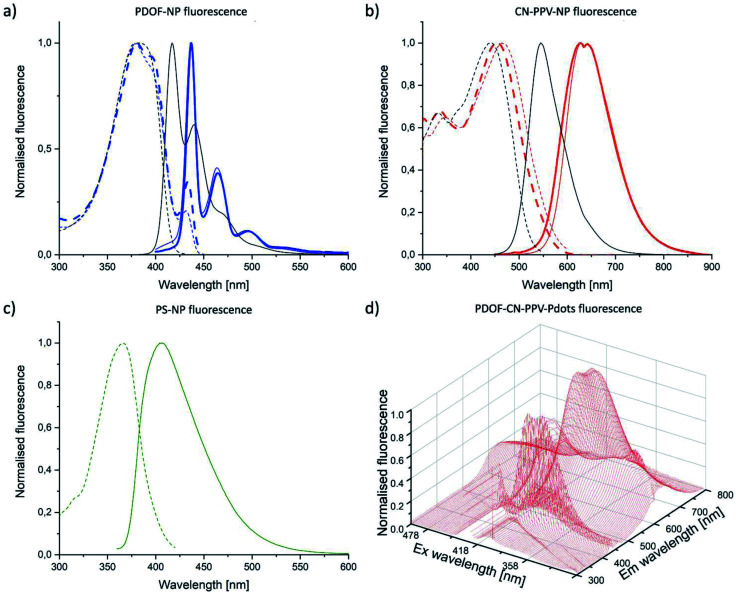
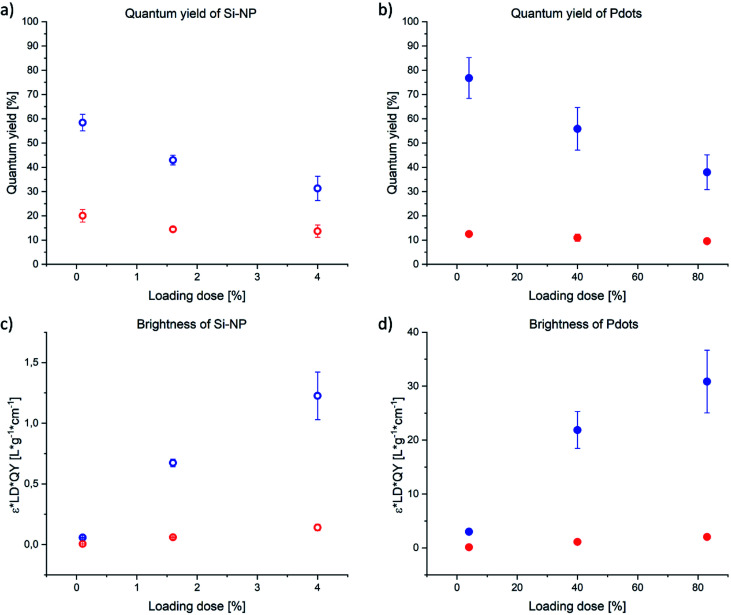
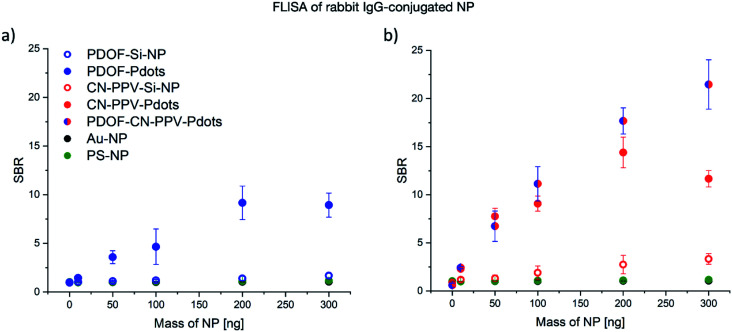
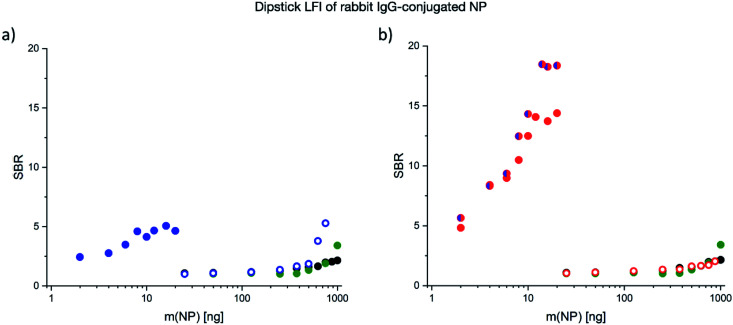
Lateral flow immunoassays (LFI) are valuable tools for point-of-care testing. However, their sensitivity is limited and can be further improved. Nanoparticles (NP) of conjugated polymers (CPNs), also known as Pdots, are reported to be highly sensitive fluorescent probes, but a direct comparison with conventional colloidal gold-based (Au-NP) LFI using the same antibody-antigen pair is missing to date. Furthermore, the influence of brightness and Stokes shift of CPs on the signal : background ratio (SBR) needs to be evaluated. In this study, we encapsulated two different CPs, poly-(9,9-di--octyl-fluorenyl-2,7-diyl) (PDOF) and poly-(2,5-di-hexyloxy-cyanoterephthalylidene) (CN-PPV) in silica shell-crosslinked Pluronic© micelles (Si-NP) and Pdots and investigated the NP brightness with respect to CP loading dose. The brightest formulation of each NP system was conjugated to rabbit IgG as a model antigen and the SBR was investigated in an ELISA-like microplate assay and LFI. Two reference particles, Au-NP and a polystyrene NP (PS-NP) loaded with a small-molecule fluorescent dye were conjugated to IgG and compared to the Si-NP and Pdots. The mass of Pdots required for detection in LFI was at least two orders of magnitude lower than that of Si-NP and the reference NP. The SBR of CN-PPV (moderate brightness, large Stokes shift) was two to three times higher than the SBR of PDOF (high brightness, small Stokes shift). To combine the favourable properties of both CPs, a polymer blend of PDOF and CN-PPV was encapsulated in Pdots, and resulted in further increase of SBR in the microplate assay and LFI. In summary, combining two CPs with different properties can lead to fluorescent signal-transducers for applications such as ELISA and LFIs, which can enhance the detection limit of the assay by 2-3 orders of magnitude.
侧向流动免疫分析(LFI)是即时检测的重要工具。然而,其灵敏度有限,仍可进一步提高。据报道,共轭聚合物纳米颗粒(CPNs),也称为量子点(Pdots),是高灵敏度的荧光探针,但迄今为止,尚未有使用相同抗体 - 抗原对与传统胶体金基(Au - NP)LFI进行直接比较的研究。此外,共轭聚合物的亮度和斯托克斯位移对信号与背景比(SBR)的影响需要评估。在本研究中,我们将两种不同的共轭聚合物,聚(9,9 - 二 - 辛基芴 - 2,7 - 二亚基)(PDOF)和聚(2,5 - 二 - 己氧基 - 氰基对苯二甲叉)(CN - PPV)封装在二氧化硅壳交联的普朗尼克©胶束(Si - NP)和量子点中,并研究了纳米颗粒亮度与共轭聚合物负载量的关系。将每个纳米颗粒系统中最亮的制剂与兔IgG作为模型抗原进行偶联,并在类似酶联免疫吸附测定(ELISA)的微孔板分析和LFI中研究SBR。将两种参考颗粒,Au - NP和负载小分子荧光染料的聚苯乙烯纳米颗粒(PS - NP)与IgG偶联,并与Si - NP和量子点进行比较。在LFI中检测所需的量子点质量比Si - NP和参考纳米颗粒至少低两个数量级。CN - PPV(中等亮度,大斯托克斯位移)的SBR比PDOF(高亮度,小斯托克斯位移)高两到三倍。为了结合两种共轭聚合物的有利特性,将PDOF和CN - PPV的聚合物共混物封装在量子点中,导致微孔板分析和LFI中的SBR进一步增加。总之,结合两种具有不同特性的共轭聚合物可以产生用于ELISA和LFI等应用的荧光信号传感器,这可以将检测限提高2 - 3个数量级。