Sun Daosheng, Wang Ziwen, Ma Rui, Wang Aiguo, Zhang Gaozhan
Anhui Province Engineering Laboratory of Advanced Building Materials, Anhui Jianzhu University Hefei 230601 China
Anhui Province Key Laboratory of Advanced Building Materials, Anhui Jianzhu University Hefei 230601 China.
RSC Adv. 2021 May 12;11(28):17369-17376. doi: 10.1039/d1ra01611c. eCollection 2021 May 6.
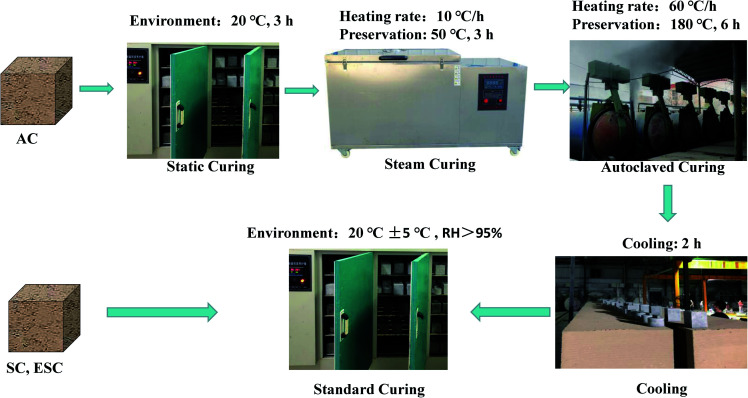
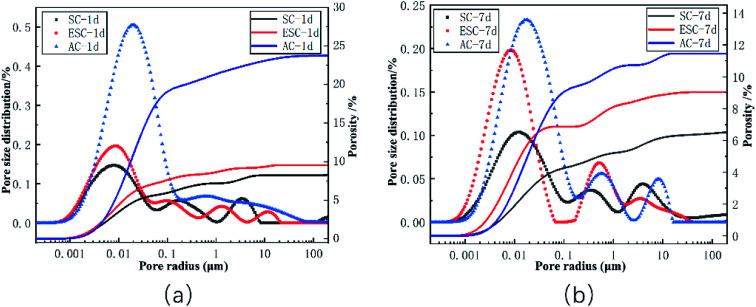
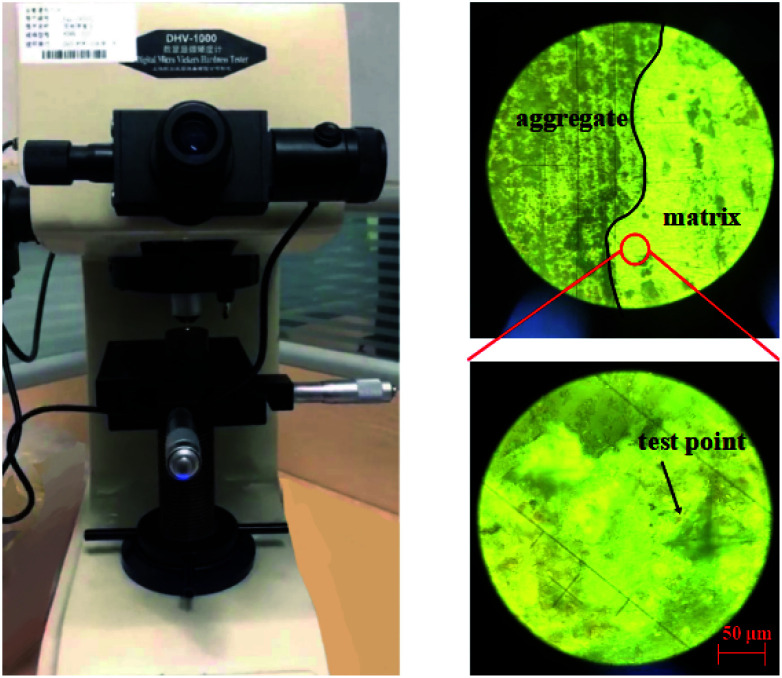
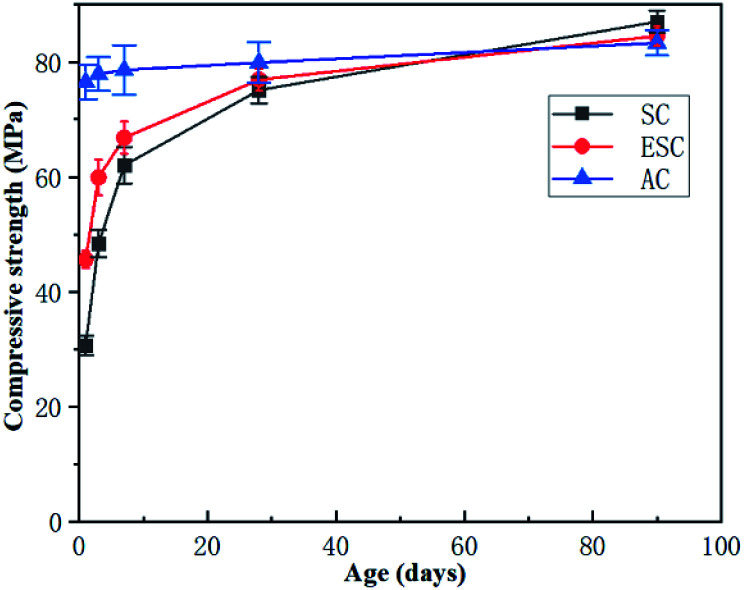
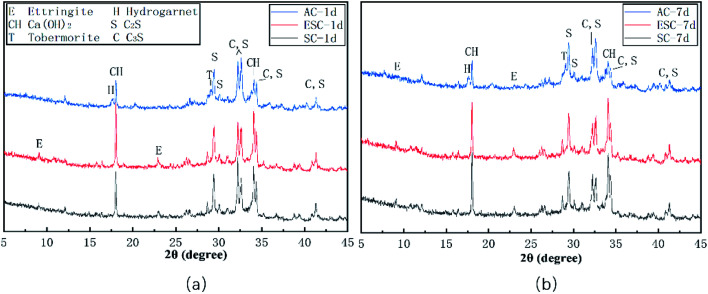
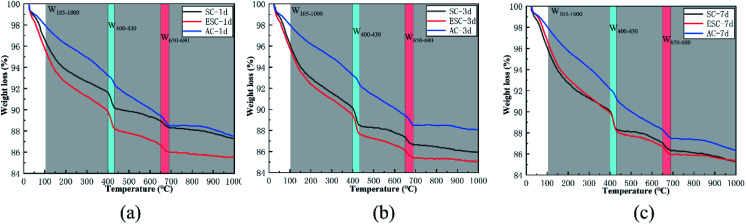
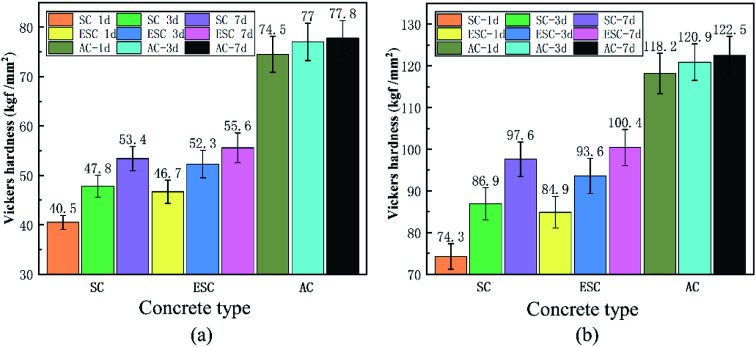
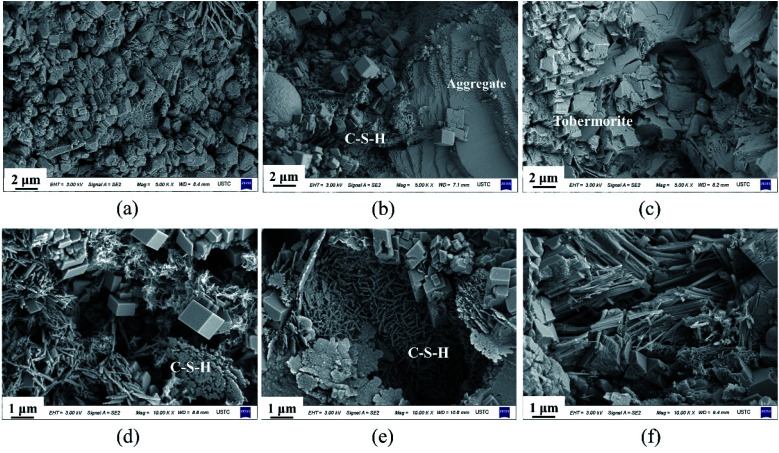
In this study, nano calcium silicate hydrate was used as an early strength agent to promote the compressive strength of concrete at 1 day. The strength development and the microstructure of standard concrete (SC), autoclave-free ultra-early strength concrete (ESC) and autoclaved concrete (AC) were comparatively studied. The development of hydration products, morphology and pore-structure with ages were investigated XRD, TG, microhardness, SEM and NMR tests to reveal the mechanism of early strength of ESC. The results showed that the compressive strength of ESC at day 1 achieved 60% of the designed strength, as strong as 45.6 MPa, and only 3% less than that of SC after 90 days. While the compressive strength of AC was significant increased over 90% of ultimate at 1 day, then slightly raised after that. The hydration products did not changed between ESC and SC, but the content of C-S-H gel, Ca(OH) and non-evaporated water of ESC was higher in the same specific age. New hydration products such as hydrogarnet and tobermorite were found in AC under autoclave conditions. The microhardness of the paste and ITZ of ESC were also higher than those of SC. The porosity of ESC at 1 day was larger than that of SC, which was contributed by gel pores (1-10 nm). However, AC with higher ratio of large pores than ESC and SC exhibited the largest porosity. The results proved that nano calcium silicate hydrate as an early strength agent significantly increased the early strength of concrete under autoclave-free conditions. Nano calcium silicate hydrate particles supplied additional nucleus in pores and ITZ, accelerated the formation of C-S-H gel, hardened hydration products, and improved the porosity structure. However, with autoclave curing, the hydration products in AC formed with larger size and higher crystallization, which benefited for early strength. However, the large porosity with large size pores might cause damage.
在本研究中,纳米硅酸钙水合物被用作早强剂以提高混凝土1天龄期的抗压强度。对标准混凝土(SC)、免蒸压超早强混凝土(ESC)和蒸压混凝土(AC)的强度发展和微观结构进行了对比研究。通过XRD、TG、显微硬度、SEM和NMR测试研究了水化产物随龄期的发展、形态和孔结构,以揭示ESC早强的机理。结果表明,ESC在1天龄期的抗压强度达到设计强度的60%,即45.6MPa,90天后仅比SC低3%。而AC在1天龄期的抗压强度显著提高,超过极限强度的90%,之后略有提高。ESC和SC之间的水化产物没有变化,但在相同龄期,ESC中C-S-H凝胶、Ca(OH)₂和未蒸发水的含量更高。在蒸压条件下的AC中发现了新的水化产物,如水石榴石和雪硅钙石。ESC浆体和界面过渡区的显微硬度也高于SC。ESC在1天龄期的孔隙率大于SC,这是由凝胶孔(1-10nm)造成的。然而,AC中大孔比例高于ESC和SC,其孔隙率最大。结果证明,纳米硅酸钙水合物作为早强剂在免蒸压条件下显著提高了混凝土的早期强度。纳米硅酸钙水合物颗粒在孔隙和界面过渡区提供了额外的晶核,加速了C-S-H凝胶的形成,使水化产物硬化,并改善了孔隙结构。然而,通过蒸压养护,AC中的水化产物形成的尺寸更大且结晶度更高,这有利于早期强度。然而,大尺寸孔隙导致的大孔隙率可能会造成损伤。