Ranjan Nilesh, Chopra Supriya, Mangaj Akshay, Rane Pallavi, Charnalia Mayuri, Kannan Sadhana, Dora Tapas, Engineer Reena, Mahantshetty Umesh, Gurram Lavanya, Mittal Prachi, Ghosh Jaya, Maheshwari Amita, Shylasree T S, Gupta Sudeep, Shrivastava S K
Department of Radiation Oncology, Tata Memorial Hospital, Homi Bhabha National Institute, Mumbai, Maharashtra, India.
Department of Radiation Oncology, ACTREC, Tata Memorial Centre, Homi Bhabha National Institute, Navi Mumbai, Maharashtra, India.
EClinicalMedicine. 2022 Apr 16;47:101390. doi: 10.1016/j.eclinm.2022.101390. eCollection 2022 May.
Adverse event reporting in oncology trials lacks temporal description. We propose a toxicity summarizing method that incorporates time.
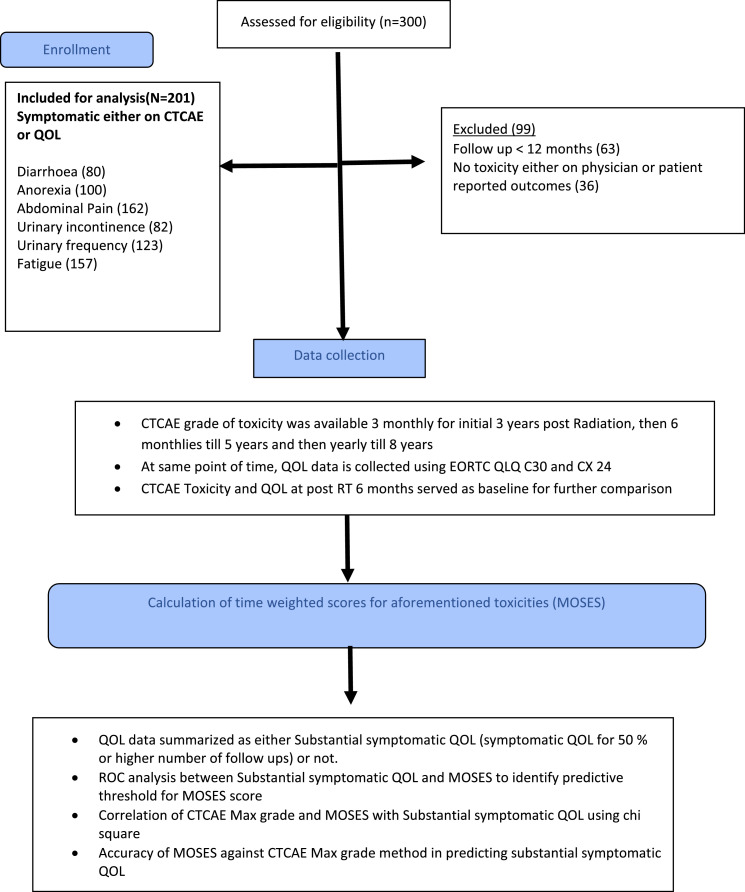
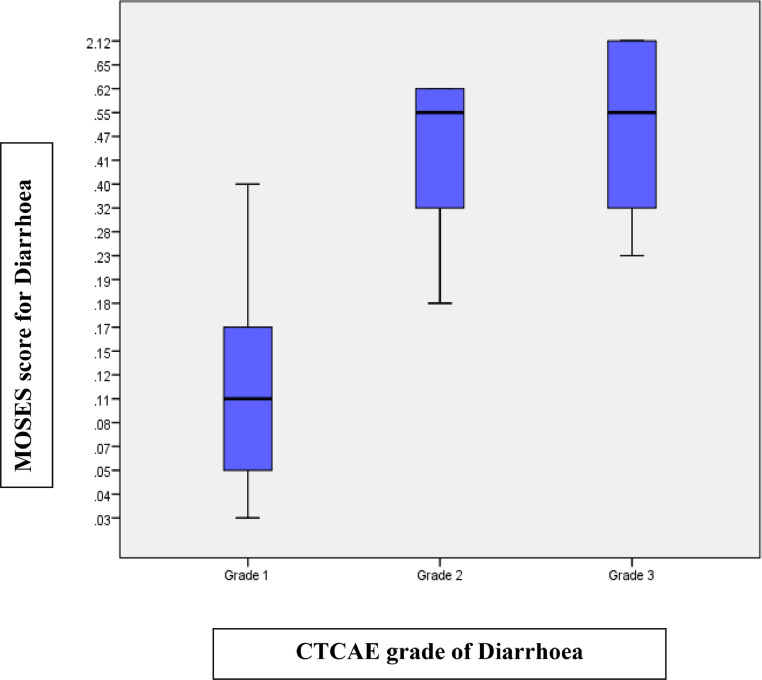
Patients recruited in a phase III trial (NCT01279135) that compared three-dimensional conformal radiotherapy (3DCRT) and intensity modulated radiotherapy (IMRT) for late toxicity in cervical cancer were included. Adverse events were reported using Common Terminology Criteria for Adverse Events (CTCAE) v3.0 and quality of life (QOL) with EORTC QLQ-C30 and CX24. A total of six symptoms with a related QOL question (diarrhoea, abdominal pain, anorexia, urinary incontinence, frequency and fatigue) were included. Month and severity score [MOSES= ∑ (CTCAE grade x proportionate time)] was calculated. Cumulative-MOSES (C-MOSES) was calculated by summating these 6 individual MOSES. QoL was categorized as "substantially symptomatic" or "not". Receiver operator curve analysis was performed to determine the MOSES cut off that predicts for substantial QOL symptoms. CTCAE and MOSES were tested for accurately categorizing QOL impact.
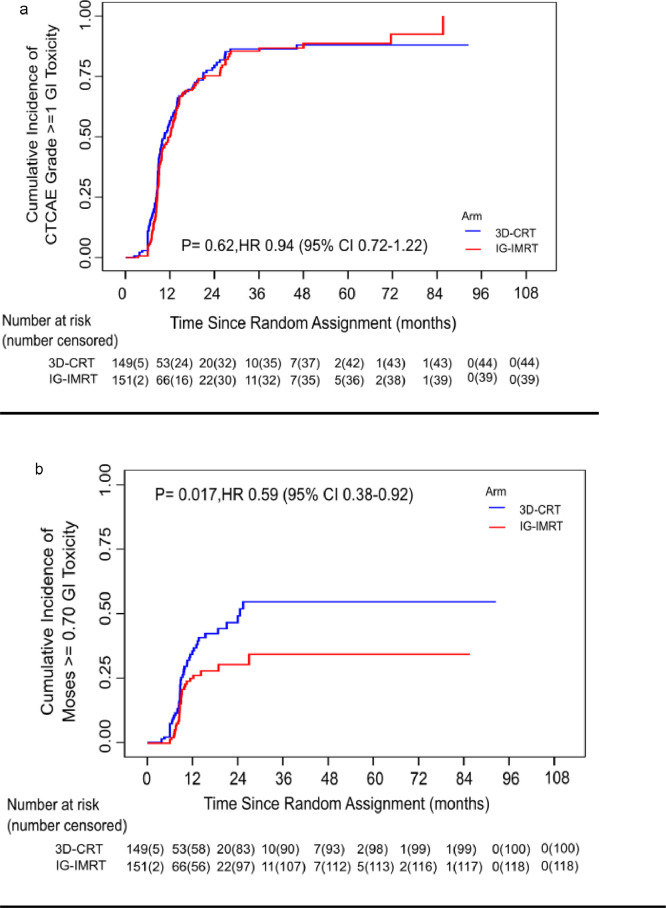
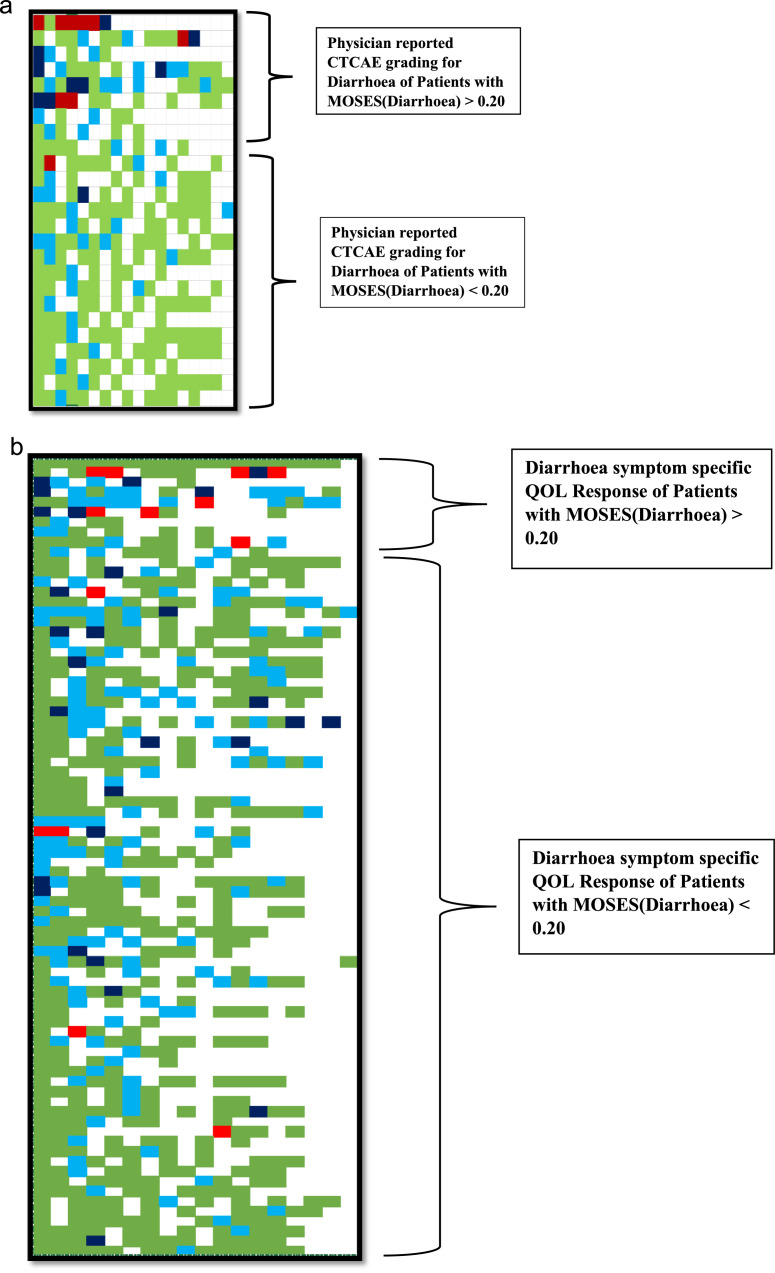
In the construction dataset, 201/300 patients had symptoms. MOSES > 0.20 had higher accuracy than CTCAE for predicting impact on QOL related to diarrhoea (85% vs. 69%), anorexia (61% vs 51%), abdominal pain (71% vs. 57%), urinary incontinence (72% vs. 61%) and frequency (62% vs. 59%). C-MOSES > 0·70 correlated with reduction in role functioning and global QOL. While no difference was seen in CTCAE grade ≥1 Gastrointestinal (GI) toxicity between 3DCRT or IMRT arm, 3DCRT had higher C-MOSES than IMRT (HR=0.64;95% CI 0.41-0.99, = 0.04).
MOSES has higher accuracy than CTCAE in categorizing symptom specific and functional QOL. These results require further external validation.
None.
肿瘤学试验中的不良事件报告缺乏时间描述。我们提出了一种纳入时间因素的毒性总结方法。
纳入一项III期试验(NCT01279135)的患者,该试验比较了三维适形放疗(3DCRT)和调强放疗(IMRT)对宫颈癌晚期毒性的影响。使用不良事件通用术语标准(CTCAE)v3.0报告不良事件,并使用欧洲癌症研究与治疗组织(EORTC)QLQ-C30和CX24评估生活质量(QOL)。总共纳入了六种伴有相关QOL问题的症状(腹泻、腹痛、厌食、尿失禁、尿频和疲劳)。计算月份和严重程度评分[MOSES = ∑(CTCAE分级×相应时间)]。通过将这6个个体MOSES相加计算累积MOSES(C-MOSES)。将QoL分类为“有明显症状”或“无”。进行受试者操作特征曲线分析以确定预测明显QOL症状的MOSES临界值。对CTCAE和MOSES进行测试,以准确分类QOL影响。
在构建数据集中,201/300例患者有症状。对于预测与腹泻相关的QOL影响(85%对69%)、厌食(61%对51%)、腹痛(71%对57%)、尿失禁(72%对61%)和尿频(62%对