The Centre for Modern Chinese City Studies, Research Center for China Administrative Division, Future City Lab, East China Normal University, Shanghai, China.
Faculty of Environmental Science and Engineering, Kunming University of Science and Technology, Kunming, China.
Front Public Health. 2022 Apr 7;10:844541. doi: 10.3389/fpubh.2022.844541. eCollection 2022.
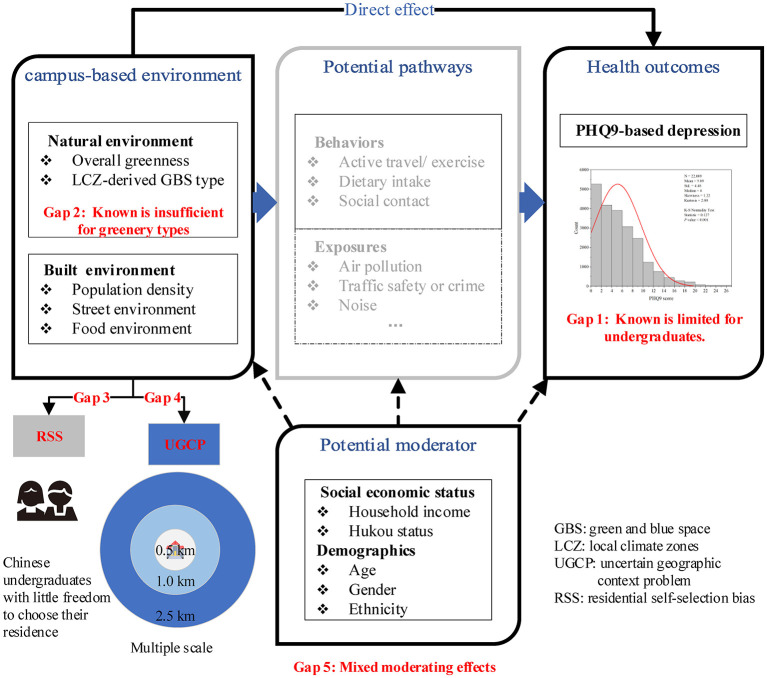
Evidence on the association between natural-built environments and depression is largely derived from the general population and prone to residential self-selection bias because of the nature of cross-sectional research design. Despite emerging adulthood, which includes the university years, is a critical stage for forming life-long health habits, studies on this topic focusing on undergraduate students are limited. The current study aims to illustrate the underlying mechanisms for how the campus-based environments affect depression in undergraduate students.
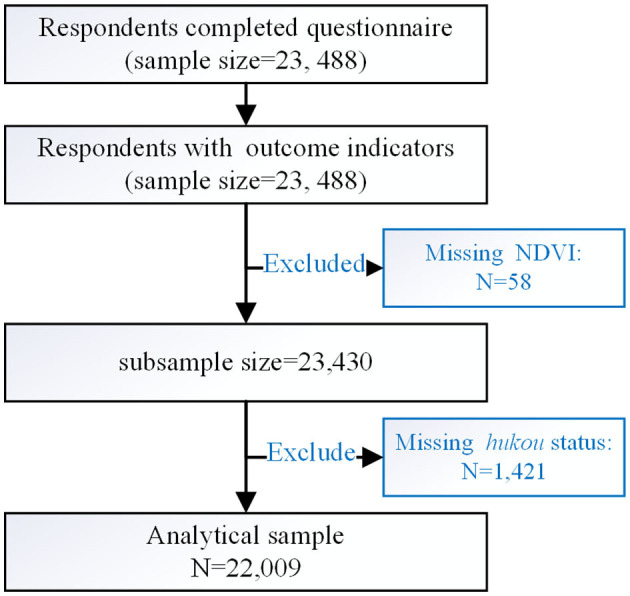
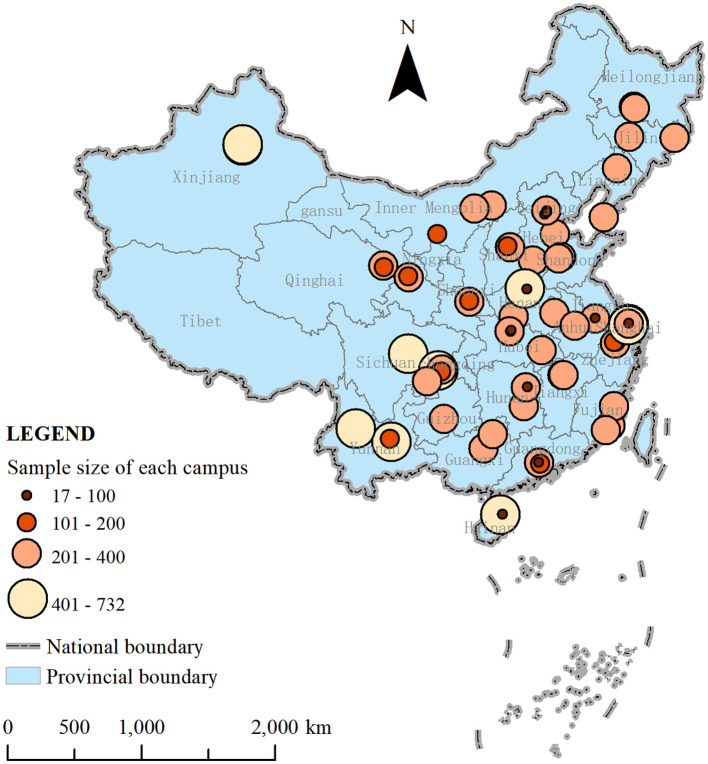
Based on a nationwide representative analytical sample of 22,009 Chinese undergraduates in 2018, we examined participants' reports of depression and campus-centered natural/built environments within multiple buffer sizes including 0.5, 1.0, and 2.5 km. After disentangling residential self-selection, we explored the moderating role of the socioeconomic attributes of undergraduates. The depression outcome was measured by the nine-item Patient Health Questionnaire (PHQ9). Indicators of exposure to green and blue space, transportation infrastructure, and food environments were objectively assessed using different circular buffers around each campus address.
Modeling results indicated that campus neighborhoods with more scattered trees (0.5 km), water (0.5, 1.0, and 2.5 km), and street intersections (1.0 and 2.5 km) were protective against depression. In contrast, those living near denser distributions of outlets serving take-away sweets and fast food (0.5, 1.0, and 2.5 km) were susceptible to depression. These associations were modified by undergraduates' socioeconomic attributes (e.g., grade, status, and ethnicity) and varied according to geographical scales and exposure metrics.
To deliver effective environmental interventions to curb the prevalence of depression among undergraduate students, further planning policies should focus on the careful conception of the campus-based environment, especially regarding different spatial scales.
关于自然-建成环境与抑郁之间关联的证据主要来自于一般人群,由于横断面研究设计的性质,存在居住者自我选择偏差。尽管成年早期包括大学时期,但这是形成终身健康习惯的关键阶段,然而,针对该主题的研究主要集中在本科生群体,数量有限。本研究旨在阐明校园环境影响本科生抑郁的潜在机制。
基于 2018 年对全国 22009 名中国本科生的代表性分析样本,我们考察了参与者对抑郁的报告,以及在 0.5、1.0 和 2.5 公里等多个缓冲区范围内的以校园为中心的自然/建成环境。在理清居住者自我选择的影响后,我们探讨了本科生社会经济属性的调节作用。抑郁结果通过九项患者健康问卷(PHQ9)来衡量。使用每个校园地址周围的不同圆形缓冲区,客观评估了绿地和蓝地、交通基础设施以及食品环境的暴露指标。
模型结果表明,校园周边树木分布较为分散(0.5 公里)、水域(0.5、1.0 和 2.5 公里)和街道交叉口(1.0 和 2.5 公里)较多的校园街区具有保护作用,可以预防抑郁。相比之下,居住在附近快餐店和外卖甜食店分布密度较高的地方(0.5、1.0 和 2.5 公里)则容易抑郁。这些关联受到本科生社会经济属性(如年级、家庭状况和种族)的调节,并根据地理尺度和暴露指标而有所不同。
为了实施有效的环境干预措施来遏制本科生中抑郁的流行,进一步的规划政策应关注校园环境的精心构思,特别是针对不同的空间尺度。