
通过在肌红蛋白中设计的人工酶对孔雀石绿进行高效生物降解。
Efficient biodegradation of malachite green by an artificial enzyme designed in myoglobin.
作者信息
Xiang Heng-Fang, Xu Jia-Kun, Liu Jiao, Yang Xin-Zhi, Gao Shu-Qin, Wen Ge-Bo, Lin Ying-Wu
机构信息
School of Chemistry and Chemical Engineering, University of South China Hengyang 421001 China
Key Lab of Sustainable Development of Polar Fisheries, Ministry of Agriculture and Rural Affairs, Yellow Sea Fisheries Research Institute, Chinese Academy of Fishery Sciences, Lab for Marine Drugs and Byproducts of Pilot National Lab for Marine Science and Technology Qingdao 266071 China
出版信息
RSC Adv. 2021 Apr 30;11(26):16090-16095. doi: 10.1039/d1ra02202d. eCollection 2021 Apr 26.
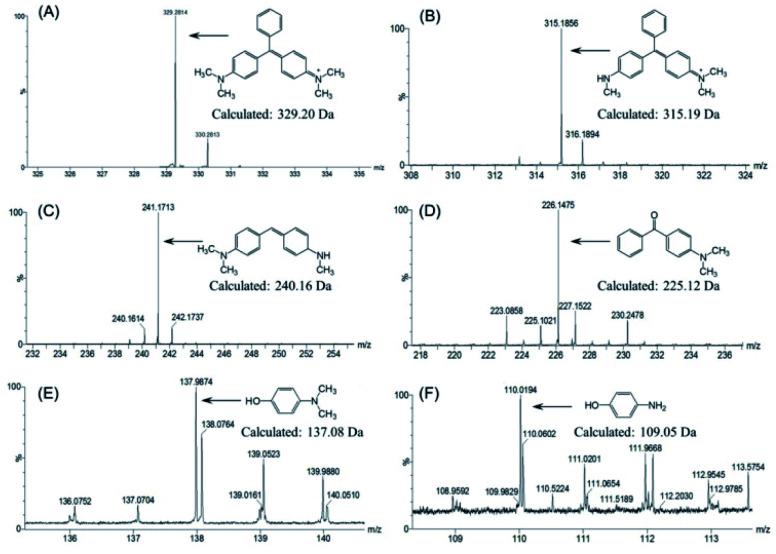
Synthetic dyes such as malachite green (MG) have a wide range of applications. Meanwhile, they bring great challenges for environmental security and cause potential damages to human health. Compared with traditional approaches, enzymatic catalysis is an emerging technique for wastewater treatment. As alternatives to natural enzymes, artificial enzymes have received much attention for potential applications. In previous studies, we have rationally designed artificial enzymes based on myoglobin (Mb), such as by introducing a distal histidine (F43H mutation) and creating a channel to the heme pocket (H64A mutation). We herein show that the artificial enzyme of F43H/H64A Mb can be successfully applied for efficient biodegradation of MG under weak acid conditions. The degradation efficiency is much higher than those of natural enzymes, such as dye-decolorizing peroxidase and laccase (13-18-fold). The interaction of MG and F43H/H64A Mb was investigated by using both experimental and molecular docking studies, and the biodegradation products of MG were also revealed by UPLC-ESI-MS analysis. Based on these results, we proposed a plausible biodegradation mechanism of MG. With the high-yield of overexpression in cells, this study suggests that the artificial enzyme has potential applications in the biodegradation of MG in fisheries and textile industries.
孔雀石绿(MG)等合成染料有着广泛的应用。与此同时,它们给环境安全带来了巨大挑战,并对人类健康造成潜在损害。与传统方法相比,酶催化是一种新兴的废水处理技术。作为天然酶的替代品,人工酶因其潜在应用受到了广泛关注。在先前的研究中,我们基于肌红蛋白(Mb)合理设计了人工酶,比如通过引入一个远端组氨酸(F43H突变)并在血红素口袋处创建一个通道(H64A突变)。我们在此表明,F43H/H64A Mb人工酶能够在弱酸条件下成功应用于MG的高效生物降解。其降解效率远高于天然酶,如染料脱色过氧化物酶和漆酶(高13 - 18倍)。通过实验和分子对接研究对MG与F43H/H64A Mb的相互作用进行了研究,并且通过超高效液相色谱 - 电喷雾电离质谱(UPLC - ESI - MS)分析揭示了MG的生物降解产物。基于这些结果,我们提出了一个合理的MG生物降解机制。鉴于该人工酶在细胞中的高表达产量,本研究表明该人工酶在渔业和纺织工业中MG的生物降解方面具有潜在应用。


 Zotero 插件