Department of Medicine, Boston Children's Hospital, Boston, MA, USA.
Department of Pediatrics, Harvard Medical School, Boston, MA, USA.
Eur J Pediatr. 2022 Jul;181(7):2879-2883. doi: 10.1007/s00431-022-04482-z. Epub 2022 Apr 28.
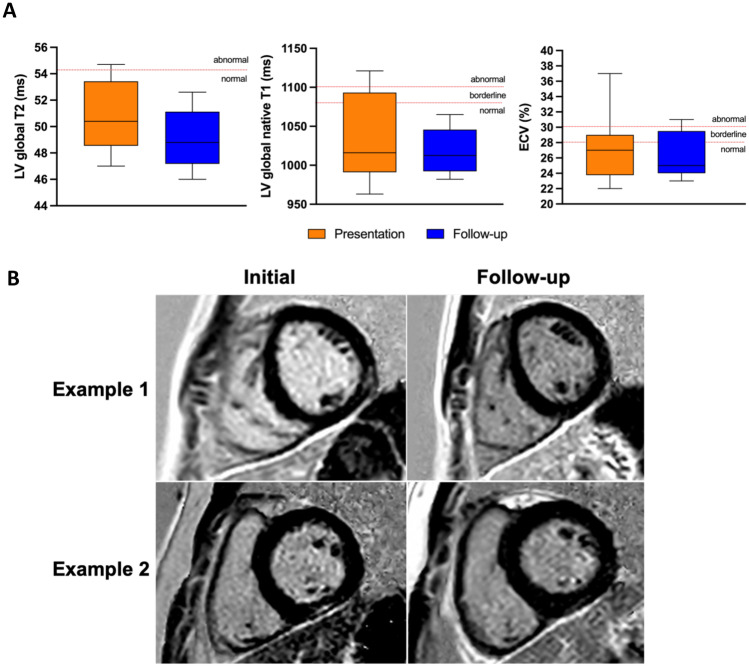
Myocarditis is a rare complication of the COVID-19 mRNA vaccine. We previously reported a case series of 15 adolescents with vaccine-associated myocarditis, 87% of whom had abnormalities on initial cardiac magnetic resonance (CMR), including late gadolinium enhancement (LGE) in 80%. We performed follow-up CMRs to determine the trajectory of myocardial recovery and better understand the natural history of vaccine-associated myocarditis. Case series of patients age < 19 years admitted to Boston Children's Hospital with acute vaccine-associated myocarditis following the BNT162b2 vaccine who had abnormal CMR at the time of initial presentation, and underwent follow-up testing. CMR assessment included left ventricular (LV) ejection fraction, T2-weighted myocardial imaging, LV global native T1, LV global T2, extracellular volume (ECV), and late gadolinium enhancement (LGE). Ten patients (9 male, median age 15 years) with vaccine-associated myocarditis underwent follow-up CMR at a median of 92 days (range 76-119) after hospital discharge. LGE was persistent in 80% of patients, though improved from prior in all cases. Two patients (20%) had abnormal LV global T1 at presentation, which normalized on follow-up. ECV decreased between acute presentation and follow-up in 6/10 patients; it remained elevated at follow-up in 1 patient and borderline in 3 patients.
CMR performed ~3 months after admission for COVID-19 vaccine-associated myocarditis showed improvement of LGE in all patients, but persistent in the majority. Follow-up CMR 6-12 months after acute episode should be considered to better understand the long-term cardiac risks.
• Myocarditis is a rare side effect of COVID-19 mRNA vaccine. •Late gadolinium enhancement is present on most cardiac magnetic resonance at the time of acute presentation.
•Late gadolinium enhancement improved on all repeat cardiac magnetic resonance at 3-month follow-up. •Most patients still had a small amount of late gadolinium enhancement, the clinical significance of which is yet to be determined.
心肌炎是 COVID-19 mRNA 疫苗的罕见并发症。我们之前报道了 15 例青少年与疫苗相关心肌炎的病例系列,其中 87%的患者在初始心脏磁共振(CMR)上存在异常,包括 80%的晚期钆增强(LGE)。我们进行了随访 CMR 以确定心肌恢复的轨迹,从而更好地了解疫苗相关心肌炎的自然病史。
在接受 BNT162b2 疫苗后因急性疫苗相关心肌炎入院且初始表现 CMR 异常的年龄<19 岁的波士顿儿童医院患者,进行了随访检测。CMR 评估包括左心室(LV)射血分数、T2 加权心肌成像、LV 整体原始 T1、LV 整体 T2、细胞外容积(ECV)和晚期钆增强(LGE)。10 例(9 例男性,中位年龄 15 岁)疫苗相关心肌炎患者在出院后中位 92 天(范围 76-119 天)进行了随访 CMR。80%的患者持续存在 LGE,但所有患者均有所改善。2 例(20%)患者在初始时 LV 整体 T1 异常,在随访时恢复正常。6/10 例患者的 ECV 在急性期和随访期之间降低;1 例患者仍升高,3 例患者接近升高。
COVID-19 疫苗相关心肌炎患者入院后 3 个月进行 CMR 检查显示所有患者的 LGE 均有所改善,但大多数患者仍存在 LGE。应考虑在急性发作后 6-12 个月进行随访 CMR,以更好地了解长期心脏风险。
• COVID-19 mRNA 疫苗的罕见副作用是心肌炎。•大多数患者在急性表现时,心脏磁共振上存在晚期钆增强。
•在 3 个月的随访时,所有患者的晚期钆增强都有所改善。•大多数患者仍存在少量晚期钆增强,其临床意义尚待确定。