Department of Translational Medicine, Graduate School of Biomedical Science and Engineering, Hanyang University, Seoul, Korea.
Department of Internal Medicine, Hanyang University College of Medicine, Seoul, Korea.
Clin Mol Hepatol. 2022 Jul;28(3):497-509. doi: 10.3350/cmh.2022.0019. Epub 2022 Apr 28.
BACKGROUND/AIMS: We aimed to define an optimal target population and drug-specific biomarkers that may predict dipeptidyl peptidase (DPP)-4 inhibitor responses in non-alcoholic fatty liver disease (NAFLD).
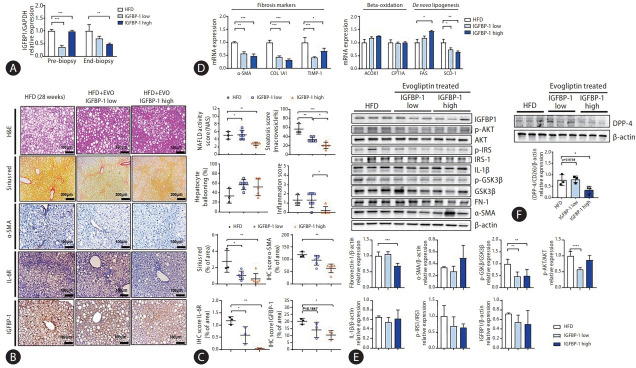
An exploration study (study I) was performed using three different NAFLD models (basket study design; high-fat diet [HFD], methionine choline-deficient diet [MCD], and high-cholesterol Western diet [WD] models). RNA transcriptome analysis was performed on pre-studied liver tissues to identify biomarkers that could predict the response to DPP-4 inhibitors. In the validation study (study II), the HFD-induced NAFLD model was divided into high and low hepatic insulin-like growth factor binding protein 1 (Igfbp-1) groups based on the pre-study liver biopsy.
DPP-4 inhibitor attenuated the NAFLD activity score and fibrosis stage in the HFD model but not in the WD and MCD models. The overall response rate was 19% across the modified basket NAFLD trial and 42%, 25%, and 0% in the HFD, WD, and MCD models. Hepatic Igfbp-1 expression was higher in the responder group than in the non-responder group in pre-study biopsy samples. In contrast, hepatic Igfbp-1 expression was lower in the responder group than in the non-responder group in the end-study biopsy samples. DPP-4 inhibitor response rates were 83% and 17% in the baseline hepatic high Igfbp-1 and low Igfbp-1 groups, respectively. Hepatic messenger RNA Igfbp-1 expression was positively correlated with serum IGFBP-1 levels.
The DPP-4 inhibitor response was higher in the HFD phenotype and pre-treatment levels of hepatic or serum IGFBP-1 were high.
背景/目的:我们旨在定义一个最佳的目标人群和药物特异性生物标志物,以预测二肽基肽酶-4(DPP-4)抑制剂在非酒精性脂肪性肝病(NAFLD)中的反应。
使用三种不同的 NAFLD 模型(篮式研究设计;高脂肪饮食[HFD]、蛋氨酸胆碱缺乏饮食[MCD]和高胆固醇西方饮食[WD]模型)进行探索性研究(研究 I)。对预先研究的肝组织进行 RNA 转录组分析,以鉴定可预测 DPP-4 抑制剂反应的生物标志物。在验证研究(研究 II)中,根据预研究肝活检,将 HFD 诱导的 NAFLD 模型分为高和低肝胰岛素样生长因子结合蛋白 1(Igfbp-1)组。
DPP-4 抑制剂可减轻 HFD 模型的 NAFLD 活动评分和纤维化阶段,但不能减轻 WD 和 MCD 模型的评分。改良篮式 NAFLD 试验的总有效率为 19%,HFD、WD 和 MCD 模型分别为 42%、25%和 0%。在预研究活检样本中,应答组的肝 Igfbp-1 表达高于无应答组。相比之下,在终期研究活检样本中,应答组的肝 Igfbp-1 表达低于无应答组。在基线时肝高 Igfbp-1 和低 Igfbp-1 组中,DPP-4 抑制剂的反应率分别为 83%和 17%。肝信使 RNA Igfbp-1 表达与血清 IGFBP-1 水平呈正相关。
在 HFD 表型中,DPP-4 抑制剂的反应更高,并且治疗前肝或血清 IGFBP-1 水平较高。