Department of Human Genetics, Hannover Medical School, Hannover, Germany.
RESIST-Cluster of Excellence 2155, Hannover Medical School, Hannover, Germany.
J Clin Immunol. 2022 Jul;42(5):1083-1092. doi: 10.1007/s10875-022-01276-8. Epub 2022 Apr 29.
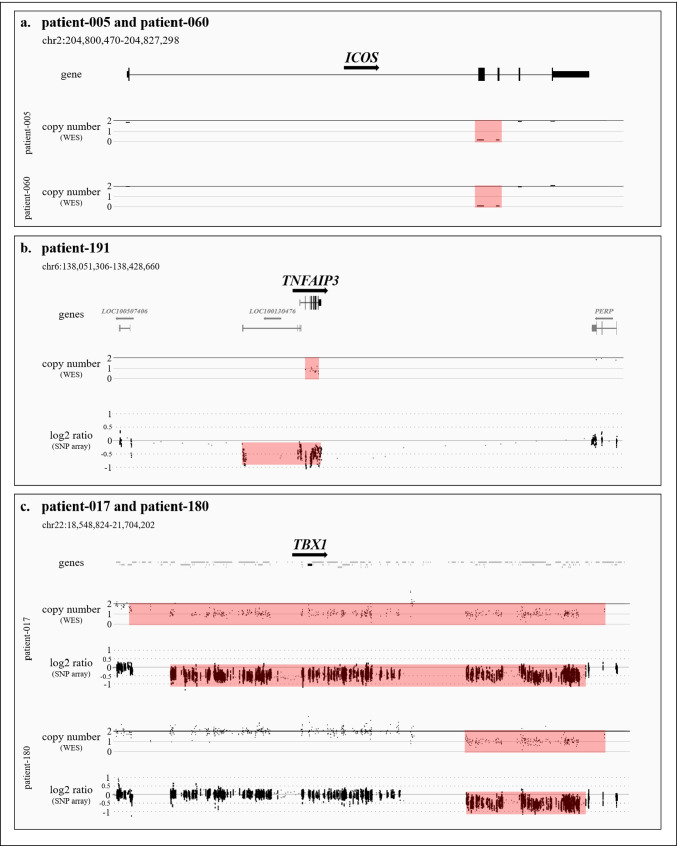
Inborn errors of immunity (IEI) are genetically driven disorders. With the advancement of sequencing technologies, a rapidly increasing number of gene defects has been identified, thereby mirroring the high heterogeneity in immunological and clinical presentations observed in patients. However, for a large majority of patients, no causative single nucleotide variant (SNV) or small indel can be identified using next-generation sequencing. First studies have shown that also copy number variants (CNVs) can cause IEI. Unfortunately, CNVs are not well examined in many routine diagnostic settings and the aim of this study was to assess the number of clinically relevant chromosomal losses and gains in a large cohort. We identified a total of 20 CNVs using whole exome sequencing data of a cohort of 191 patients with a suspected IEI. A definite molecular diagnosis could be made in five patients (2.6%), including pathogenic deletions affecting ICOS, TNFAIP3, and 22q11.2. CNVs of uncertain significance were observed in fifteen patients (7.9%), including deletions of 11q22.1q22.3 and 16p11.2 but also duplications affecting entire or parts of genes previously associated with IEI. Importantly, five patients carrying a CNV of uncertain significance also carried pathogenic or likely pathogenic SNVs (PIK3R1, NFKB1, NLRC4, DOCK2), or SNVs of unknown significance (NFKB2). This cooccurrence of SNVs and CNVs suggests modifying effects in some patients, and functional follow-up is warranted now in order to better understand phenotypic heterogeneity. In summary, the diagnostic yield of IEI can be increased substantially by evaluating CNVs, which allows an improved therapeutic management in those patients.
先天性免疫缺陷(IEI)是由基因驱动的疾病。随着测序技术的进步,越来越多的基因缺陷被发现,这反映了患者免疫和临床表现的高度异质性。然而,对于绝大多数患者,使用下一代测序技术无法确定单一核苷酸变异(SNV)或小插入缺失的致病原因。最初的研究表明,拷贝数变异(CNV)也可导致 IEI。不幸的是,在许多常规诊断环境中,CNV 并未得到充分检查,本研究的目的是评估大量患者群体中临床相关的染色体缺失和增益数量。我们通过对 191 名疑似 IEI 患者的外显子组测序数据进行分析,共鉴定出 20 个 CNV。在五名患者(2.6%)中可以明确做出分子诊断,包括影响 ICOS、TNFAIP3 和 22q11.2 的致病性缺失。在十五名患者(7.9%)中观察到意义未明的 CNV,包括 11q22.1q22.3 和 16p11.2 的缺失,但也有影响先前与 IEI 相关的整个或部分基因的重复。重要的是,五名携带意义未明 CNV 的患者还携带致病性或可能致病性的 SNV(PIK3R1、NFKB1、NLRC4、DOCK2)或意义未明的 SNV(NFKB2)。这些 SNV 和 CNV 的共存表明在某些患者中存在修饰作用,现在需要进行功能随访,以便更好地理解表型异质性。总之,通过评估 CNV,可以大大提高 IEI 的诊断率,从而改善这些患者的治疗管理。