Subbiah Vivek, Braña Irene, Longhi Alessandra, Boni Valentina, Delord Jean-Pierre, Awada Ahmad, Boudou-Rouquette Pascaline, Sarantopoulos John, Shapiro Geoffrey I, Elias Anthony, Ratan Ravin, Fernandez Cristian, Kahatt Carmen, Cullell-Young Martin, Siguero Mariano, Zeaiter Ali, Chawla Sant P
The University of Texas MD Anderson Cancer Center, Houston, Texas.
Hospital Universitari Vall d'Hebron, Barcelona, Spain.
Clin Cancer Res. 2022 Jul 1;28(13):2762-2770. doi: 10.1158/1078-0432.CCR-22-0696.
Lurbinectedin suppresses the oncogenic transcription factor EWS-FLI1 through relocalization to the nucleolus, and delays tumor growth in mice bearing Ewing sarcoma xenografts. On the basis of this rationale, lurbinectedin was evaluated in patients with relapsed Ewing sarcoma.
This open-label, single-arm, Basket phase II trial included a cohort of 28 treated adult patients with confirmed Ewing sarcoma, measurable disease as per Response Evaluation Criteria In Solid Tumors (RECIST) v.1.1, Eastern Cooperative Oncology Group performance status ≤2, adequate organ function, no central nervous system metastasis, and pretreated with ≤2 chemotherapy lines for metastatic/recurrent disease. Patients received lurbinectedin 3.2 mg/m2 as a 1-hour infusion every 3 weeks. Primary endpoint was overall response rate (ORR) as per RECIST v.1.1. Secondary endpoints included time-to-event parameters and safety profile.
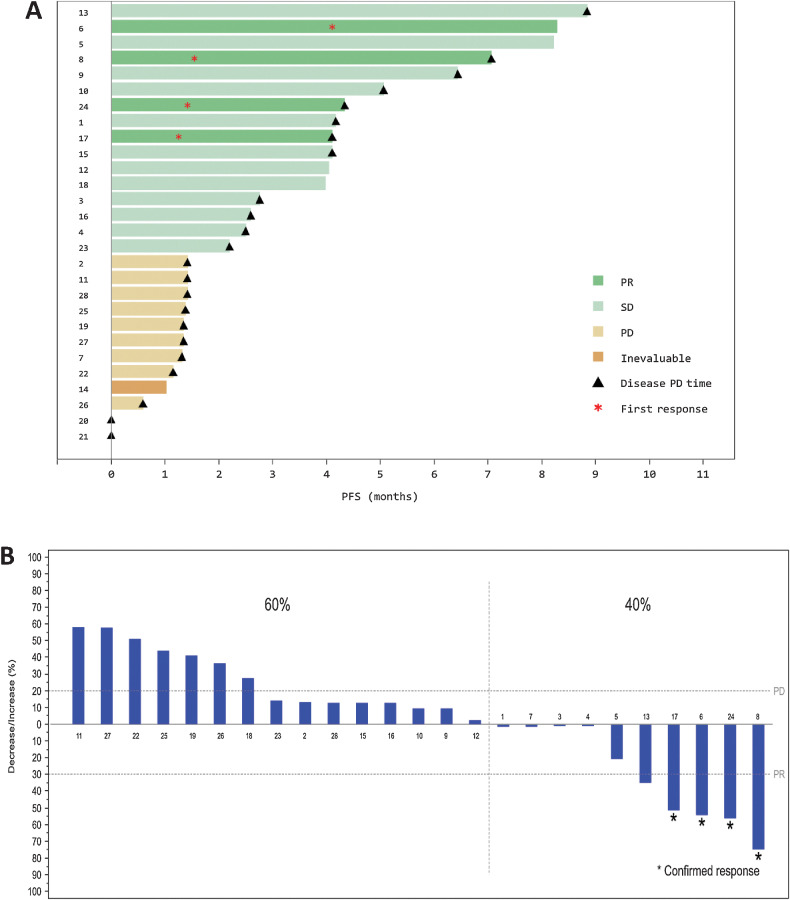
ORR was 14.3% [95% confidence interval (CI), 4.0%-32.7%], with median duration of response of 4.2 months (95% CI, 2.9-5.5 months). Median progression-free survival was 2.7 months (95% CI, 1.4-4.3 months), clinical benefit rate was 39.3%, and disease control rate was 57.1%. With 39% censoring, median overall survival was 12.0 months (95% CI, 8.5-18.5 months). Most common grade 3/4 adverse events were neutropenia (57%), anemia, thrombocytopenia, and treatment-related febrile neutropenia (14% each). No deaths or discontinuations were due to toxicity.
Lurbinectedin was active in the treatment of relapsed Ewing sarcoma and had a manageable safety profile. Lurbinectedin could represent a valuable addition to therapies for Ewing sarcoma, and is currently being evaluated in combination with irinotecan in advanced Ewing sarcoma in a phase Ib/II trial.
鲁比卡丁通过重新定位于核仁来抑制致癌转录因子EWS-FLI1,并延缓携带尤因肉瘤异种移植瘤小鼠的肿瘤生长。基于这一原理,对复发的尤因肉瘤患者进行了鲁比卡丁的评估。
这项开放标签、单臂、篮子II期试验纳入了28例经治疗的成年尤因肉瘤确诊患者,根据实体瘤疗效评价标准(RECIST)v.1.1可测量疾病,东部肿瘤协作组体能状态≤2,器官功能良好,无中枢神经系统转移,且转移性/复发性疾病的化疗线数≤2。患者接受鲁比卡丁3.2mg/m²,每3周静脉输注1小时。主要终点是根据RECIST v.1.1的总缓解率(ORR)。次要终点包括事件发生时间参数和安全性。
ORR为14.3%[95%置信区间(CI),4.0%-32.7%],中位缓解持续时间为4.2个月(95%CI,2.9-5.5个月)。中位无进展生存期为2.7个月(95%CI,1.4-4.3个月),临床获益率为39.3%,疾病控制率为57.1%。由于39%的删失,中位总生存期为12.0个月(95%CI,8.5-18.5个月)。最常见的3/4级不良事件是中性粒细胞减少(57%)、贫血、血小板减少和治疗相关的发热性中性粒细胞减少(各14%)。没有死亡或停药是由于毒性。
鲁比卡丁在复发的尤因肉瘤治疗中具有活性,且安全性可控。鲁比卡丁可能是尤因肉瘤治疗的一个有价值的补充,目前正在Ib/II期试验中与伊立替康联合用于晚期尤因肉瘤的评估。