START Madrid-CIOCC, Centro Integral Oncológico Clara Campal, Madrid, Spain.
Gustave Roussy, Villejuif, France.
ESMO Open. 2022 Oct;7(5):100571. doi: 10.1016/j.esmoop.2022.100571. Epub 2022 Aug 28.
Lurbinectedin, a selective inhibitor of oncogenic transcription, has shown preclinical antitumor activity against homologous recombination repair-deficient models and preliminary clinical activity in BRCA1/2 breast cancer.
This phase II basket multitumor trial (NCT02454972) evaluated lurbinectedin 3.2 mg/m 1-h intravenous infusion every 3 weeks in a cohort of 21 patients with pretreated germline BRCA1/2 breast cancer. Patients with any hormone receptor and human epidermal growth factor receptor 2 status were enrolled. The primary efficacy endpoint was overall response rate (ORR) according to RECIST v1.1. Secondary endpoints included duration of response (DoR), progression-free survival (PFS), overall survival (OS) and safety.
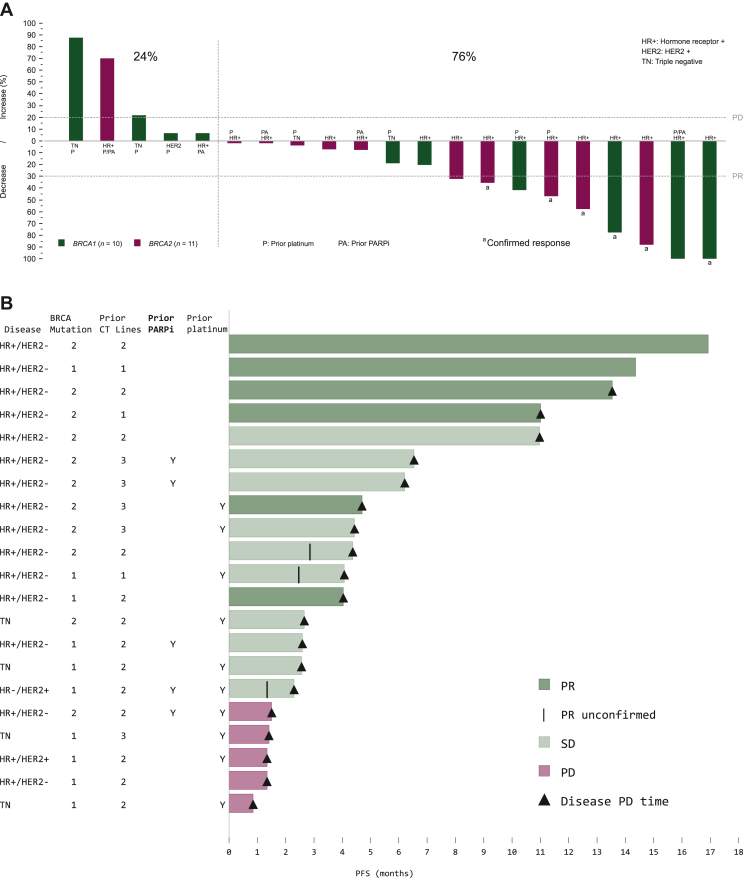
Confirmed partial response (PR) was observed in six patients [ORR = 28.6%; 95% confidence interval (CI) 11.3% to 52.2%] who had received a median of two prior advanced chemotherapy lines. Lurbinectedin was active in both BRCA mutations: four PRs in 11 patients (36.4%) with BRCA2 and two PRs in 10 patients (20.0%) with BRCA1. Median DoR was 8.6 months, median PFS was 4.1 months and median OS was 16.1 months. Stable disease (SD) was observed in 10 patients (47.6%), including 3 with unconfirmed response in a subsequent tumor assessment [ORR unconfirmed = 42.9% (95% CI 21.8% to 66.0%)]. Clinical benefit rate (PR + SD ≥ 4 months) was 76.2% (95% CI 52.8% to 91.8%). No objective response was observed among patients who had received prior poly (ADP-ribose) polymerase inhibitors. The most common treatment-related adverse events (AEs) were nausea (61.9%), fatigue (38.1%) and vomiting (23.8%). These AEs were mostly grade 1/2. The most common grade 3/4 toxicity was neutropenia (42.9%: grade 4, 23.8%: with no febrile neutropenia).
This phase II study met its primary endpoint and showed activity of lurbinectedin in germline BRCA1/2 breast cancer. Lurbinectedin showed a predictable and manageable safety profile. Considering the exploratory aim of this trial as well as previous results in other phase II studies, further development of lurbinectedin in this indication is warranted.
Lurbinectedin 是一种选择性的致癌转录抑制剂,在同源重组修复缺陷模型中显示出了临床前抗肿瘤活性,并在 BRCA1/2 乳腺癌的初步临床研究中显示出了活性。
这项 II 期篮子多瘤种试验(NCT02454972)评估了预处理的种系 BRCA1/2 乳腺癌患者中,21 例患者每 3 周接受 3.2mg/m1 小时静脉输注的 lurbinectedin 的疗效。患者可以有任何激素受体和人表皮生长因子受体 2 状态。主要疗效终点是根据 RECIST v1.1 评估的总体缓解率(ORR)。次要终点包括缓解持续时间(DoR)、无进展生存期(PFS)、总生存期(OS)和安全性。
6 名患者观察到确认的部分缓解(PR)[ORR=28.6%;95%置信区间(CI)11.3%至 52.2%],他们接受了中位数为两线的晚期化疗。在两种 BRCA 突变中,lurbinectedin 均有活性:11 名患者中有 4 名 PR(36.4%),10 名患者中有 2 名 BRCA1 突变的患者中有 2 名 PR(20.0%)。中位 DoR 为 8.6 个月,中位 PFS 为 4.1 个月,中位 OS 为 16.1 个月。10 名患者(47.6%)观察到疾病稳定(SD),包括在随后的肿瘤评估中 3 名患者的缓解未被确认[ORR 未确认=42.9%(95%CI 21.8%至 66.0%)]。临床获益率(PR+SD≥4 个月)为 76.2%(95%CI 52.8%至 91.8%)。在先前接受过聚(ADP-核糖)聚合酶抑制剂治疗的患者中,没有观察到客观缓解。最常见的治疗相关不良事件(AE)是恶心(61.9%)、疲劳(38.1%)和呕吐(23.8%)。这些 AE 主要为 1/2 级。最常见的 3/4 级毒性是中性粒细胞减少症(42.9%:4 级,23.8%:无发热性中性粒细胞减少症)。
这项 II 期研究达到了主要终点,显示了 lurbinectedin 在种系 BRCA1/2 乳腺癌中的活性。lurbinectedin 表现出可预测和可管理的安全性特征。考虑到该试验的探索性目的以及其他 II 期研究的结果,在该适应证中进一步开发 lurbinectedin 是合理的。