Department of Biostatistics, Faculty of Medicine, Girne American University, Karmi, Cyprus.
Department of Biostatistics, Faculty of Medicine, Tokat Gaziosmanpasa University, Turkey.
Comput Biol Chem. 2022 Jun;98:107681. doi: 10.1016/j.compbiolchem.2022.107681. Epub 2022 Apr 9.
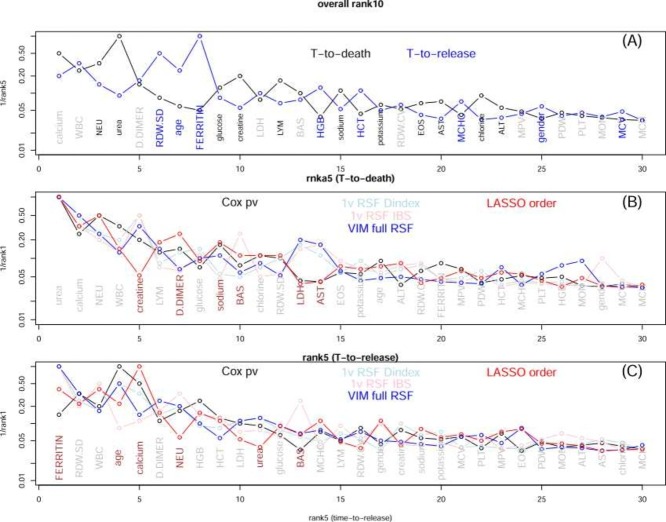
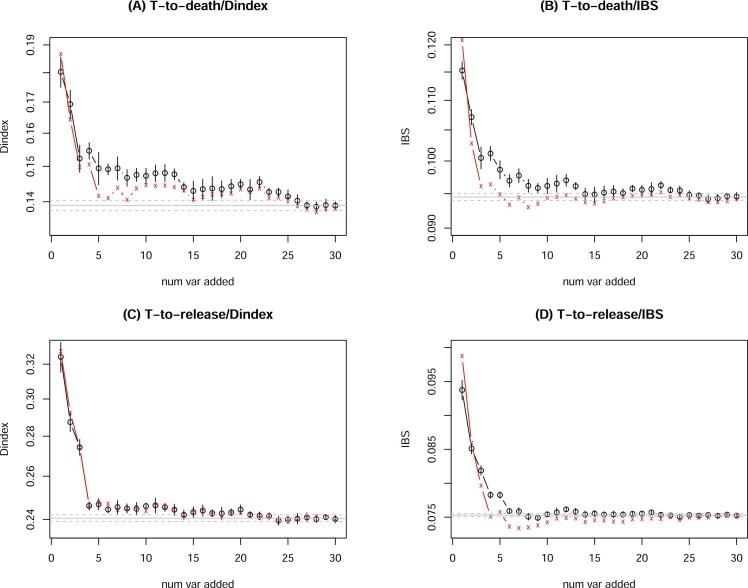
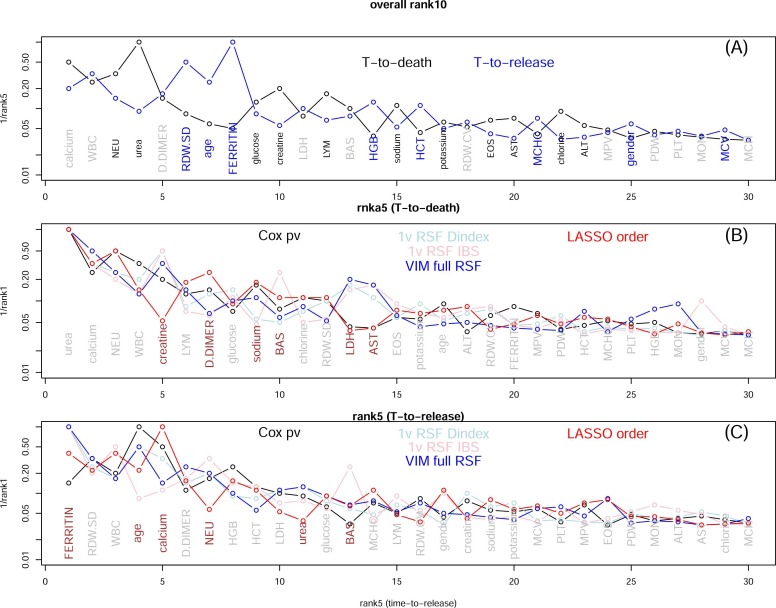
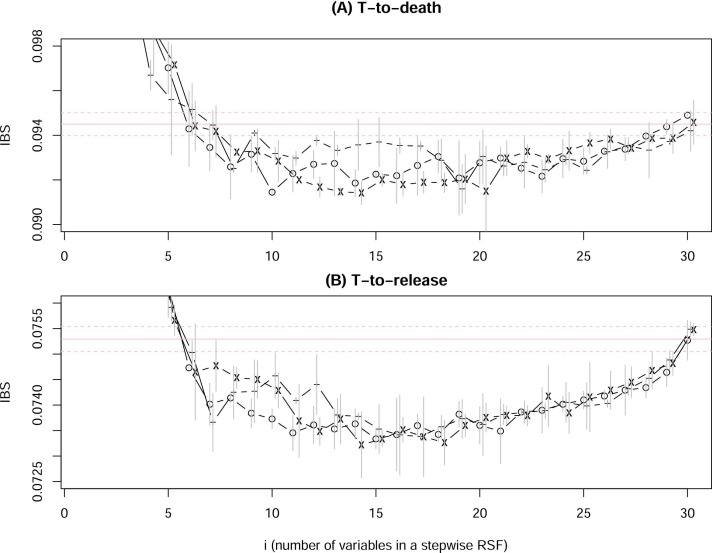
Having a complete and reliable list of risk factors from routine laboratory blood test for COVID-19 disease severity and mortality is important for patient care and hospital management. It is common to use meta-analysis to combine analysis results from different studies to make it more reproducible. In this paper, we propose to run multiple analyses on the same set of data to produce a more robust list of risk factors. With our time-to-event survival data, the standard survival analysis were extended in three directions. The first is to extend from tests and corresponding p-values to machine learning and their prediction performance. The second is to extend from single-variable to multiple-variable analysis. The third is to expand from analyzing time-to-decease data with death as the event of interest to analyzing time-to-hospital-release data to treat early recovery as a meaningful event as well. Our extension of the type of analyses leads to ten ranking lists. We conclude that 20 out of 30 factors are deemed to be reliably associated to faster-death or faster-recovery. Considering correlation among factors and evidenced by stepwise variable selection in random survival forest, 10 ~ 15 factors seem to be able to achieve the optimal prognosis performance. Our final list of risk factors contain calcium, white blood cell and neutrophils count, urea and creatine, d-dimer, red cell distribution widths, age, ferritin, glucose, lactate dehydrogenase, lymphocyte, basophils, anemia related factors (hemoglobin, hematocrit, mean corpuscular hemoglobin concentration), sodium, potassium, eosinophils, and aspartate aminotransferase.
拥有一份完整可靠的、来自常规实验室血液检测的新冠肺炎疾病严重程度和死亡率风险因素清单,对于患者护理和医院管理非常重要。通常使用荟萃分析来合并来自不同研究的分析结果,以使其更具可重复性。在本文中,我们建议对同一组数据进行多次分析,以生成更稳健的风险因素清单。对于我们的生存时间事件数据,标准生存分析在三个方向上进行了扩展。第一个方向是将测试及其对应的 p 值扩展到机器学习及其预测性能。第二个方向是将单变量分析扩展到多变量分析。第三个方向是将分析死亡时间数据扩展到分析住院释放时间数据,以将早期恢复视为有意义的事件。我们对分析类型的扩展导致了十个排名列表。我们得出结论,30 个因素中有 20 个被认为与更快的死亡或更快的恢复相关。考虑到因素之间的相关性,并通过随机生存森林中的逐步变量选择得到证实,10~15 个因素似乎能够达到最佳预后性能。我们最终的风险因素清单包括钙、白细胞和中性粒细胞计数、尿素和肌酸、D-二聚体、红细胞分布宽度、年龄、铁蛋白、葡萄糖、乳酸脱氢酶、淋巴细胞、嗜碱性粒细胞、贫血相关因素(血红蛋白、血细胞比容、平均红细胞血红蛋白浓度)、钠、钾、嗜酸性粒细胞和天冬氨酸氨基转移酶。