Department of Cellular Biophysics, Max Planck Institute for Medical Research, 69120, Heidelberg, Germany.
Department of Biophysical Chemistry, University of Heidelberg, 69120, Heidelberg, Germany.
Sci Rep. 2022 Apr 29;12(1):7053. doi: 10.1038/s41598-022-10858-w.
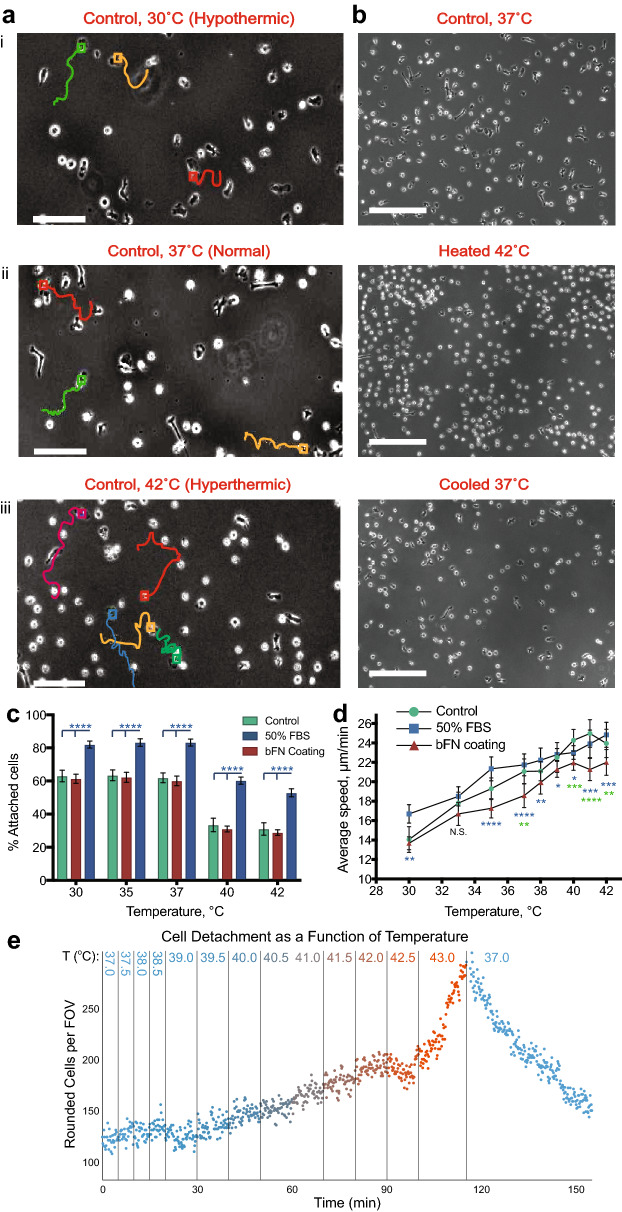
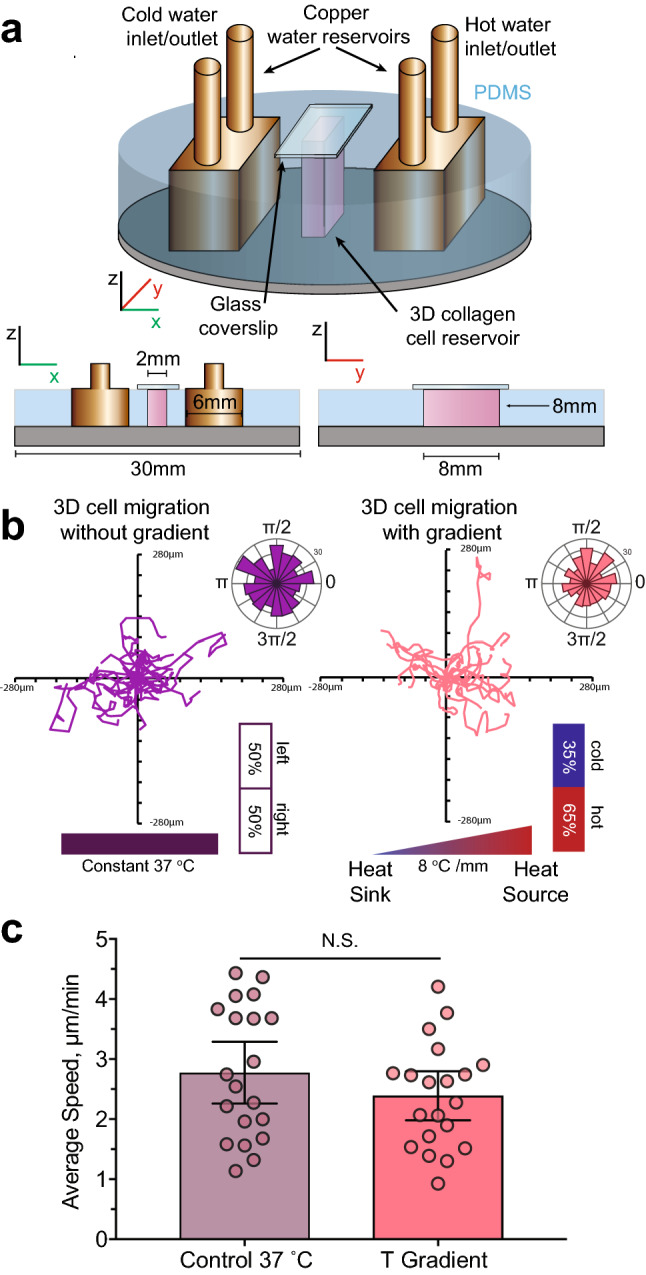
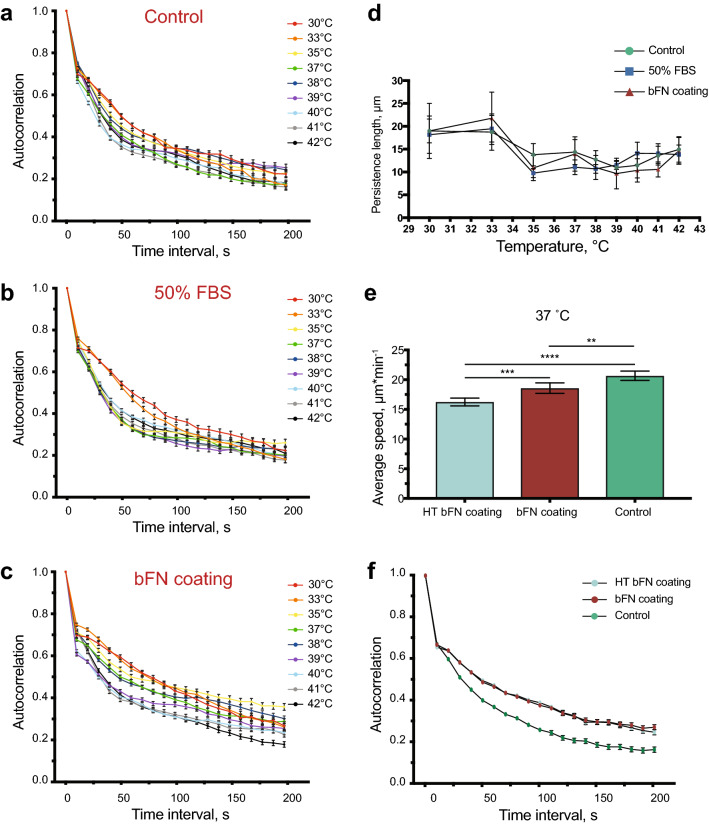
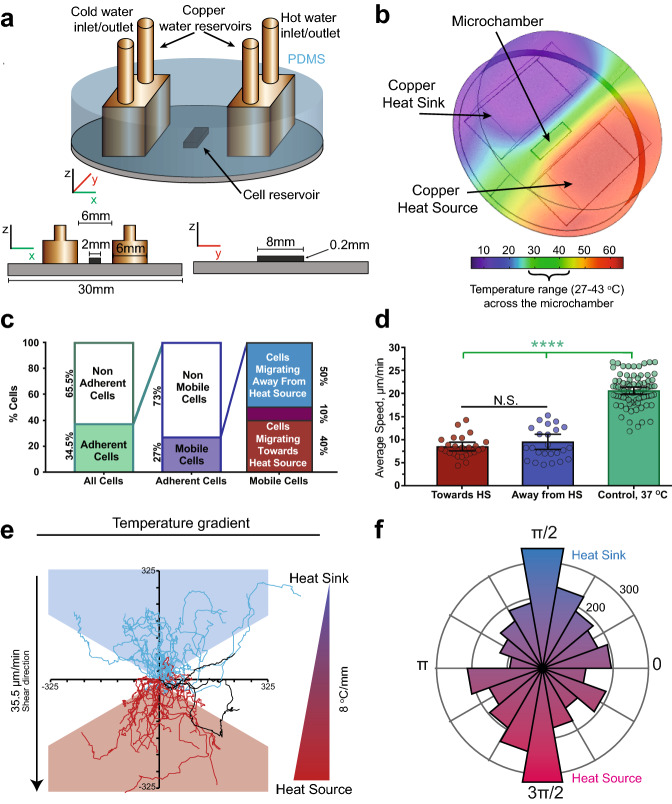
Cell migration plays an essential role in wound healing and inflammatory processes inside the human body. Peripheral blood neutrophils, a type of polymorphonuclear leukocyte (PMN), are the first cells to be activated during inflammation and subsequently migrate toward an injured tissue or infection site. This response is dependent on both biochemical signaling and the extracellular environment, one aspect of which includes increased temperature in the tissues surrounding the inflammation site. In our study, we analyzed temperature-dependent neutrophil migration using differentiated HL-60 cells. The migration speed of differentiated HL-60 cells was found to correlate positively with temperature from 30 to 42 °C, with higher temperatures inducing a concomitant increase in cell detachment. The migration persistence time of differentiated HL-60 cells was higher at lower temperatures (30-33 °C), while the migration persistence length stayed constant throughout the temperature range. Coupled with the increased speed observed at high temperatures, this suggests that neutrophils are primed to migrate more effectively at the elevated temperatures characteristic of inflammation. Temperature gradients exist on both cell and tissue scales. Taking this into consideration, we also investigated the ability of differentiated HL-60 cells to sense and react to the presence of temperature gradients, a process known as thermotaxis. Using a two-dimensional temperature gradient chamber with a range of 27-43 °C, we observed a migration bias parallel to the gradient, resulting in both positive and negative thermotaxis. To better mimic the extracellular matrix (ECM) environment in vivo, a three-dimensional collagen temperature gradient chamber was constructed, allowing observation of biased neutrophil-like differentiated HL-60 migration toward the heat source.
细胞迁移在人体的伤口愈合和炎症过程中起着至关重要的作用。外周血中性粒细胞是一种多形核白细胞(PMN),是炎症过程中最早被激活并随后迁移到受损组织或感染部位的细胞。这种反应既依赖于生化信号,也依赖于细胞外环境,其中一个方面是炎症部位周围组织温度的升高。在我们的研究中,我们使用分化的 HL-60 细胞分析了温度依赖性中性粒细胞迁移。发现分化的 HL-60 细胞的迁移速度与温度呈正相关,从 30°C 到 42°C,温度越高,细胞脱附的伴随增加。分化的 HL-60 细胞的迁移持续时间在较低温度(30-33°C)下较高,而在整个温度范围内迁移持续长度保持不变。与高温下观察到的速度增加相结合,这表明中性粒细胞在炎症时的升高温度下更有效地迁移。细胞和组织尺度上都存在温度梯度。考虑到这一点,我们还研究了分化的 HL-60 细胞感知和对温度梯度存在的反应能力,这一过程称为趋热性。使用具有 27-43°C 范围的二维温度梯度室,我们观察到与梯度平行的迁移偏倚,导致正和负趋热性。为了更好地模拟体内细胞外基质(ECM)环境,构建了一个三维胶原温度梯度室,观察到类似中性粒细胞的分化 HL-60 细胞向热源的偏倚迁移。