Department of Gynecology and Obstetrics, Jane Fonda Center for Adolescent Reproductive Health, Emory University School of Medicine, Atlanta GA, United States.
Department of Gynecology and Obstetrics, Family Planning Division, Emory University School of Medicine, Atlanta GA, United States.
Contraception. 2022 Sep;113:30-36. doi: 10.1016/j.contraception.2022.04.010. Epub 2022 Apr 27.
Assessing access to sexual and reproductive health care during the COVID-19 pandemic, experiences with intimate partner violence (IPV), and exploring sociodemographic disparities STUDY DESIGN: From September 2020 to January 2021, we recruited 436 individuals assigned female at birth (18-49 years.) in Georgia, USA for an online survey. The final convenience sample was n = 423; a response rate could not be calculated. Survey themes included: sociodemographic and financial information, access to contraceptive services/care, IPV, and pregnancy. Respondents who reported a loss of health insurance, difficulty accessing contraception, barriers to medical care, or IPV were characterized as having a negative sexual and reproductive health experience during the pandemic. We explored associations between sociodemographic variables and negative sexual and reproductive health experiences.
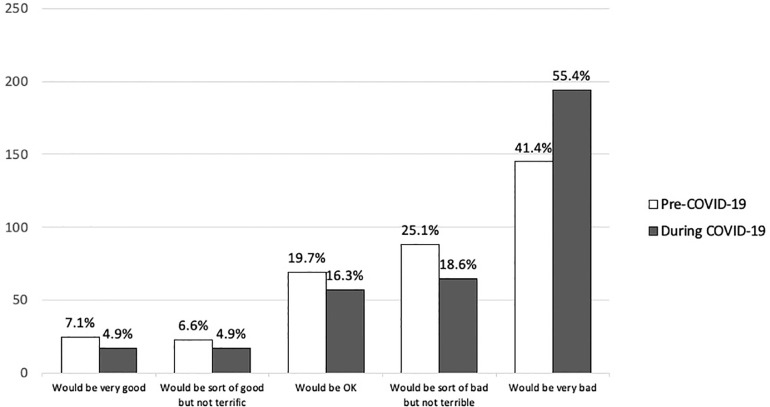
Since March 2020, 66/436 (16%) of respondents lost their health insurance, and 45% (89/436) reported income loss. Of our sample, 144/436 people (33%) attempted to access contraception. The pandemic made contraceptive access more difficult for 38/144 (26%) of respondents; however, 106/144 (74%) said it had no effect or positive effect on access. Twenty-one respondents reported IPV (5%). COVID-19 amplified negative views of unplanned pregnancy. Seventy-six people (18%) reported at least 1 negative sexual and reproductive health experience during the pandemic; people in an urban setting and those identifying as homo/bisexual were more likely to report negative experiences (24%, 28% respectively).
Urban and sexual minority populations had negative sexual and reproductive health experiences during COVID-19 more than their counterparts. The pandemic has shifted perspectives on family planning, likely due to the diverse impacts of COVID-19, including loss of health insurance and income.
Females across Georgia reported varying impacts of the COVID-19's pandemic on their sexual and reproductive health care. These findings could be utilized to propose recommendations for care and intimate partner violence support mechanisms, tailored to urban and sexual minority populations.
评估 COVID-19 大流行期间获得性健康和生殖健康护理的情况、亲密伴侣暴力(IPV)的经历,并探索社会人口统计学差异。
从 2020 年 9 月至 2021 年 1 月,我们在美国佐治亚州招募了 436 名出生时为女性(18-49 岁)的个体参加在线调查。最终的方便样本为 n=423;无法计算回复率。调查主题包括:社会人口统计学和财务信息、获得避孕服务/护理、IPV 和怀孕。报告失去健康保险、难以获得避孕措施、医疗保健障碍或 IPV 的受访者被认为在大流行期间性健康和生殖健康经历不佳。我们探讨了社会人口统计学变量与性健康和生殖健康不良经历之间的关联。
自 2020 年 3 月以来,436 名受访者中有 66/436(16%)失去了健康保险,45%(89/436)报告收入损失。在我们的样本中,有 144/436 人(33%)试图获得避孕措施。大流行使 38/144(26%)的受访者获得避孕措施更加困难;然而,106/144(74%)表示这对获得避孕措施没有影响或有积极影响。有 21 名受访者报告了 IPV(5%)。COVID-19 放大了对意外怀孕的负面看法。76 人(18%)报告在大流行期间至少有 1 次性健康和生殖健康不良经历;城市居民和同性恋/双性恋者更有可能报告不良经历(分别为 24%、28%)。
城市和性少数群体在 COVID-19 期间的性健康和生殖健康经历比他们的同龄人更差。大流行改变了人们对计划生育的看法,这可能是由于 COVID-19 的多种影响,包括失去健康保险和收入。
佐治亚州的女性报告了 COVID-19 大流行对她们性健康和生殖健康护理的不同影响。这些发现可用于提出针对城市和性少数群体的护理和亲密伴侣暴力支持机制的建议。