Institute for Mental Health Policy Research, Centre for Addiction and Mental Health, 100 Collip Circle, Suite 200, ON, N6G 4X8, London, Canada.
Campbell Family Mental Health Research Institute, Centre for Addiction and Mental Health, Toronto, Ontario, Canada.
BMC Psychiatry. 2022 Apr 30;22(1):306. doi: 10.1186/s12888-022-03917-z.
Mental health problems and substance use co-morbidities during and after the COVID-19 pandemic are a public health priority. Identifying individuals at high-risk of developing mental health problems and potential sequela can inform mitigating strategies. We aimed to identify distinct groups of individuals (i.e., latent classes) based on patterns of self-reported mental health symptoms and investigate their associations with alcohol and cannabis use.
We used data from six successive waves of a web-based cross-sectional survey of adults aged 18 years and older living in Canada (6,021 participants). We applied latent class analysis to three domains of self-reported mental health most likely linked to effects of the pandemic: anxiety, depression, and loneliness. Logistic regression was used to characterize latent class membership, estimate the association of class membership with alcohol and cannabis use, and perform sex-based analyses.
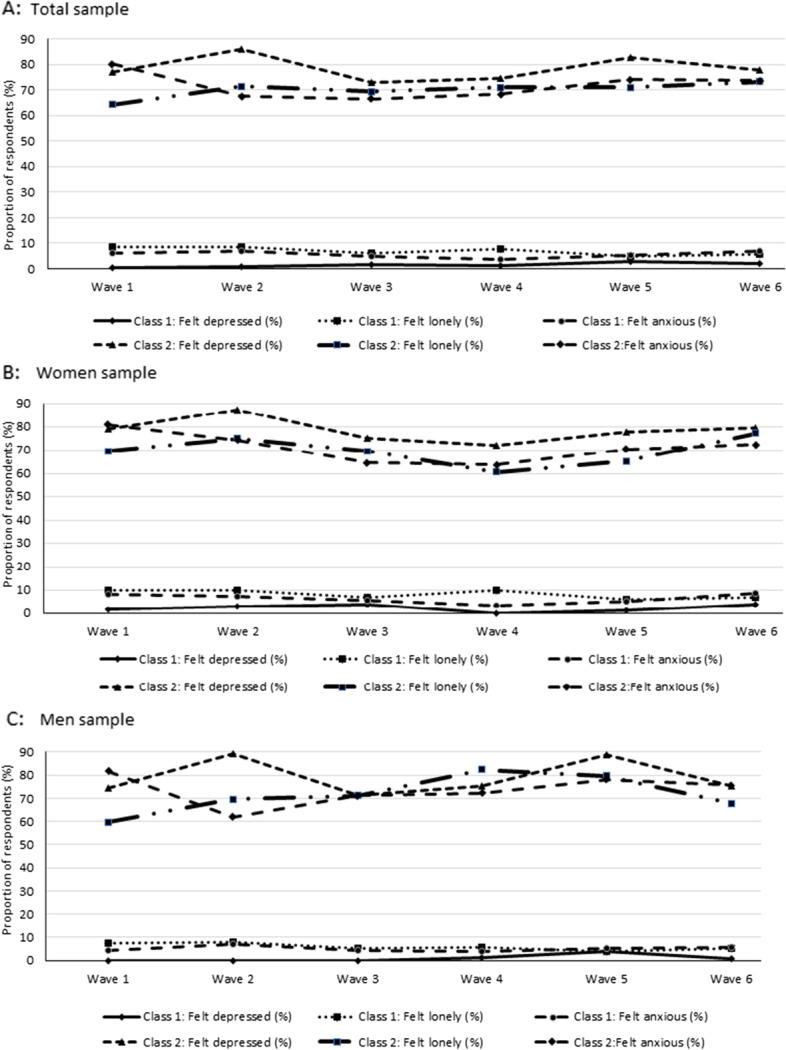
We identified two distinct classes: (1) individuals with low scores on all three mental health indicators (no/low-symptoms) and (2) those reporting high scores across the three measures (high-symptoms). Between 73.9 and 77.1% of participants were in the no/low-symptoms class and 22.9-26.1% of participants were in the high-symptom class. We consistently found across all six waves that individuals at greater risk of being in the high-symptom class were more likely to report worrying about getting COVID-19 with adjusted odds ratios (aORs) between 1.72 (95%CI:1.17-2.51) and 3.51 (95%CI:2.20-5.60). Those aged 60 + were less likely to be in this group with aORs (95%CI) between 0.26 (0.15-0.44) and 0.48 (0.29-0.77) across waves. We also found some factors associated with class membership varied at different time points. Individuals in the high-symptom class were more likely to use cannabis at least once a week (aOR = 2.28, 95%CI:1.92-2.70), drink alcohol heavily (aOR = 1.71, 95%CI:1.49-1.96); and increase the use of cannabis (aOR = 3.50, 95%CI:2.80-4.37) and alcohol (aOR = 2.37, 95%CI:2.06-2.74) during the pandemic. Women in the high-symptom class had lower odds of drinking more alcohol during the pandemic than men.
We identified the determinants of experiencing high anxiety, depression, and loneliness symptoms and found a significant association with alcohol and cannabis consumption. This suggests that initiatives and supports are needed to address mental health and substance use multi-morbidities.
在 COVID-19 大流行期间和之后,心理健康问题和物质使用共病是公共卫生的重点。确定有发展心理健康问题和潜在后遗症风险的个体,可以为缓解策略提供信息。我们旨在根据自我报告的心理健康症状模式确定不同的个体群体(即潜在类别),并调查他们与酒精和大麻使用的关联。
我们使用了来自加拿大六个连续波的基于网络的横断面调查的成年人数据,年龄在 18 岁及以上(6021 名参与者)。我们应用潜在类别分析来分析三个最有可能与大流行影响相关的自我报告的心理健康领域:焦虑、抑郁和孤独。我们使用逻辑回归来描述潜在类别成员资格,估计类别成员资格与酒精和大麻使用的关联,并进行基于性别的分析。
我们确定了两个不同的类别:(1)所有三个心理健康指标得分较低的个体(无/低症状)和(2)三个指标得分较高的个体(高症状)。在 73.9%至 77.1%的参与者中属于无/低症状类别,22.9%至 26.1%的参与者属于高症状类别。我们在所有六个波次中都发现,处于高症状类别风险更高的个体更有可能担心感染 COVID-19,调整后的优势比(aOR)在 1.72(95%CI:1.17-2.51)和 3.51(95%CI:2.20-5.60)之间。在不同的波次中,年龄在 60 岁及以上的个体不太可能属于这一类别,aOR(95%CI)在 0.26(0.15-0.44)和 0.48(0.29-0.77)之间。我们还发现,一些与类别成员资格相关的因素在不同时间点有所不同。高症状类别的个体更有可能每周至少使用一次大麻(aOR=2.28,95%CI:1.92-2.70),大量饮酒(aOR=1.71,95%CI:1.49-1.96);并增加大麻(aOR=3.50,95%CI:2.80-4.37)和酒精(aOR=2.37,95%CI:2.06-2.74)的使用量。高症状类别的女性在大流行期间饮酒量增加的可能性低于男性。
我们确定了经历高焦虑、抑郁和孤独症状的决定因素,并发现与酒精和大麻使用有显著关联。这表明需要采取措施和支持来解决心理健康和物质使用的多重问题。