Department of Medicine, School of Medicine, University of California - Irvine, Orange, CA, USA.
PINC AI Applied Sciences, Premier Inc., Charlotte, NC, USA.
Am J Med Sci. 2022 Oct;364(4):444-453. doi: 10.1016/j.amjms.2022.04.029. Epub 2022 Apr 29.
Hyperkalemia (HK) may be associated with poor clinical outcomes among COVID-19 patients. This study aimed to describe the prevalence of HK and evaluate the associations between HK and in-hospital mortality, intensive care unit (ICU) admission, length of hospital stay (LOS), and hospitalization cost among COVID-19 inpatients.
A retrospective cohort study was conducted using a large hospital discharge database (PINC AI Healthcare Database) for COVID-19 inpatients discharged between April 1 and August 31, 2020. HK was defined with discharge diagnosis and potassium binder use.
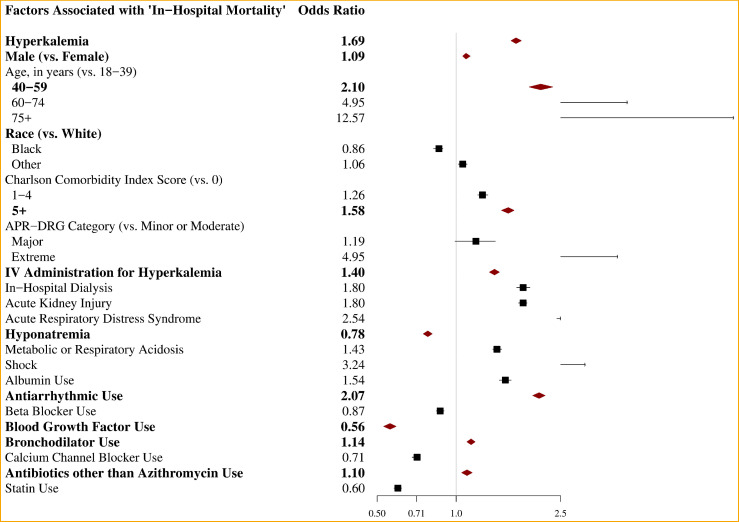
Of 192,182 COVID-19 inpatients, 12% (n = 22,702) had HK. HK patients were more likely to be older (median age 67 vs 63 years), male (63% vs 50%), black (30% vs 22%), and have a history of chronic kidney disease (45% vs 16%) or diabetes mellitus (55% vs 35%) than non-HK patients (all p<.001). A significantly higher proportion of patients with HK had in-hospital mortality (42% vs 11%, p<.001) than those without HK; this was persistent after adjusting for confounders (adjusted odds ratio [OR] 1.69, 95% confidence interval [CI]1.62-1.77). Patients with HK were also more likely to be admitted to ICU (OR 1.05, 95% CI 1.01-1.09), incur higher cost of care (adjusted mean difference $5,389) and have longer LOS (adjusted mean difference 1.3 days) than non-HK patients.
Presence of HK was independently associated with higher in-hospital mortality, LOS, and cost of care among COVID-19 inpatients. Detecting and closely monitoring HK are recommended to improve clinical outcomes and reduce LOS and healthcare cost among COVID-19 patients.
高钾血症(HK)可能与 COVID-19 患者的临床预后不良有关。本研究旨在描述 HK 在 COVID-19 住院患者中的流行情况,并评估 HK 与住院死亡率、重症监护病房(ICU)入院、住院时间(LOS)和住院费用之间的关系。
使用大型医院出院数据库(PINC AI Healthcare Database)对 2020 年 4 月 1 日至 8 月 31 日出院的 COVID-19 住院患者进行回顾性队列研究。根据出院诊断和钾结合剂的使用情况定义 HK。
在 192182 例 COVID-19 住院患者中,有 12%(n=22702)患有 HK。与非 HK 患者相比,HK 患者更有可能年龄较大(中位数年龄 67 岁 vs 63 岁)、男性(63% vs 50%)、黑人(30% vs 22%),且有慢性肾脏病(45% vs 16%)或糖尿病(55% vs 35%)病史(均 p<.001)。HK 患者的住院死亡率(42% vs 11%,p<.001)明显高于非 HK 患者;调整混杂因素后仍存在此差异(校正优势比 [OR] 1.69,95%置信区间 [CI]1.62-1.77)。与非 HK 患者相比,HK 患者更有可能入住 ICU(OR 1.05,95% CI 1.01-1.09)、产生更高的医疗费用(调整后的平均差异为 5389 美元)和 LOS 更长(调整后的平均差异为 1.3 天)。
HK 的存在与 COVID-19 住院患者的住院死亡率、LOS 和医疗费用增加独立相关。建议检测和密切监测 HK,以改善 COVID-19 患者的临床预后,降低 LOS 和医疗成本。