Di Francesco Juliette, Kwong Grace P S, Deardon Rob, Checkley Sylvia L, Mastromonaco Gabriela F, Mavrot Fabien, Leclerc Lisa-Marie, Kutz Susan
Department of Ecosystem and Public Health, Faculty of Veterinary Medicine, University of Calgary, 3280 Hospital Drive NW, Calgary, Alberta T2N 4Z6, Canada.
Faculty of Veterinary Medicine, University of Calgary, 3280 Hospital Drive NW, Calgary, Alberta T2N 4Z6, Canada.
Conserv Physiol. 2022 Jan 21;10(1):coab103. doi: 10.1093/conphys/coab103. eCollection 2022.
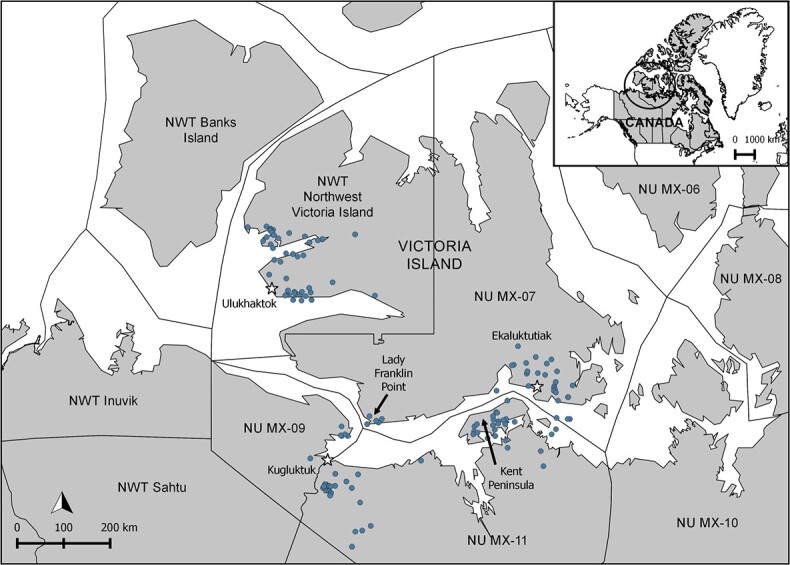
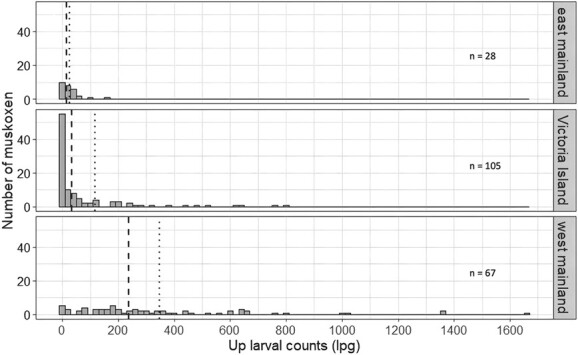
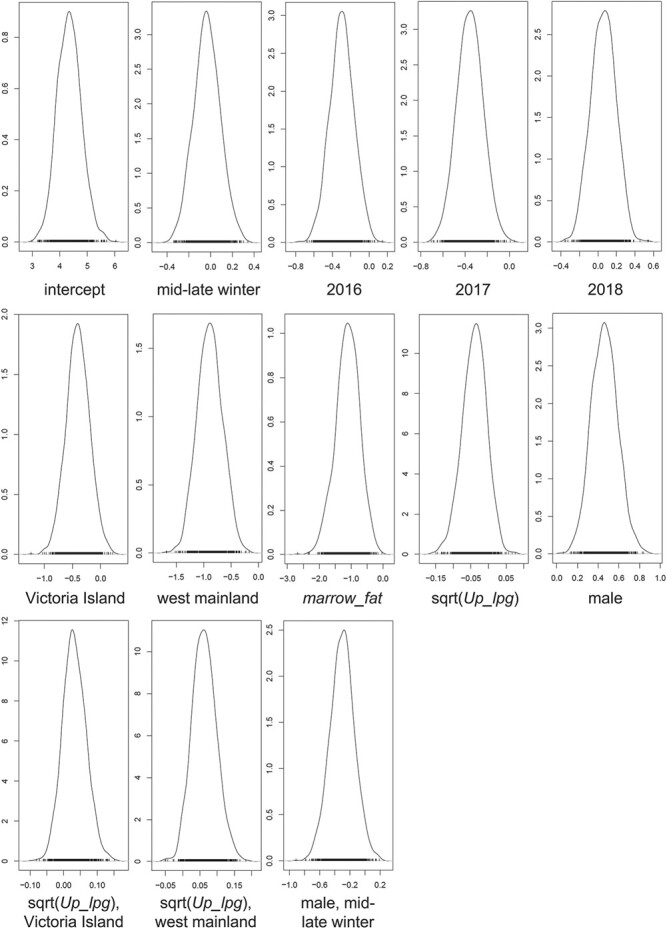
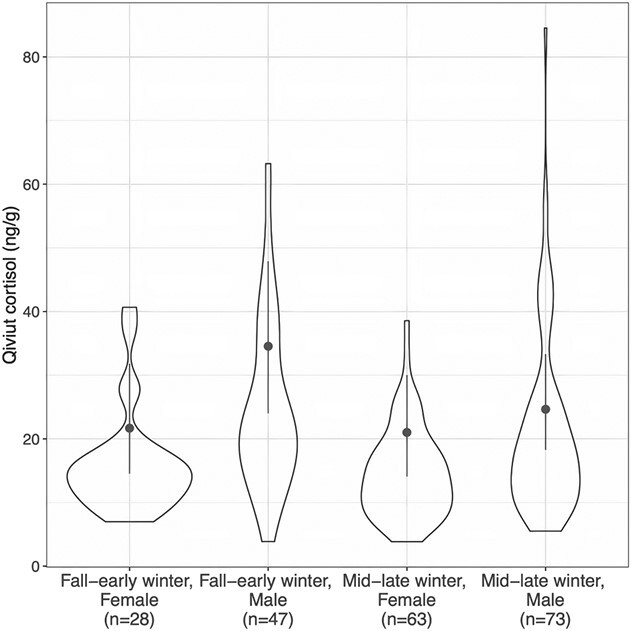
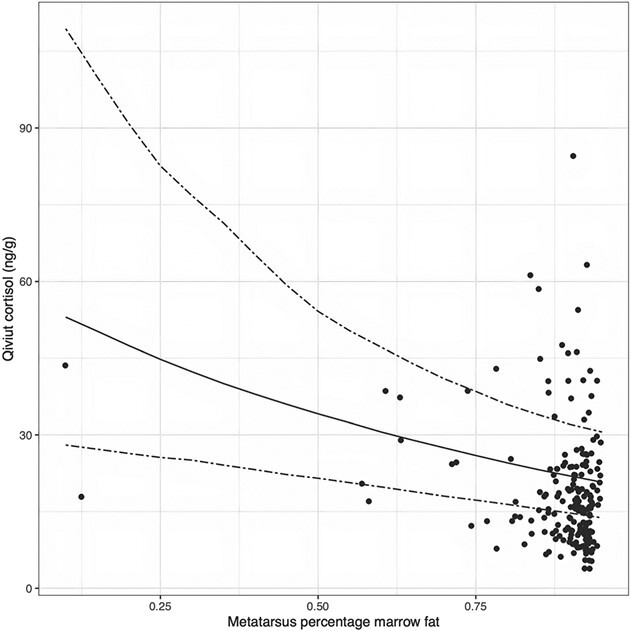
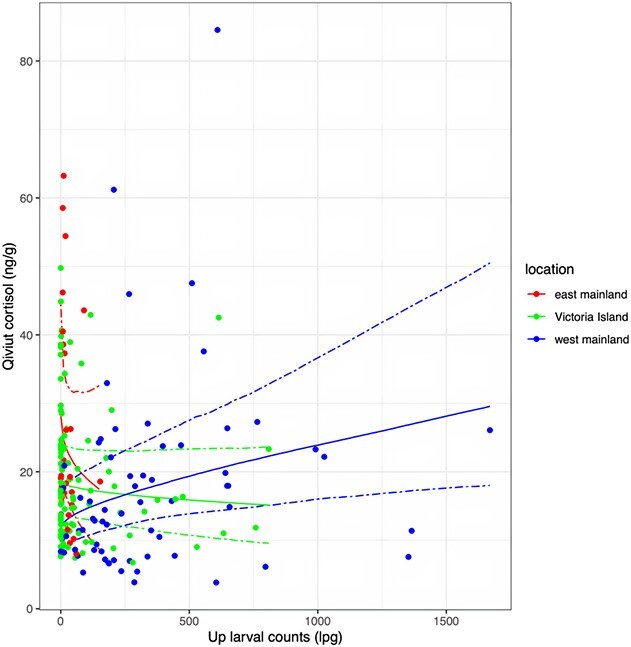
Glucocorticoid (GC) levels are increasingly and widely used as biomarkers of hypothalamic-pituitary-adrenal (HPA) axis activity to study the effects of environmental changes and other perturbations on wildlife individuals and populations. However, identifying the intrinsic and extrinsic factors that influence GC levels is a key step in endocrinology studies to ensure accurate interpretation of GC responses. In muskoxen, qiviut (fine woolly undercoat hair) cortisol concentration is an integrative biomarker of HPA axis activity over the course of the hair's growth. We gathered data from 219 wild muskoxen harvested in the Canadian Arctic between October 2015 and May 2019. We examined the relationship between qiviut cortisol and various intrinsic (sex, age, body condition and incisor breakage) and extrinsic biotic factors (lungworm and gastrointestinal parasite infections and exposure to bacteria), as well as broader non-specific landscape and temporal features (geographical location, season and year). A Bayesian approach, which allows for the joint estimation of missing values in the data and model parameters estimates, was applied for the statistical analyses. The main findings include the following: (i) higher qiviut cortisol levels in males than in females; (ii) inter-annual variations; (iii) higher qiviut cortisol levels in a declining population compared to a stable population; (iv) a negative association between qiviut cortisol and marrow fat percentage; (v) a relationship between qiviut cortisol and the infection intensity of the lungworm , which varied depending on the geographical location; and (vi) no association between qiviut cortisol and other pathogen exposure/infection intensity metrics. This study confirmed and further identified important sources of variability in qiviut cortisol levels, while providing important insights on the relationship between GC levels and pathogen exposure/infection intensity. Results support the use of qiviut cortisol as a tool to monitor temporal changes in HPA axis activity at a population level and to inform management and conservation actions.
糖皮质激素(GC)水平正越来越广泛地用作下丘脑 - 垂体 - 肾上腺(HPA)轴活动的生物标志物,以研究环境变化和其他干扰因素对野生动物个体及种群的影响。然而,识别影响GC水平的内在和外在因素是内分泌学研究中的关键一步,以确保对GC反应进行准确解读。在麝牛中,qiviut(细软的绒毛底层毛发)皮质醇浓度是毛发在生长过程中HPA轴活动的综合生物标志物。我们收集了2015年10月至2019年5月期间在加拿大北极地区捕猎的219头野生麝牛的数据。我们研究了qiviut皮质醇与各种内在因素(性别、年龄、身体状况和门齿破损情况)、外在生物因素(肺线虫和胃肠道寄生虫感染以及细菌暴露)以及更广泛的非特定景观和时间特征(地理位置、季节和年份)之间的关系。统计分析采用了贝叶斯方法,该方法允许对数据中的缺失值和模型参数估计进行联合估计。主要研究结果如下:(i)雄性的qiviut皮质醇水平高于雌性;(ii)年际变化;(iii)与稳定种群相比,数量下降的种群中qiviut皮质醇水平更高;(iv)qiviut皮质醇与骨髓脂肪百分比呈负相关;(v)qiviut皮质醇与肺线虫感染强度之间存在关系,且这种关系因地理位置而异;(vi)qiviut皮质醇与其他病原体暴露/感染强度指标之间无关联。本研究证实并进一步确定了qiviut皮质醇水平变异性的重要来源,同时提供了关于GC水平与病原体暴露/感染强度之间关系的重要见解。研究结果支持将qiviut皮质醇用作监测种群水平上HPA轴活动时间变化的工具,并为管理和保护行动提供参考。