
关节镜临床试验中的术后多模式疼痛管理与阿片类药物消耗:一项系统评价
Postoperative Multimodal Pain Management and Opioid Consumption in Arthroscopy Clinical Trials: A Systematic Review.
作者信息
Paul Ryan W, Szukics Patrick F, Brutico Joseph, Tjoumakaris Fotios P, Freedman Kevin B
机构信息
Rothman Orthopaedic Institute, Philadelphia, Pennsylvania, U.S.A.
Rowan University School of Osteopathic Medicine, Department of Orthopaedic Surgery, Stratford, New Jersey, U.S.A.
出版信息
Arthrosc Sports Med Rehabil. 2021 Dec 17;4(2):e721-e746. doi: 10.1016/j.asmr.2021.09.011. eCollection 2022 Apr.
PURPOSE
To provide an updated review of multimodal pain management in arthroscopic surgery by evaluating pain and opioid consumption after shoulder, knee, and hip arthroscopy.
METHODS
A comprehensive literature search was performed to identify randomized controlled trials (RCTs) investigating multimodal pain management after shoulder, knee, and hip arthroscopy. Articles were identified from January 2011 through December 2020 using various databases. As the primary outcome variables of this study, differences in postoperative pain and opioid consumption volumes were summarized from all reported postoperative time points.
RESULTS
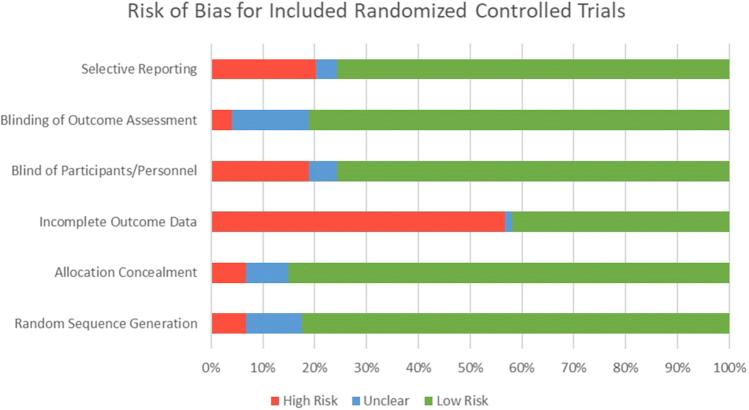
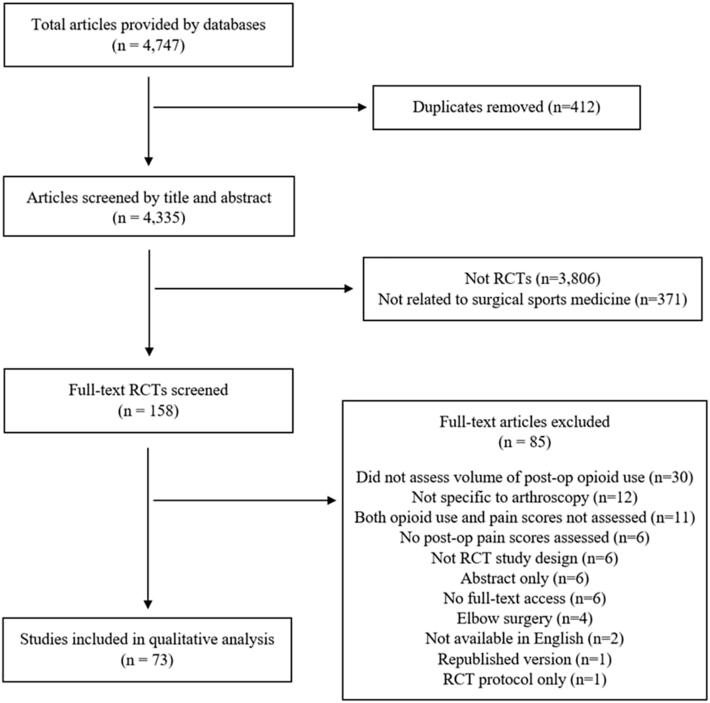
37 shoulder, 28 knee, and 8 hip arthroscopy RCTs were included in the study. The most frequent bias present in the included RCTs was incomplete outcome data (58%), while group allocation concealment was the least frequent bias (15%). Qualitative analysis of rotator cuff repair ( = 12), anterior cruciate ligament reconstruction ( = 11), meniscectomy ( = 5), femoroacetabular impingement ( = 2), oral medications ( = 8), postoperative interventions ( = 10), and nonpharmacological interventions ( = 6) was performed.
CONCLUSIONS
Many multimodal pain management protocols offer improved pain control and decreased opioid consumption after arthroscopic surgery. On the basis of the current literature, the evidence supports an interscalene nerve block with a dexamethasone-dexmedetomidine combination for rotator cuff repair, a proximal continuous adductor canal block for anterior cruciate ligament reconstruction, and local infiltration analgesia (e.g., periacetabular injection with 20 mL of .5% bupivacaine) for hip arthroscopy. When evaluating oral medication, the evidence supports 150 mg Pregabalin for shoulder arthroscopy, 400 mg Celecoxib for knee arthroscopy, and 200 mg Celecoxib for hip arthroscopy, all taken preoperatively. There is promising evidence for the use of various nonpharmacological modalities, specifically preoperative opioid education for rotator cuff repair patients; however, more clinical trials that evaluate nonpharmacological interventions should be performed.
LEVEL OF EVIDENCE
Level II, systematic review of Level I and II studies.
目的
通过评估肩关节、膝关节和髋关节关节镜检查后的疼痛及阿片类药物消耗量,对关节镜手术中的多模式疼痛管理进行更新综述。
方法
进行全面的文献检索,以确定研究肩关节、膝关节和髋关节关节镜检查后多模式疼痛管理的随机对照试验(RCT)。使用各种数据库从2011年1月至2020年12月识别文章。作为本研究的主要结局变量,总结了所有报告的术后时间点的术后疼痛和阿片类药物消耗量的差异。
结果
该研究纳入了37项肩关节、28项膝关节和8项髋关节关节镜检查的RCT。纳入的RCT中最常见的偏倚是结局数据不完整(58%),而组分配隐藏是最不常见的偏倚(15%)。对肩袖修复(n = 12)、前交叉韧带重建(n = 11)、半月板切除术(n = 5)、股骨髋臼撞击症(n = 2)、口服药物(n = 8)、术后干预措施(n = 10)和非药物干预措施(n = 6)进行了定性分析。
结论
许多多模式疼痛管理方案在关节镜手术后可改善疼痛控制并减少阿片类药物的消耗量。基于当前文献,证据支持在肩袖修复中使用地塞米松-右美托咪定联合的肌间沟神经阻滞,在前交叉韧带重建中使用近端连续收肌管阻滞,以及在髋关节镜检查中使用局部浸润镇痛(如用20 mL 0.5%布比卡因进行髋臼周围注射)。在评估口服药物时,证据支持在肩关节镜检查前服用150 mg普瑞巴林,在膝关节镜检查前服用400 mg塞来昔布,在髋关节镜检查前服用200 mg塞来昔布。有证据表明使用各种非药物方法很有前景,特别是对肩袖修复患者进行术前阿片类药物教育;然而,应开展更多评估非药物干预措施的临床试验。
证据级别
二级,对一级和二级研究的系统评价。
 Zotero 插件