Shimamura Yoshinosuke, Anbo Yoshiyasu, Furuta Yasushi
Office of Infection Control and Prevention, Teine Keijinkai Medical Center, Sapporo, JPN.
Cureus. 2022 Mar 27;14(3):e23549. doi: 10.7759/cureus.23549. eCollection 2022 Mar.
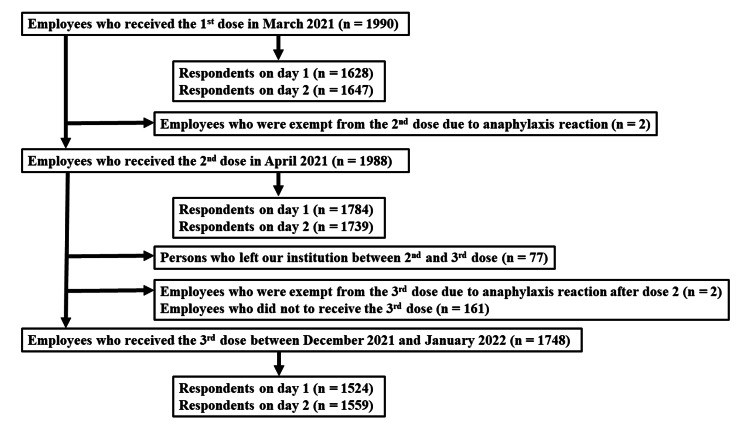
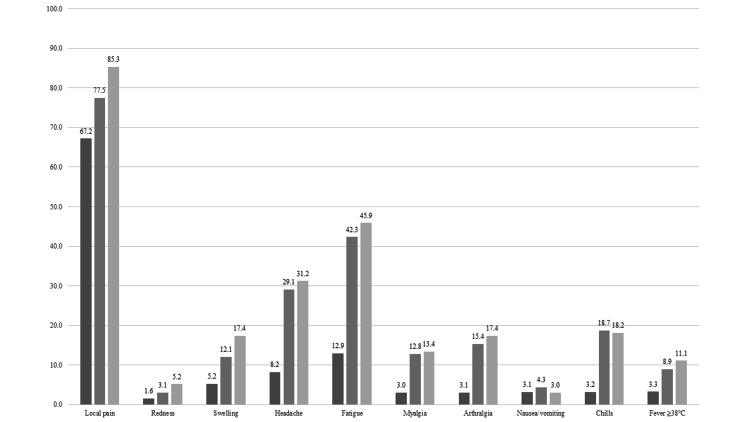
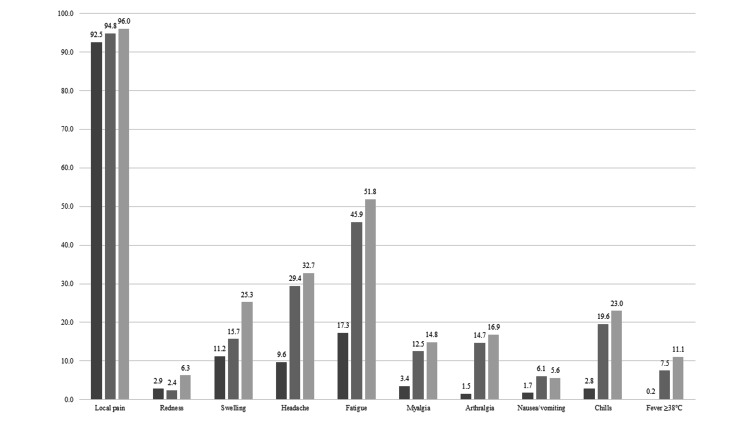
Background/objective Although a third dose of the coronavirus disease 2019 vaccine was initiated, the reports of the post-vaccination adverse reactions after dose three from Japan were limited. We aimed to report on post-vaccination adverse reactions to the third dose of the vaccine among healthcare workers and compare the results with those after the first two doses of vaccine at a tertiary medical center in Japan. Materials and methods After each vaccine (Pfizer-BioNTech) administration, healthcare workers answered a Web-based questionnaire for two consecutive days regarding local and systemic adverse reactions and anaphylaxis reactions. Information about those who took antipyretics and analgesics was also collected. Data were collected using Microsoft Forms (Microsoft, Redmond, WA, USA), a web-based questionnaire software. We compared the proportions of post-vaccination adverse reactions among the three doses of vaccine using the chi-squared test. Results A total of 1,990 employees received the first dose in March 2021, 1,988 employees received the second dose in April 2021, and 1,748 employees received the third dose between December 2021 and January 2022. The median age was 32 years and 21% were men. Local and systemic adverse reactions were greater after dose three than those with the primary series, except for nausea and vomiting. Injected site pain, fatigue, and headache were the three most commonly reported adverse reactions throughout the three sessions. A total of four employees developed anaphylaxis reactions. Additionally, 944 and 1,016 employees reported taking antipyretics and analgesics after doses two and three. Conclusions The coronavirus 2019 booster vaccine was safe and well-tolerated. Clinicians should encourage the public to receive the coronavirus 2019 vaccine series.
背景/目的 尽管已开始接种第三剂2019冠状病毒病疫苗,但来自日本的关于第三剂疫苗接种后不良反应的报告有限。我们旨在报告日本一家三级医疗中心医护人员接种第三剂疫苗后的不良反应,并将结果与前两剂疫苗接种后的结果进行比较。材料与方法 每次接种疫苗(辉瑞-BioNTech)后,医护人员连续两天通过网络问卷回答有关局部和全身不良反应以及过敏反应的问题。还收集了服用退烧药和镇痛药人员的信息。数据通过基于网络的问卷软件Microsoft Forms(美国华盛顿州雷德蒙德市的微软公司)收集。我们使用卡方检验比较了三剂疫苗接种后不良反应的比例。结果 共有1990名员工于2021年3月接种了第一剂疫苗,1988名员工于2021年4月接种了第二剂疫苗,1748名员工于2021年12月至2022年1月期间接种了第三剂疫苗。年龄中位数为32岁,男性占21%。除恶心和呕吐外,第三剂接种后的局部和全身不良反应比初次接种系列更严重。注射部位疼痛、疲劳和头痛是三个接种阶段中最常报告的三种不良反应。共有4名员工出现过敏反应。此外,分别有944名和1016名员工报告在接种第二剂和第三剂后服用了退烧药和镇痛药。结论 2019冠状病毒病加强疫苗安全且耐受性良好。临床医生应鼓励公众接种2019冠状病毒病疫苗系列。