Yang Qian, Hong Yan, Zhao Ting, Song Hongjun, Ming Guo-Li
Department of Neuroscience and Mahoney Institute for Neurosciences, Perelman School of Medicine, University of Pennsylvania, Philadelphia, PA, United States.
Department of Cell and Developmental Biology, Perelman School of Medicine, University of Pennsylvania, Philadelphia, PA, United States.
Front Neurosci. 2022 Apr 14;16:872794. doi: 10.3389/fnins.2022.872794. eCollection 2022.
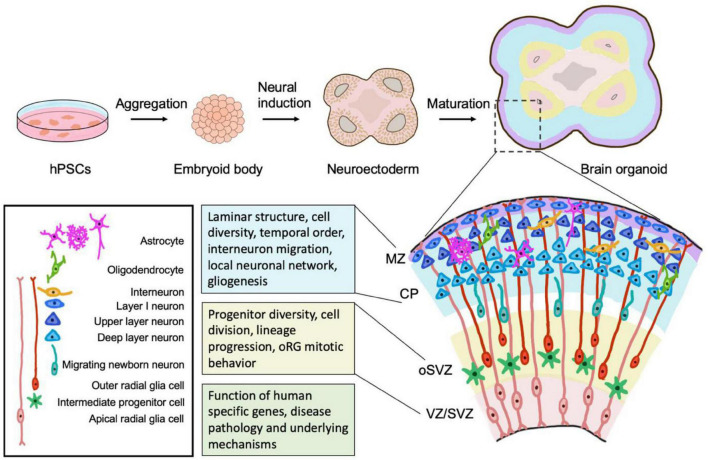
Human neurogenesis occurs mainly in embryonic, fetal, and neonatal stages and generates tremendously diverse neural cell types that constitute the human nervous system. Studies on human neurogenesis have been limited due to a lack of access to human embryonic and fetal tissues. Brain organoids derived from human pluripotent stem cells not only recapitulate major developmental processes during neurogenesis, but also exhibit human-specific features, thus providing an unprecedented opportunity to study human neurodevelopment. First, three-dimensional brain organoids resemble early human neurogenesis with diverse stem cell pools, including the presence of primate-enriched outer radial glia cells. Second, brain organoids recapitulate human neurogenesis at the cellular level, generating diverse neuronal cell types and forming stratified cortical layers. Third, brain organoids also capture gliogenesis with the presence of human-specific astrocytes. Fourth, combined with genome-editing technologies, brain organoids are promising models for investigating functions of human-specific genes at different stages of human neurogenesis. Finally, human organoids derived from patient iPSCs can recapitulate specific disease phenotypes, providing unique models for studying developmental brain disorders of genetic and environmental causes, and for mechanistic studies and drug screening. The aim of this review is to illustrate why brain organoids are good models to study various steps of human neurogenesis, with a focus on corticogenesis. We also discuss limitations of current brain organoid models and future improvements.
人类神经发生主要发生在胚胎、胎儿和新生儿阶段,并产生构成人类神经系统的极其多样的神经细胞类型。由于无法获取人类胚胎和胎儿组织,对人类神经发生的研究一直受到限制。源自人类多能干细胞的脑类器官不仅重现了神经发生过程中的主要发育过程,还展现出人类特有的特征,从而为研究人类神经发育提供了前所未有的机会。第一,三维脑类器官类似于早期人类神经发生,具有多样的干细胞库,包括富含灵长类动物的外侧放射状胶质细胞。第二,脑类器官在细胞水平上重现了人类神经发生,产生了多样的神经元细胞类型并形成了分层的皮质层。第三,脑类器官还通过人类特有的星形胶质细胞的存在体现了神经胶质生成。第四,结合基因组编辑技术,脑类器官是研究人类神经发生不同阶段人类特有基因功能的有前景的模型。最后,源自患者诱导多能干细胞的人类类器官可以重现特定的疾病表型,为研究遗传和环境原因导致的发育性脑部疾病、进行机制研究和药物筛选提供独特的模型。本综述的目的是阐述为什么脑类器官是研究人类神经发生各个步骤的良好模型,重点是皮质发生。我们还讨论了当前脑类器官模型的局限性以及未来的改进方向。