Aborajooh Emad, Alqaisi Talal M, Yassin Mohammad, Alqpelat Eyad, Abofaraj Alaa, Alrawajih Tariq, Alzoubi Hamed, Abu Lubad Mohammad
Department of General Surgery and Anesthesia, Mu'tah University, Kerak, 61710, Jordan.
Department of General Surgery, Al-Karak Governmental Hospital, Kerak, Jordan.
Ann Med Surg (Lond). 2022 Apr 2;76:103552. doi: 10.1016/j.amsu.2022.103552. eCollection 2022 Apr.
Diabetes mellitus (DM) is a common metabolic disorder that significantly affects public health. Diabetic foot ulcer (DFU) is one of the serious complications of diabetes. DFU has a wide spectrum of bacterial isolates comprising Gram-positive, Gram-negative, aerobic bacteria and anaerobes. In the last two decades there has been an increase in the multidrug-resistant isolates (MDR).
This cross-sectional prospective observational study was conducted in southern Jordan among patients with DFU. The included variables are sociodemographic and clinical information. Isolates from swab culture of ulcers and antimicrobial susceptibility pattern are also recorded.
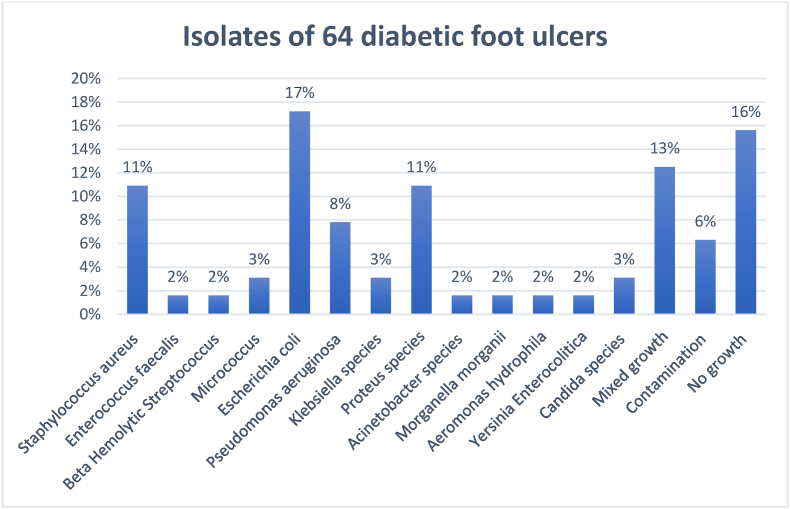
A total of 64 diabetic patients with DFU were included in this study. Most patients included in the study were males with male-to-female ratio of (2.2:1). The mean age was 54 years (SD ± 10.7). The mean duration of DM was 16.4 years (SD ± 7.5) and the mean HbA1c was 9.9% (SD ± 2.1). Neuropathy and anemia were noted in 72% and 44% of patients, respectively. The most frequent bacterial isolates were gram negative bacteria accounts for 29 isolates (45.3%). About 37.5% (24) of bacterial isolates showed MDR pattern. Previous antibiotic use in the last 30 days showed significant association with MDR bacteria (p-value <0.05). Previous history of amputations, presence of neuropathy, renal impairment, retinopathy, presence of anemia, limited joint mobility and presence of foot deformity were significantly associated with Wagner's grade ≥ three.
Many factors affect and increase the risk of having high grade diabetic foot ulcer. The most frequent bacterial isolates from diabetic foot ulcers were gram negative bacteria. High rates of MDR in this study reflect the loose implementation of regulations in Jordan regarding antibiotics dispensing.
糖尿病(DM)是一种常见的代谢紊乱疾病,严重影响公众健康。糖尿病足溃疡(DFU)是糖尿病的严重并发症之一。DFU的细菌分离株种类繁多,包括革兰氏阳性菌、革兰氏阴性菌、需氧菌和厌氧菌。在过去二十年中,多重耐药分离株(MDR)有所增加。
这项横断面前瞻性观察研究在约旦南部的DFU患者中进行。纳入的变量包括社会人口统计学和临床信息。还记录了溃疡拭子培养的分离株及抗菌药物敏感性模式。
本研究共纳入64例DFU糖尿病患者。研究中的大多数患者为男性,男女比例为(2.2:1)。平均年龄为54岁(标准差±10.7)。DM的平均病程为16.4年(标准差±7.5),平均糖化血红蛋白为9.9%(标准差±2.1)。分别有72%和44%的患者出现神经病变和贫血。最常见的细菌分离株是革兰氏阴性菌,占29株(45.3%)。约37.5%(24株)的细菌分离株呈现MDR模式。过去30天内使用过抗生素与MDR细菌有显著关联(p值<0.05)。既往截肢史、神经病变、肾功能损害、视网膜病变、贫血、关节活动受限和足部畸形与瓦格纳分级≥三级显著相关。
许多因素会影响并增加发生高级别糖尿病足溃疡的风险。糖尿病足溃疡最常见的细菌分离株是革兰氏阴性菌。本研究中MDR的高发生率反映了约旦在抗生素配药方面的监管执行不力。