Chen Thomas Yen-Ting, Chang Renin, Hung Yao-Min, Yip Hei-Tung, Wei James Cheng-Chung
Harvard T.H. Chan School of Public Health, Boston, MA, USA.
Department of Medical Research and Education, Kaohsiung Veterans General Hospital, Kaohsiung, Taiwan.
EClinicalMedicine. 2022 Apr 21;47:101402. doi: 10.1016/j.eclinm.2022.101402. eCollection 2022 May.
While the etiology of sudden sensorineural hearing loss (SSNHL) remains unclear, viral infection has been suggested as a possible cause. Human papillomavirus (HPV) might trigger immune-mediated reaction and induce inflammatory cytokines which are injurious to the cochlea. This study aimed to investigate the association between HPV infection and the risk of developing SSNHL using a nationwide population-based data set.
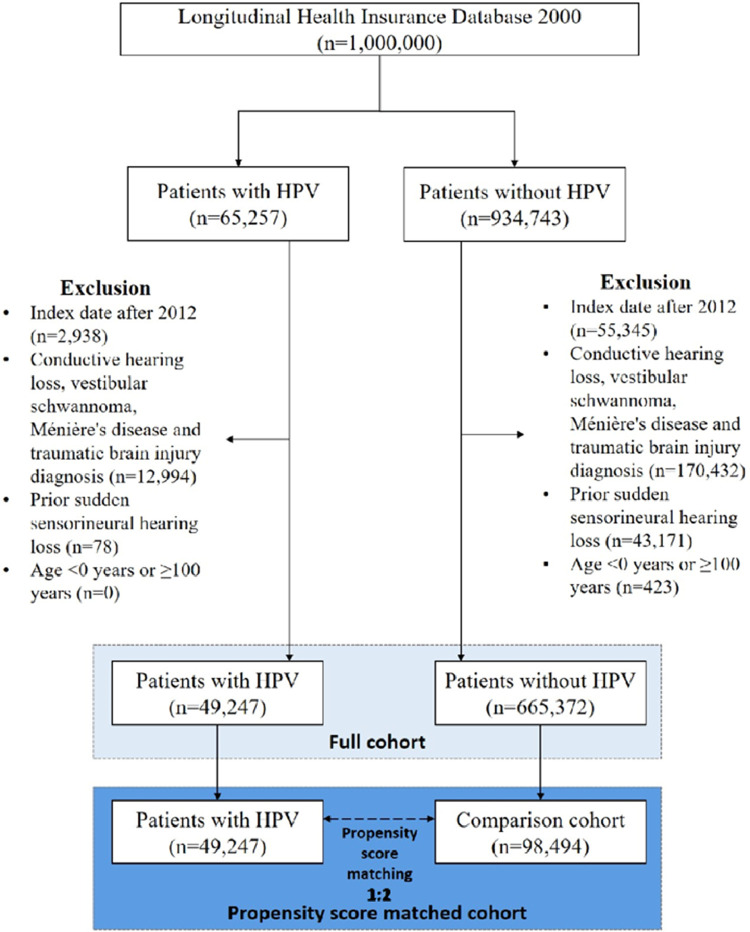
In this study, we used the population-based National Health Insurance Research Database of Taiwan to enroll 49,247 individuals with HPV infection from January 1st, 2000, to December 31st, 2013, and compared with a control group of 98,494 individuals who had never been diagnosed with HPV infection (at a 1:2 ratio matched by age, sex, index year, and comorbidities) in relation to the risk of subsequent SSNHL. The primary outcome was the time from the index date to the date when the first diagnosis of SSNHL occurred, death, withdrawal from the National Health Insurance Program, or the end of the study. Cox model with frailty was conducted to estimate hazard ratios (HRs) and 95% confidence intervals (CIs), relative to comparison group. Sensitivity analyses were performed to validate our findings.
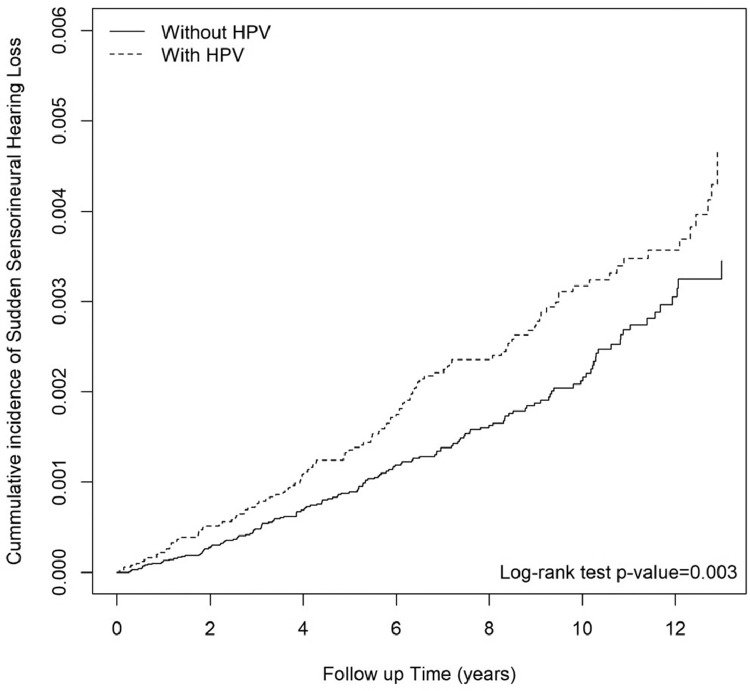
The adjusted hazard ratio (aHR) of developing SSNHL was 1.37 (95% CI, 1.07-1.74) after adjustment for demographic characteristics, comorbidities, and medications. Sensitivity analyses showed consistent positive association. In our sub-group analysis, a significantly higher effect of HPV on SSNHL was noted in the patients with a previous diagnosis of cerebrovascular disease, compared with those without cerebrovascular disease (aHR: 4.59 versus 1.27, -value for interaction = 0.024).
HPV infections are associated with higher risk of subsequent SSNHL in the Taiwanese population. More research is needed to examine the causality and to determine the potential efficacy of specific precautions.
This research received no specific grant from any funding agency in the public, commercial, or not-for-profit sectors.
虽然突发性感音神经性听力损失(SSNHL)的病因尚不清楚,但病毒感染被认为是一种可能的原因。人乳头瘤病毒(HPV)可能引发免疫介导反应并诱导对耳蜗有害的炎性细胞因子。本研究旨在利用全国性的基于人群的数据集调查HPV感染与发生SSNHL风险之间的关联。
在本研究中,我们使用台湾基于人群的国民健康保险研究数据库,纳入了2000年1月1日至2013年12月31日期间49247例HPV感染个体,并与98494例从未被诊断为HPV感染的个体组成的对照组(年龄、性别、索引年份和合并症按1:2比例匹配)比较后续发生SSNHL的风险。主要结局是从索引日期到首次诊断为SSNHL、死亡、退出国民健康保险计划或研究结束的日期。采用具有脆弱性的Cox模型估计相对于对照组的风险比(HRs)和95%置信区间(CIs)。进行敏感性分析以验证我们的研究结果。
在调整了人口统计学特征、合并症和药物治疗后,发生SSNHL的调整后风险比(aHR)为1.37(95%CI,1.07 - 1.74)。敏感性分析显示出一致的正相关。在我们的亚组分析中,与无脑血管疾病的患者相比,既往诊断有脑血管疾病的患者中HPV对SSNHL的影响显著更高(aHR:4.59对1.27,交互作用P值 = 0.024)。
在台湾人群中,HPV感染与后续发生SSNHL的较高风险相关。需要更多研究来检验因果关系并确定特定预防措施的潜在效果。
本研究未获得公共、商业或非营利部门任何资助机构的特定资助。