Kabir Imrana I, Osborn John C, Lu Weijian, Mata Jitendra P, Rehm Christine, Yeoh Guan H, Ersez Tunay
School of Mechanical and Manufacturing Engineering, University of New South Wales, Sydney, NSW 2052, Australia.
Australian Nuclear Science and Technology Organisation, Locked Bag 2001, Kirrawee DC, NSW 2232, Australia.
J Appl Crystallogr. 2022 Mar 25;55(Pt 2):353-361. doi: 10.1107/S1600576722002084. eCollection 2022 Apr 1.
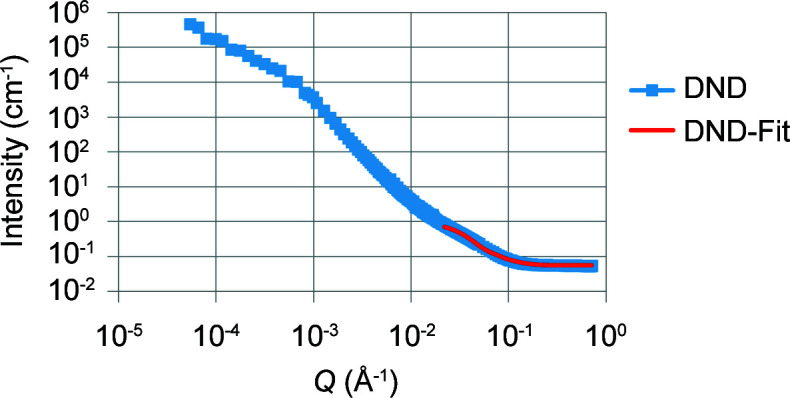
Ultra-small-angle neutron scattering (USANS) and small-angle neutron scattering (SANS) measurements, covering length scales from micrometres to nanometres, were made to investigate the structure of nanodiamonds (NDs) and their suspensions. These nanodiamonds were produced by two different techniques, namely by the detonation method and by the laser ablation of a carbon-hydro-carbon mixture. The (U)SANS results indicated the presence of structures four orders of magnitude larger than the dimensions of a single ND particle, consisting of aggregations of ND particles. This aggregation of the ND particles was studied by employing the contrast variation technique. Two different solvents, namely HO and dimethyl sulfoxide (and their deuterated counterparts), were used to understand the role of hydrogen in the shape and size of the aggregates. The analysis of experimental data from SANS measurements also reveals the ND particles to have an ellipsoidal structure. Using a defined shape model and the SANS contrast variation technique, it was possible to characterize the non-diamond outer shell of the particles and determine the outer layer thickness. This clarification of the structure of the NDs will allow better preparation of suspensions/samples for various applications. Understanding the structure of NDs at multiple length scales also provides crucial knowledge of particle-particle interaction and its effect on the aggregation structures.
为了研究纳米金刚石(NDs)及其悬浮液的结构,进行了超小角中子散射(USANS)和小角中子散射(SANS)测量,测量范围覆盖从微米到纳米的长度尺度。这些纳米金刚石是通过两种不同技术制备的,即爆轰法和碳 - 碳氢混合物的激光烧蚀法。(U)SANS结果表明存在比单个ND颗粒尺寸大四个数量级的结构,该结构由ND颗粒的聚集体组成。通过采用对比变化技术研究了ND颗粒的这种聚集现象。使用两种不同的溶剂,即水和二甲基亚砜(及其氘代对应物)来了解氢在聚集体形状和尺寸中的作用。对SANS测量实验数据的分析还揭示了ND颗粒具有椭圆形结构。使用定义的形状模型和SANS对比变化技术,可以表征颗粒的非金刚石外壳并确定外层厚度。对NDs结构的这种阐明将有助于更好地制备用于各种应用的悬浮液/样品。了解多个长度尺度上的NDs结构还提供了关于颗粒 - 颗粒相互作用及其对聚集结构影响的关键知识。