Smeets Diede, Gisterå Anton, Malin Stephen G, Tsiantoulas Dimitrios
Department of Laboratory Medicine, Medical University of Vienna, Vienna, Austria.
Center for Molecular Medicine, Karolinska University Hospital, Stockholm, Sweden.
Front Cardiovasc Med. 2022 Apr 15;9:864602. doi: 10.3389/fcvm.2022.864602. eCollection 2022.
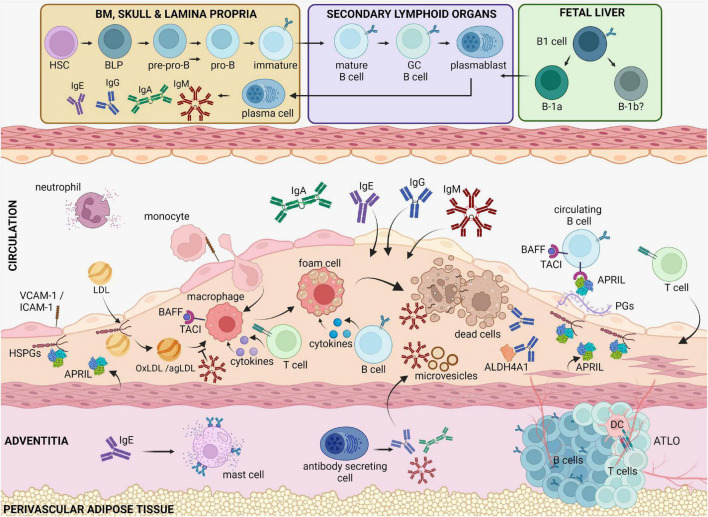
B cells are a core element of the pathophysiology of atherosclerotic cardiovascular disease (ASCVD). Multiple experimental and epidemiological studies have revealed both protective and deleterious functions of B cells in atherosclerotic plaque formation. The spearhead property of B cells that influences the development of atherosclerosis is their unique ability to produce and secrete high amounts of antigen-specific antibodies that can act at distant sites. Exposure to an atherogenic milieu impacts B cell homeostasis, cell differentiation and antibody production. However, it is not clear whether B cell responses in atherosclerosis are instructed by atherosclerosis-specific antigens (ASA). Dissecting the full spectrum of the B cell properties in atherosclerosis will pave the way for designing innovative therapies against the devastating consequences of ASCVD.
B细胞是动脉粥样硬化性心血管疾病(ASCVD)病理生理学的核心要素。多项实验和流行病学研究揭示了B细胞在动脉粥样硬化斑块形成中的保护和有害作用。B细胞影响动脉粥样硬化发展的首要特性是其产生和分泌大量可作用于远处部位的抗原特异性抗体的独特能力。暴露于致动脉粥样硬化环境会影响B细胞的稳态、细胞分化和抗体产生。然而,尚不清楚动脉粥样硬化中的B细胞反应是否由动脉粥样硬化特异性抗原(ASA)所指导。剖析动脉粥样硬化中B细胞特性的全貌将为设计针对ASCVD灾难性后果的创新疗法铺平道路。