Maccora Ilaria, Abu Rumeileh Sarah, Curci Franco, de Libero Cinzia, Marrani Edoardo, Mastrolia Maria Vincenza, Pagnini Ilaria, Simonini Gabriele
Rheumatology Unit, Meyer Children's University Hospital, Florence, Italy.
NeuroFARBA Department, University of Florence, Florence, Italy.
Front Pediatr. 2022 Apr 12;10:851453. doi: 10.3389/fped.2022.851453. eCollection 2022.
Our study aimed to evaluate the efficacy of Tocilizumab and Abatacept for treating Childhood Chronic non-infectious Uveitis (CCU), resistant to anti-tumor necrosis factor (anti-TNF) treatment.
This is a monocentric retrospective charts review study (January 2010-April 2021) recruiting CCU, refractory to anti-TNF. To be included, children should have active uveitis at the time of Tocilizumab (8 mg/kg, every 4 weeks) or Abatacept (10 mg/kg, every 4 weeks). The main outcome was the achievement of ocular remission on treatment defined as the absence of flares for ≥ 6 months.
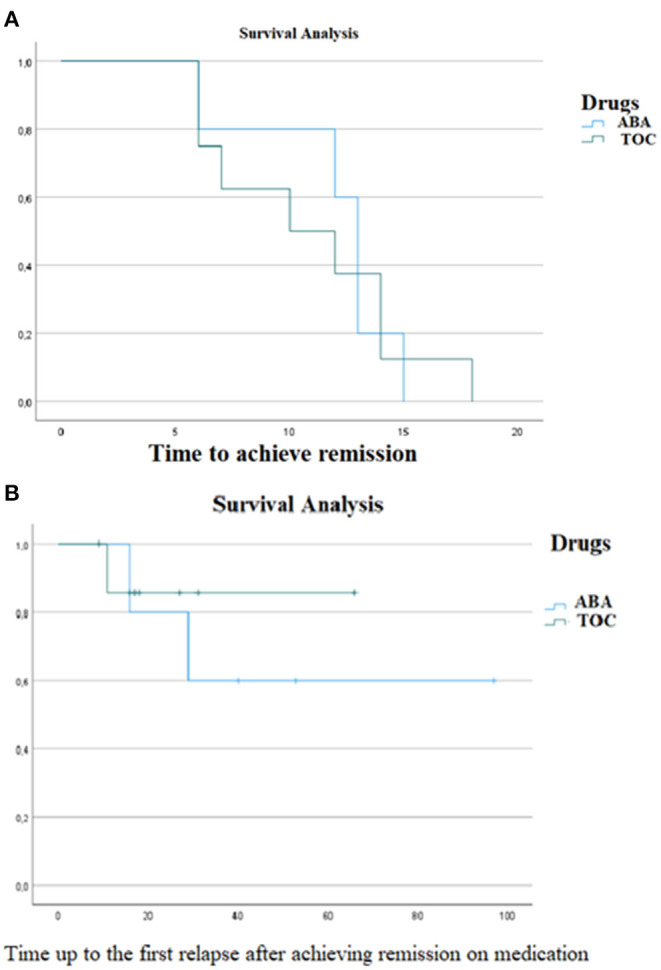
In this study, 18 patients with CCU (14 F), previously treated with Methotrexate and Adalimumab, were enrolled: 15 had juvenile idiopathic arthritis (JIA) (83.3%), 2 idiopathic (11.1%), and 1 Behçet (5.6%). Furthermore, ten patients received Abatacept and 8 patients received Tocilizumab. The mean duration of treatment on Abatacept was 31.6 months (SD ± 30.8), on Tocilizumab 25.25 months (SD ± 17.8). In total, 13 children (72.2%) achieved remission, with a better remission rate for the Tocilizumab group (8/8) compared to the Abatacept group (5/10) (χ 5.53, = 0.019). No difference was evaluated between the two groups in the proportion of patients who showed flares during the treatment (2/6 Abatacept vs. 1/8 Tocilizumab). A significant difference was evaluated in the proportion of patients who flared after treatment discontinuation: 3/3 Abatacept vs. 0/3 Tocilizumab (χ 3.8, = 0.025).
Even though this is a monocentric retrospective study, in a relatively small group, our study suggests a superior efficacy of Tocilizumab over Abatacept for treating anti-TNF refractory CCU.
我们的研究旨在评估托珠单抗和阿巴西普治疗对抗肿瘤坏死因子(抗TNF)治疗耐药的儿童慢性非感染性葡萄膜炎(CCU)的疗效。
这是一项单中心回顾性病历审查研究(2010年1月至2021年4月),招募对抗TNF治疗无效的CCU患者。纳入的儿童在使用托珠单抗(8mg/kg,每4周一次)或阿巴西普(10mg/kg,每4周一次)时应患有活动性葡萄膜炎。主要结局是治疗时达到眼部缓解,定义为无炎症发作≥6个月。
在本研究中,纳入了18例曾接受甲氨蝶呤和阿达木单抗治疗的CCU患者(14例女性):15例患有幼年特发性关节炎(JIA)(83.3%),2例为特发性(11.1%),1例为白塞病(5.6%)。此外,10例患者接受了阿巴西普治疗,8例患者接受了托珠单抗治疗。阿巴西普治疗的平均持续时间为31.6个月(标准差±30.8),托珠单抗治疗为25.25个月(标准差±17.8)。总共有13名儿童(72.2%)实现缓解,托珠单抗组(8/8)的缓解率高于阿巴西普组(5/10)(χ=5.53,P=0.019)。两组在治疗期间出现炎症发作的患者比例方面未评估出差异(阿巴西普组2/6 vs.托珠单抗组1/8)。在治疗停药后出现炎症发作的患者比例方面评估出显著差异:阿巴西普组3/3 vs.托珠单抗组0/3(χ=3.8,P=0.025)。
尽管这是一项单中心回顾性研究,且样本量相对较小,但我们的研究表明,在治疗抗TNF难治性CCU方面,托珠单抗的疗效优于阿巴西普。