Department of Food Hygiene and Environmental Health, Faculty of Veterinary Medicine, University of Helsinkigrid.7737.4, Helsinki, Finland.
Helsinki Institute for Information Technology HIIT, Department of Mathematics and Statistics, University of Helsinkigrid.7737.4, Helsinki, Finland.
mBio. 2022 Jun 28;13(3):e0238421. doi: 10.1128/mbio.02384-21. Epub 2022 May 2.
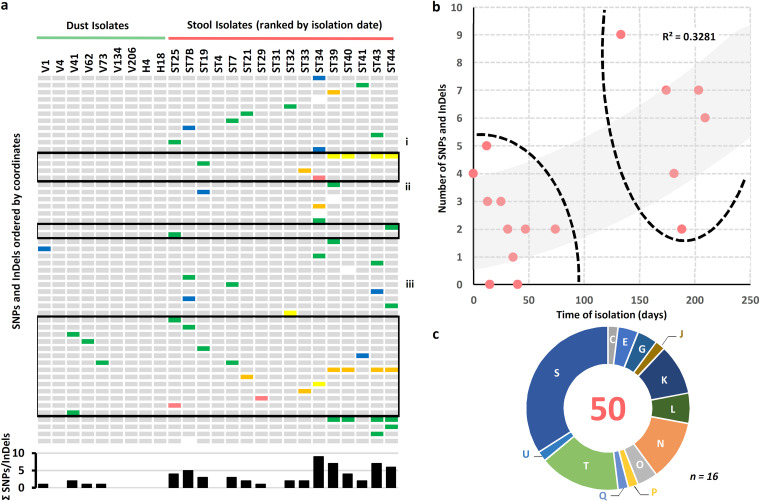
In early life, the immature human gut microbiota is prone to colonization by pathogens that are usually outcompeted by mature microbiota in the adult gut. Colonization and neurotoxin production by a vegetative Clostridium botulinum culture in the gut of an infant can lead to flaccid paralysis, resulting in a clinical outcome known as infant botulism, a potentially life-threatening condition. Beside host factors, little is known of the ecology, colonization, and adaptation of C. botulinum to the gut environment. In our previous report, an infant with intestinal botulism was shown to be colonized by neurotoxigenic C. botulinum culture for 7 months. In an effort to gain ecological and evolutionary insights into this unusually long gut colonization by C. botulinum, we analyzed and compared the genomes of C. botulinum isolates recovered from the infant feces during the course of intoxication and isolates from the infant household dust. A number of observed mutations and genomic alterations pinpointed at phenotypic traits that may have promoted colonization and adaptation to the gut environment and to the host. These traits include motility, quorum-sensing, sporulation, and carbohydrate metabolism. We provide novel perspectives and suggest a tentative model of the pathogenesis of C. botulinum in infant botulism. While the clinical aspects of infant botulism and the mode of action of BoNT have been thoroughly investigated, little is known on the pathogenesis and adaptive mechanisms of C. botulinum in the gut. Here, we provide for the first time a comprehensive view on the genomic dynamics and plasticity of C. botulinum over time in a case of infant botulism. The genomic and phenotypic analysis of C. botulinum isolates collected during the disease course offers an unprecedented view of C. botulinum ecology, evolution, and pathogenesis and may be instrumental in developing novel strategies for prevention and treatment of toxicoinfectious botulism.
在生命早期,不成熟的人类肠道微生物群容易被病原体定植,而这些病原体通常会被成人肠道中的成熟微生物群所竞争。在婴儿肠道中,一种营养型的肉毒梭菌(Clostridium botulinum)培养物的定植和神经毒素产生可导致弛缓性瘫痪,从而导致一种称为婴儿肉毒中毒的临床结果,这是一种潜在的危及生命的疾病。除了宿主因素外,人们对肉毒梭菌的生态、定植和对肠道环境的适应知之甚少。在我们之前的报告中,显示一名患有肠道肉毒中毒的婴儿被产毒肉毒梭菌培养物定植了 7 个月。为了深入了解肉毒梭菌在肠道中异常长时间定植的生态学和进化,我们分析并比较了从婴儿粪便中毒过程中分离出的产毒肉毒梭菌分离株和婴儿家庭灰尘中的分离株的基因组。一些观察到的突变和基因组改变指出了可能促进定植和适应肠道环境和宿主的表型特征。这些特征包括运动性、群体感应、孢子形成和碳水化合物代谢。我们提供了新的视角,并提出了一个关于婴儿肉毒中毒中肉毒梭菌发病机制的试探性模型。虽然婴儿肉毒中毒的临床方面和 BoNT 的作用模式已经得到了彻底的研究,但对肉毒梭菌在肠道中的发病机制和适应机制知之甚少。在这里,我们首次提供了在婴儿肉毒中毒病例中肉毒梭菌随时间变化的基因组动态和可塑性的全面视图。在疾病过程中收集的肉毒梭菌分离株的基因组和表型分析为肉毒梭菌的生态学、进化和发病机制提供了前所未有的视角,并且可能有助于开发预防和治疗毒感染性肉毒中毒的新策略。