Meurens François, Carlin Frédéric, Federighi Michel, Filippitzi Maria-Eleni, Fournier Matthieu, Fravalo Philippe, Ganière Jean-Pierre, Grisot Lionel, Guillier Laurent, Hilaire Didier, Kooh Pauline, Le Bouquin-Leneveu Sophie, Le Maréchal Caroline, Mazuet Christelle, Morvan Hervé, Petit Karine, Vaillancourt Jean-Pierre, Woudstra Cédric
INRAE, Oniris, BIOEPAR, Nantes, France.
Department of Veterinary Microbiology and Immunology, Western College of Veterinary Medicine, University of Saskatchewan, Saskatoon, SK, Canada.
Front Microbiol. 2023 Jan 5;13:1099184. doi: 10.3389/fmicb.2022.1099184. eCollection 2022.
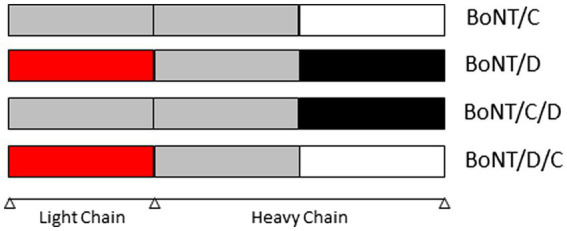
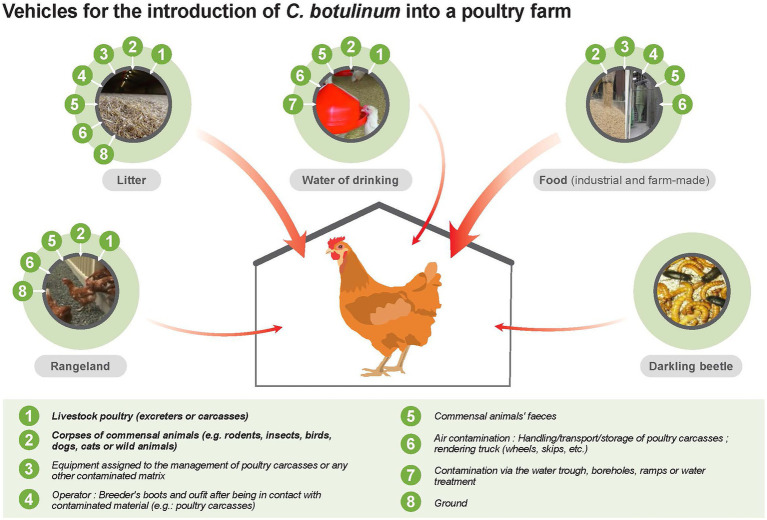
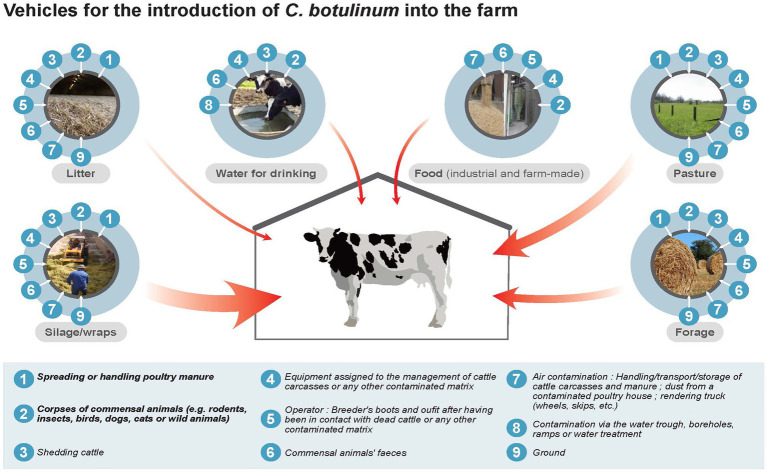
is the main causative agent of botulism, a neurological disease encountered in humans as well as animals. Nine types of botulinum neurotoxins (BoNTs) have been described so far. Amongst these "toxinotypes," the A, the B and E are the most frequently encountered in humans while the C, D, C/D and D/C are mostly affecting domestic and wild birds as well as cattle. In France for instance, many cases and outbreaks are reported in these animal species every year. However, underestimation is very likely at least for avifauna species where the detection of dead animals can be challenging. Knowledge about BoNTs C, D, C/D, and D/C and the diseases they cause in animals and humans is still scarce and unclear. Specifically, the potential role of animal botulism outbreaks in cattle and poultry as a source of human illness needs to be further assessed. In this narrative review, we present the current knowledge about toxinotypes C, D, C/D, and D/C in cattle and poultry with, amongst various other aspects, their epidemiological cycles. We also discuss the zoonotic potential of these toxinotypes and some possible ways of risk mitigation. An adapted and effective management of botulism outbreaks in livestock also requires a better understanding of these less common and known toxinotypes.
是肉毒中毒的主要病原体,肉毒中毒是一种在人类和动物中都有出现的神经疾病。迄今为止,已描述了九种肉毒杆菌神经毒素(BoNTs)。在这些“毒素型”中,A型、B型和E型在人类中最常出现,而C型、D型、C/D型和D/C型主要影响家禽和野鸟以及牛。例如,在法国,每年都有许多这些动物物种的病例和疫情报告。然而,至少对于鸟类来说,很可能存在低估情况,因为检测死鸟可能具有挑战性。关于BoNTs C型、D型、C/D型和D/C型及其在动物和人类中引起的疾病的知识仍然匮乏且不明确。具体而言,牛和家禽中动物肉毒中毒疫情作为人类疾病来源的潜在作用需要进一步评估。在这篇叙述性综述中,我们介绍了关于牛和家禽中毒素型C型、D型、C/D型和D/C型的现有知识,包括它们的流行病学循环等各个方面。我们还讨论了这些毒素型的人畜共患病潜力以及一些可能的风险缓解方法。对家畜肉毒中毒疫情进行适应性和有效的管理还需要更好地了解这些不太常见和已知的毒素型。