Department of Clinical Biochemistry, King's College Hospital NHS Foundation Trust, London, United Kingdom.
Contract R&D Department (Viapath), King's College Hospital NHS Foundation Trust, London, United Kingdom.
PLoS One. 2022 May 2;17(5):e0266652. doi: 10.1371/journal.pone.0266652. eCollection 2022.
Procalcitonin (PCT) is an acute-phase reactant with concentrations ≥0.5 μg/L indicative of possible bacterial infection in patients with SARS-CoV-2 infection (COVID-19). Some with severe COVID-19 develop cytokine storm secondary to virally driven hyper-inflammation. However, increased pro-inflammatory cytokines are also seen in bacterial sepsis. This study aimed to assess the clinical utility of a cytokine panel in the assessment of COVID-19 with bacterial superinfections along with PCT and C-reactive protein (CRP).
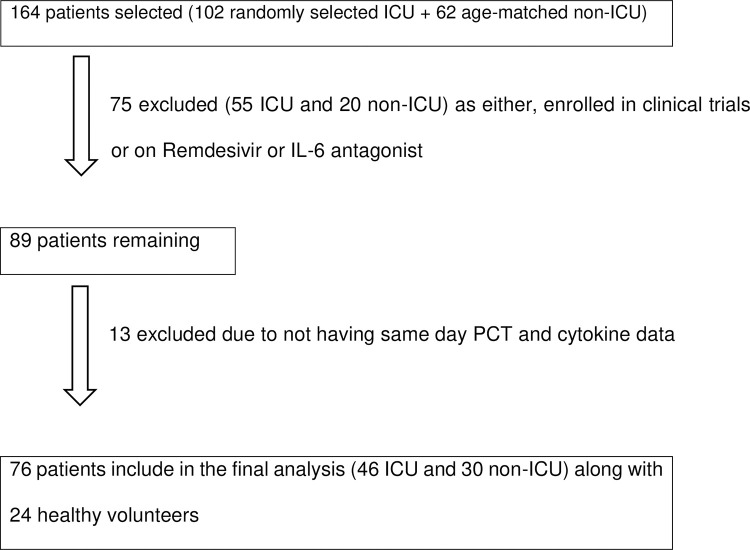
The retrospective analysis included serum cytokines (interleukins; IL-1β, IL-6, IL-8 and tumour necrosis factor (TNFα)) measured using Ella™ (Bio-Techne, Oxford, UK) and PCT measured by Roche Cobas (Burgess Hill, UK) in patients admitted with COVID-19 between March 2020 and January 2021. Patients enrolled into COVID-19 clinical trials, treated with Remdesivir/IL-6 inhibitors were excluded. The cytokine data was compared between intensive care unit (ICU) patients, age matched non-ICU patients and healthy volunteers as well as ICU patients with high and normal PCT (≥0.5 vs. <0.5 μg/L).
Cytokine concentrations and CRP were higher in COVID-19 patients (76; ICU & non-ICU) vs. healthy controls (n = 24), all p<0.0001. IL-6, IL-8, TNFα and were higher in ICU patients (n = 46) vs. non-ICU patients (n = 30) despite similar CRP. Among 46 ICU patients, the high PCT group (n = 26) had higher TNFα (p<0.01) and longer ICU stay (mean 47 vs. 25 days, p<0.05). There was no difference in CRP and blood/respiratory culture results between the groups.
Pro-inflammatory cytokines and PCT were higher in COVID-19 patients requiring ICU admission vs. non-ICU admissions despite no difference in CRP. Furthermore, TNFα was higher in those with high PCT and requiring longer ICU admission despite no difference in CRP or rate of bacterial superinfection.
降钙素原(PCT)是一种急性期反应物,浓度≥0.5μg/L 提示 SARS-CoV-2 感染(COVID-19)患者可能存在细菌感染。一些严重 COVID-19 患者因病毒驱动的过度炎症而发生细胞因子风暴。然而,在细菌性败血症中也会看到更多的促炎细胞因子。本研究旨在评估细胞因子谱在评估 COVID-19 合并细菌合并感染中的临床应用,同时评估 PCT 和 C 反应蛋白(CRP)。
回顾性分析包括 2020 年 3 月至 2021 年 1 月期间因 COVID-19 入院患者的血清细胞因子(白细胞介素;IL-1β、IL-6、IL-8 和肿瘤坏死因子(TNFα)),使用 Ella™(Bio-Techne,英国牛津)测量,并使用罗氏 Cobas(英国贝塞斯希尔)测量 PCT。排除入组 COVID-19 临床试验并接受瑞德西韦/IL-6 抑制剂治疗的患者。将细胞因子数据与 ICU 患者、年龄匹配的非 ICU 患者和健康志愿者以及 PCT 高值(≥0.5μg/L)和低值(<0.5μg/L)的 ICU 患者进行比较。
COVID-19 患者(76 例 ICU 和非 ICU 患者)与健康对照者(n=24)的细胞因子浓度和 CRP 均较高(均为 p<0.0001)。尽管 CRP 相似,但 ICU 患者(n=46)的 IL-6、IL-8 和 TNFα 均较高(n=46)。在 46 例 ICU 患者中,高 PCT 组(n=26)的 TNFα 较高(p<0.01),ICU 入住时间较长(均值 47 天 vs. 25 天,p<0.05)。两组之间 CRP 和血液/呼吸道培养结果无差异。
与非 ICU 入院患者相比,需要 ICU 入院的 COVID-19 患者的促炎细胞因子和 PCT 更高,尽管 CRP 无差异。此外,高 PCT 组和需要较长 ICU 入住时间的患者的 TNFα 较高,尽管 CRP 或细菌合并感染率无差异。