Department of Health Management and Policy, American University of Beirut, Beirut, Lebanon.
Center for Systematic Reviews on Health Policy and Systems Research (SPARK), American University of Beirut, Beirut, Lebanon.
BMJ Glob Health. 2022 May;7(5). doi: 10.1136/bmjgh-2021-007465.
To systematically identify and describe approaches to prioritise primary research topics in any health-related area.
We searched Medline and CINAHL databases and Google Scholar. Teams of two reviewers screened studies and extracted data in duplicate and independently. We synthesised the information across the included approaches by developing common categorisation of relevant concepts.
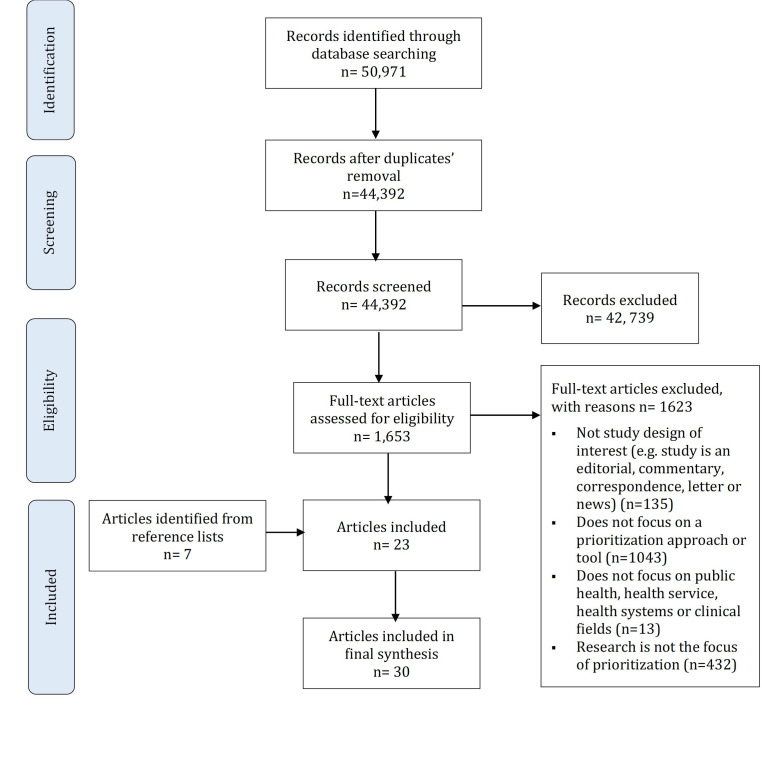
Of 44 392 citations, 30 articles reporting on 25 approaches were included, addressing the following fields: health in general (n=9), clinical (n=10), health policy and systems (n=10), public health (n=6) and health service research (n=5) (10 addressed more than 1 field). The approaches proposed the following aspects to be addressed in the prioritisation process: situation analysis/ environmental scan, methods for generation of initial list of topics, use of prioritisation criteria, stakeholder engagement, ranking process/technique, dissemination and implementation, revision and appeal mechanism, and monitoring and evaluation. Twenty-two approaches proposed involving stakeholders in the priority setting process. The most commonly proposed stakeholder category was 'researchers/academia' (n=17, 77%) followed by 'healthcare providers' (n=16, 73%). Fifteen of the approaches proposed a list of criteria for determining research priorities. We developed a common framework of 28 prioritisation criteria clustered into nine domains. The criterion most frequently mentioned by the identified approaches was 'health burden' (n=12, 80%), followed by 'availability of resources' (n=11, 73%).
We identified and described 25 prioritisation approaches for primary research topics in any health-related area. Findings highlight the need for greater participation of potential users (eg, policy-makers and the general public) and incorporation of equity as part of the prioritisation process. Findings can guide the work of researchers, policy-makers and funders seeking to conduct or fund primary health research. More importantly, the findings should be used to enhance a more coordinated approach to prioritising health research to inform decision making at all levels.
系统地识别和描述在任何与健康相关的领域中确定主要研究课题的方法。
我们检索了 Medline 和 CINAHL 数据库以及 Google Scholar。两组评审员重复筛选研究并独立提取数据。我们通过开发相关概念的通用分类,对纳入方法的信息进行综合。
在 44392 条引文,有 30 篇文章报道了 25 种方法,涵盖以下领域:一般健康(n=9)、临床(n=10)、卫生政策和系统(n=10)、公共卫生(n=6)和卫生服务研究(n=5)(10 种方法涉及不止一个领域)。这些方法提出了在优先排序过程中需要解决的以下方面:情况分析/环境扫描、初始主题列表生成方法、使用优先排序标准、利益相关者参与、排名过程/技术、传播和实施、修订和申诉机制以及监测和评估。有 22 种方法建议让利益相关者参与设定优先顺序的过程。最常提出的利益相关者类别是“研究人员/学术界”(n=17,77%),其次是“医疗保健提供者”(n=16,73%)。有 15 种方法提出了一套确定研究优先事项的标准。我们开发了一个共同的框架,将 28 个优先排序标准分为九个领域。被确定的方法中最常提到的标准是“健康负担”(n=12,80%),其次是“资源可用性”(n=11,73%)。
我们确定并描述了 25 种在任何与健康相关的领域中确定主要研究课题的方法。研究结果强调需要让潜在的使用者(例如决策者和公众)更多地参与,并将公平作为优先排序过程的一部分。研究结果可以为寻求开展或资助初级卫生研究的研究人员、决策者和资助者提供指导。更重要的是,这些结果应该用于增强更协调的方法来优先考虑卫生研究,以便在各级决策中提供信息。