Department of International Health, Johns Hopkins University Bloomberg School of Public Health, Baltimore, Maryland, USA
Department of International Health, Johns Hopkins University Bloomberg School of Public Health, Baltimore, Maryland, USA.
BMJ Glob Health. 2022 May;7(5). doi: 10.1136/bmjgh-2021-008069.
There are concerns about the impact of the COVID-19 pandemic on the continuation of essential health services in sub-Saharan Africa. Through the Countdown to 2030 for Women's, Children's and Adolescents' Health country collaborations, analysts from country and global public health institutions and ministries of health assessed the trends in selected services for maternal, newborn and child health, general service utilisation.
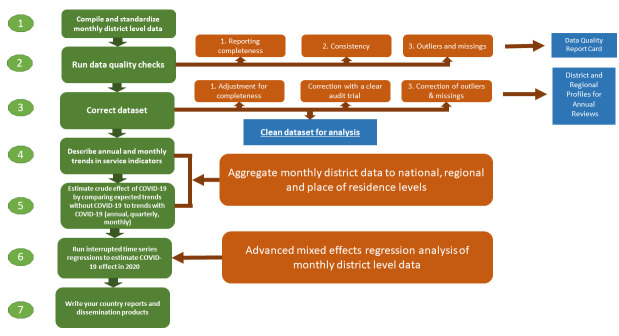
Monthly routine health facility data by district for the period 2017-2020 were compiled by 12 country teams and adjusted after extensive quality assessments. Mixed effects linear regressions were used to estimate the size of any change in service utilisation for each month from March to December 2020 and for the whole COVID-19 period in 2020.
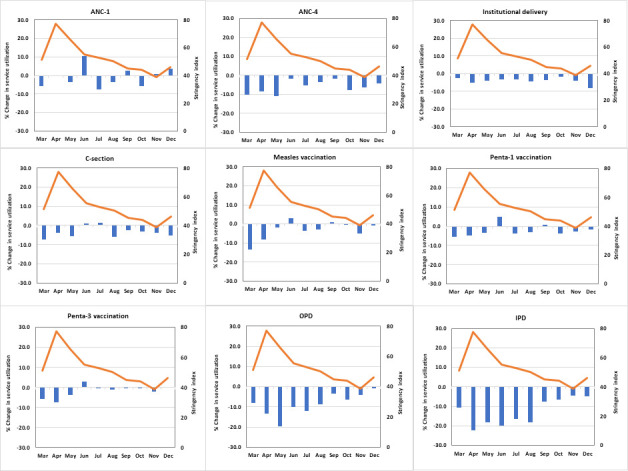
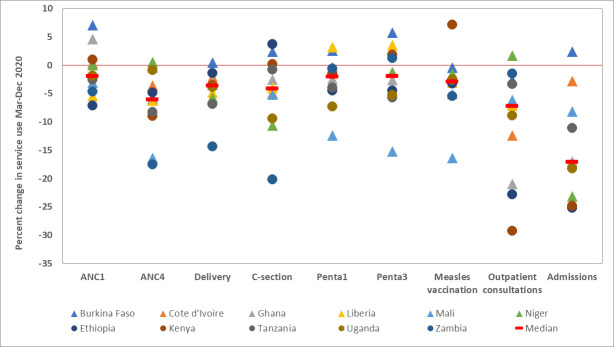
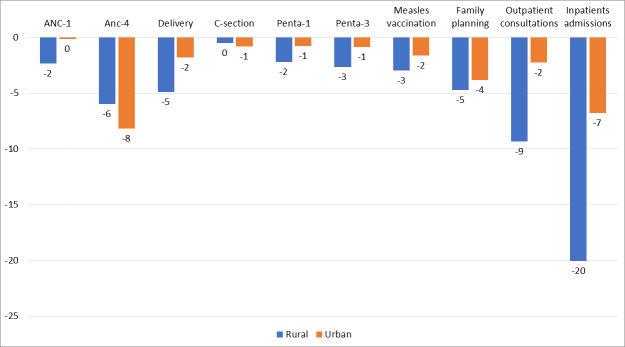
The completeness of reporting of health facilities was high in 2020 (median of 12 countries, 96% national and 91% of districts ≥90%), higher than in the preceding years and extreme outliers were few. The country median reduction in utilisation of nine health services for the whole period March-December 2020 was 3.9% (range: -8.2 to 2.4). The greatest reductions were observed for inpatient admissions (median=-17.0%) and outpatient admissions (median=-7.1%), while antenatal, delivery care and immunisation services generally had smaller reductions (median from -2% to -6%). Eastern African countries had greater reductions than those in West Africa, and rural districts were slightly more affected than urban districts. The greatest drop in services was observed for March-June 2020 for general services, when the response was strongest as measured by a stringency index.
The district health facility reports provide a solid basis for trend assessment after extensive data quality assessment and adjustment. Even the modest negative impact on service utilisation observed in most countries will require major efforts, supported by the international partners, to maintain progress towards the SDG health targets by 2030.
人们担心 COVID-19 大流行会对撒哈拉以南非洲基本卫生服务的持续提供产生影响。通过 2030 年倒计时促进妇女、儿童和青少年健康国家合作,来自国家和全球公共卫生机构及卫生部的分析人员评估了孕产妇、新生儿和儿童健康以及一般服务使用方面的选定服务的趋势。
12 个国家团队汇编了 2017-2020 年期间每个月的地区常规卫生机构数据,并在进行广泛质量评估后进行了调整。使用混合效应线性回归来估计 2020 年 3 月至 12 月每个月以及整个 COVID-19 期间(2020 年)服务使用情况的任何变化。
2020 年卫生机构报告的完整性很高(中位数为 12 个国家,全国有 96%、91%的地区报告完整率≥90%),高于前几年,极端异常值很少。2020 年 3 月至 12 月整个期间,9 项卫生服务利用率下降了 3.9%(范围:-8.2%至 2.4%)。最大的降幅出现在住院治疗(中位数=-17.0%)和门诊治疗(中位数=-7.1%),而产前、分娩护理和免疫服务的降幅通常较小(中位数为-2%至-6%)。东非国家的降幅大于西非国家,农村地区比城市地区受影响略大。2020 年 3 月至 6 月,综合服务的降幅最大,这一期间的响应措施最强,通过严格指数进行衡量。
经过广泛的数据质量评估和调整,地区卫生机构报告为趋势评估提供了坚实的基础。即使在大多数国家观察到的服务利用率适度负向影响,也需要在国际伙伴的支持下做出重大努力,以保持到 2030 年实现可持续发展目标健康指标的进展。