Department of Surgery, Indiana University, 545 Barnhill Dr., Emerson 125, Indianapolis, IN, United States.
Children's Wisconsin, Milwaukee, WI, United States.
J Pediatr Surg. 2022 Jul;57(7):1370-1376. doi: 10.1016/j.jpedsurg.2022.03.034. Epub 2022 Apr 12.
Firearm sales in the United States (U.S.) markedly increased during the COVID-19 pandemic. Our objective was to determine if firearm injuries in children were associated with stay-at-home orders (SHO) during the COVID-19 pandemic. We hypothesized there would be an increase in pediatric firearm injuries during SHO.
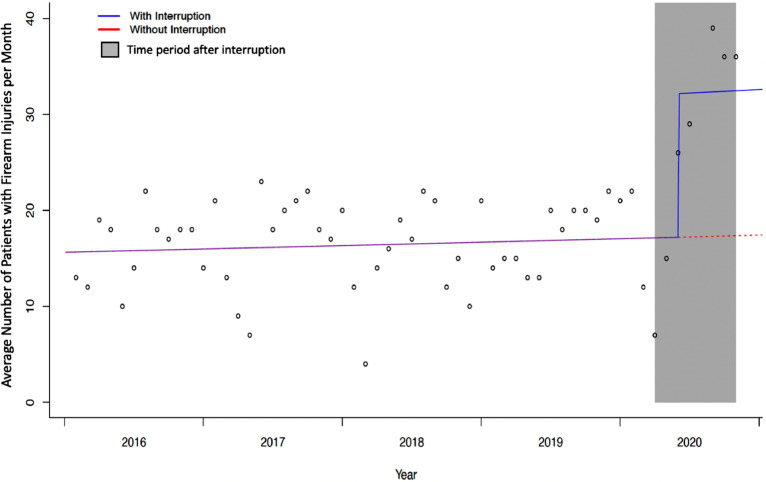
This was a multi institutional, retrospective study of institutional trauma registries. Patients <18 years with traumatic injuries meeting National Trauma Data Bank (NTDB) criteria were included. A "COVID" cohort, defined as time from initiation of state SHO through September 30, 2020 was compared to "Historical" controls from an averaged period of corresponding dates in 2016-2019. An interrupted time series analysis (ITSA) was utilized to evaluate the association of the U.S. declaration of a national state of emergency with pediatric firearm injuries.
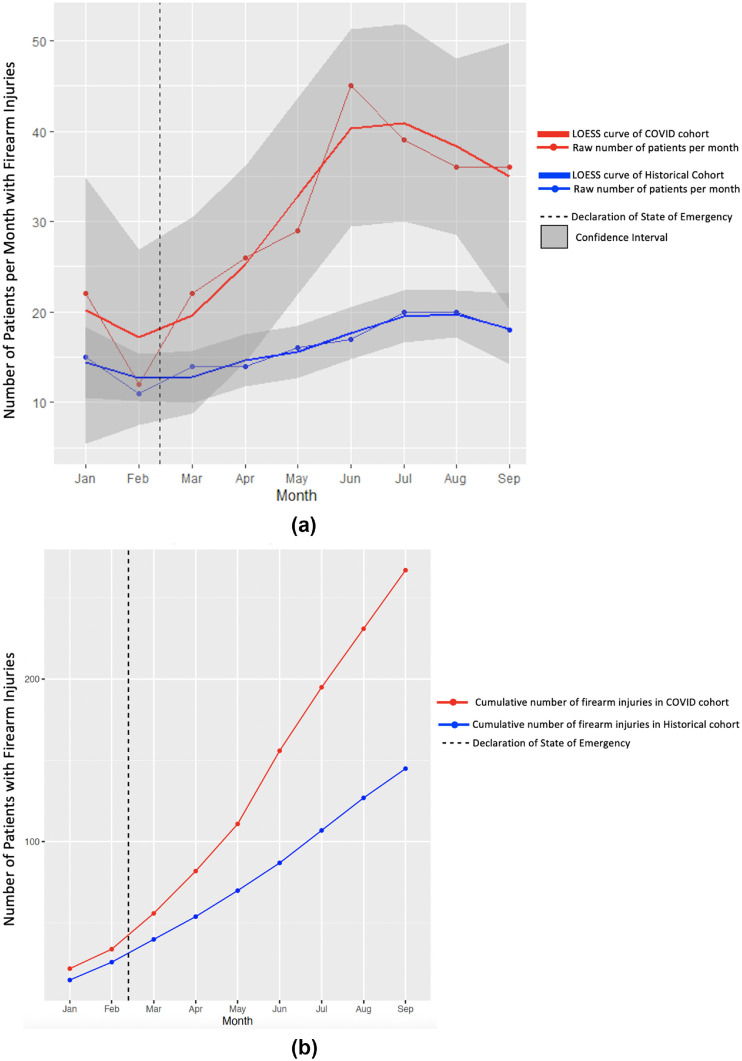
Nine Level I pediatric trauma centers were included, contributing 48,111 pediatric trauma patients, of which 1,090 patients (2.3%) suffered firearm injuries. There was a significant increase in the proportion of firearm injuries in the COVID cohort (COVID 3.04% vs. Historical 1.83%; p < 0.001). There was an increased cumulative burden of firearm injuries in 2020 compared to a historical average. ITSA showed an 87% increase in the observed rate of firearm injuries above expected after the declaration of a nationwide emergency (p < 0.001).
The proportion of firearm injuries affecting children increased during the COVID-19 pandemic. The pandemic was associated with an increase in pediatric firearm injuries above expected rates based on historical patterns.
在美国(U.S.),COVID-19 大流行期间枪支销售量显著增加。我们的目的是确定儿童枪支伤害是否与 COVID-19 大流行期间的居家令(SHO)有关。我们假设在 SHO 期间,儿科枪支伤害会增加。
这是一项多机构、回顾性研究,对机构创伤登记处进行了研究。纳入符合国家创伤数据库(NTDB)标准的<18 岁有创伤性损伤的患者。“COVID”队列定义为从启动州 SHO 到 2020 年 9 月 30 日的时间,与 2016-2019 年同期的“历史”对照进行比较。利用中断时间序列分析(ITSA)来评估美国宣布国家紧急状态与儿科枪支伤害的关联。
纳入了 9 个一级儿科创伤中心,共贡献了 48111 例儿科创伤患者,其中 1090 例(2.3%)患者遭受枪支伤害。COVID 队列中枪支伤害的比例显著增加(COVID 3.04% vs. Historical 1.83%;p<0.001)。与历史平均值相比,2020 年枪支伤害的累积负担增加。ITSA 显示,在宣布全国紧急状态后,观察到的枪支伤害率比预期高出 87%(p<0.001)。
COVID-19 大流行期间,影响儿童的枪支伤害比例增加。大流行与儿科枪支伤害的增加有关,高于基于历史模式的预期率。