Belay Daniel Gashaneh, Asratie Melaku Hunie, Gashaw Moges, Tsega Nuhamin Tesfa, Endalew Mastewal, Aragaw Fantu Mamo
Department of Human Anatomy, School of Medicine, College of Medicine and Health Sciences, University of Gondar, Gondar, Ethiopia.
Department of Epidemiology and Biostatistics, Institute of Public Health Health, College of Medicine and Health Sciences, University of Gondar, Gondar, Ethiopia.
BMC Public Health. 2022 May 2;22(1):872. doi: 10.1186/s12889-022-13249-y.
Soil-transmitted helminths caused millions of morbidity of preschool age children in sub-Saharan Africa with low socio-economic status and lack of clean water and sanitation. In Ethiopia, nearly half of children are affected by intestinal parasites. Despite this prevalence, deworming medication utilization among preschool age children is low. Hence, this study aimed to assess the community and individual level determinants and spatial distributions of deworming among preschool age children in Ethiopia.
Crossectional collected 2016 Ethiopian Demographic and Health Survey datasets with a total weighted 8146 children 12-59 months old were used for this study. The data were cleaned, extracted, and analyzed using STAT Version 16 software and exported to MS excel for spatial analysis. In addition, ArcGIS and SaTScan software were used to detect the geographic distribution of deworming utilization among preschool age children.
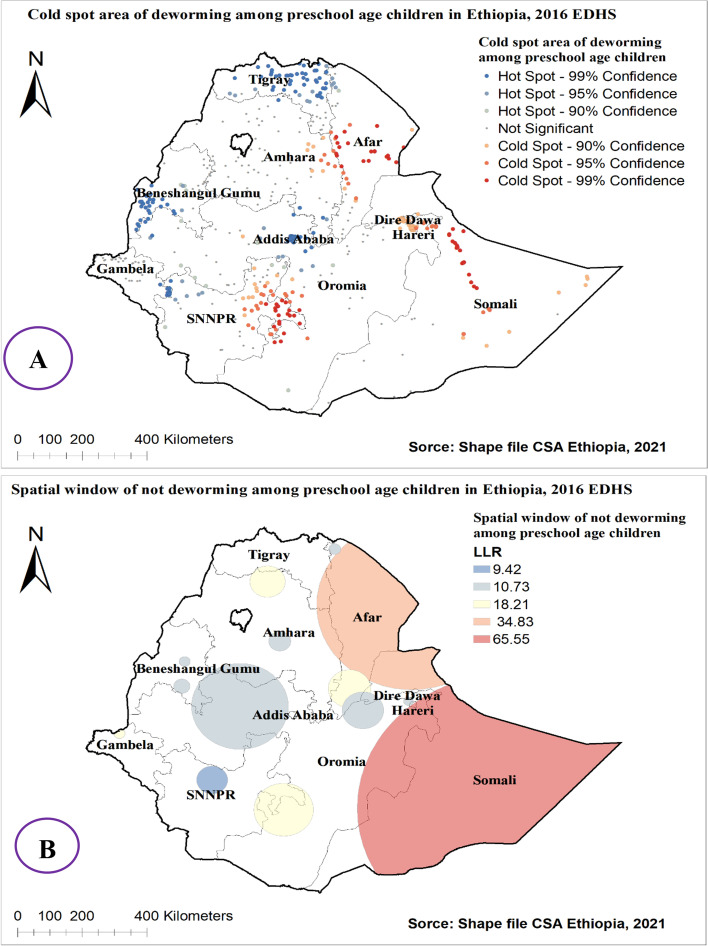
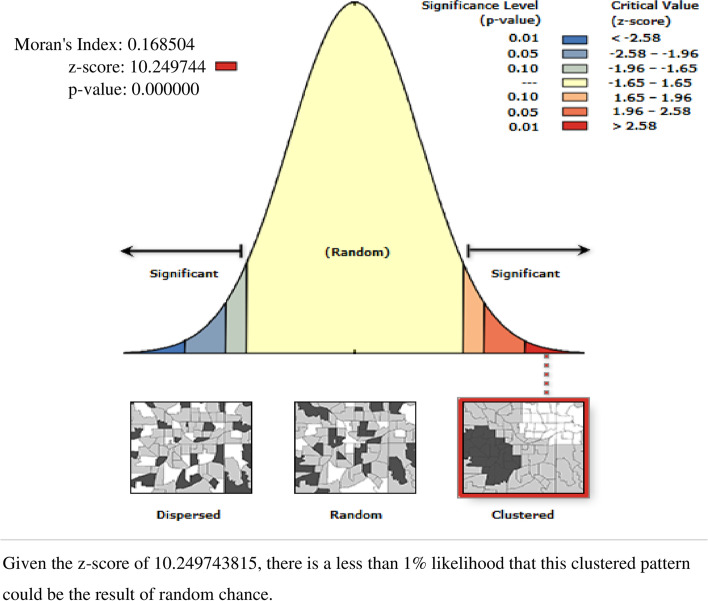
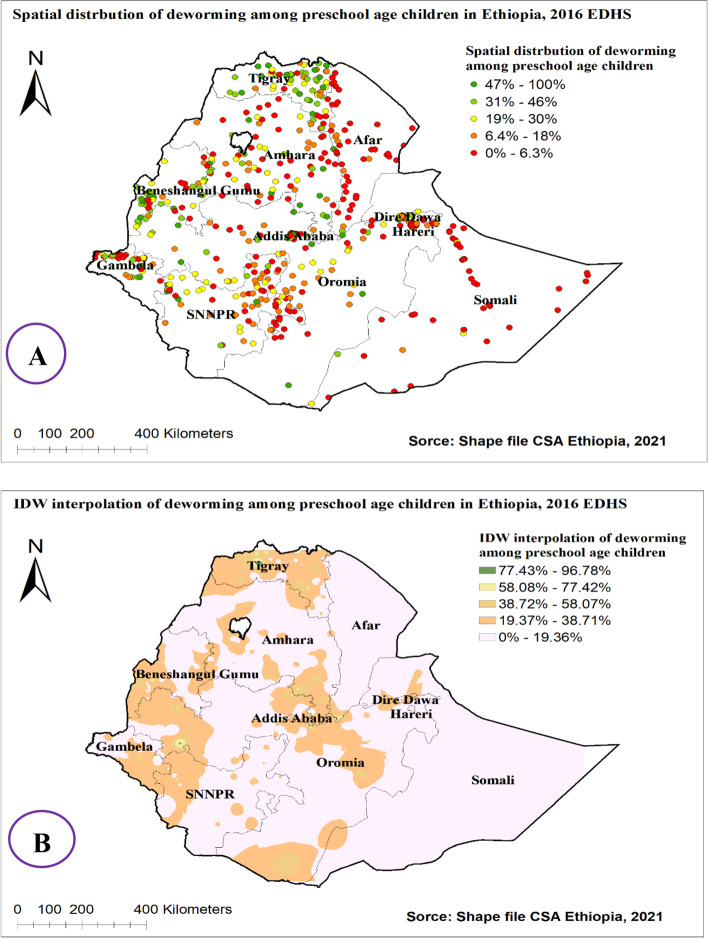
The magnitude of deworming among preschool age children in Ethiopia was 13.32% (95% CI: 12.60, 14.08) and ranges from the lowest 3.34% (95% CI: 1.01, 10.45) Afar region to the highest 28.66% (95% CI:24.95, 32.69) Tigray region. In multilevel multivariable logistics regression analysis; variables such as secondary and above women education [AOR = 1.89; 95%CI; 1.32, 2.73], women who have occupation [AOR = 1.47; 95%CI; 1.23, 1.76], child with 12-23 months old [AOR = 2.00; 95%CI; 1.62, 2.46], having ANC visit [AOR = 1.68; 95%CI; 1.35, 2.08], households that have media exposure [AOR = 1.50; 95%CI; 1.22, 1.85] were significantly associated with deworming among preschool age children. Afar, Eastern Amhara, Dire Dewa, Harari, Somalia, and Eastern SNNPE regions were cold spot regions with Global Moran's I value 0.268 (p < 0.0001) for deworming of preschool age children.
The prevalence of deworming among preschool age children in Ethiopia is relatively low. Individual-level factors such as; maternal education and occupation, having ANC visit, child age, household media exposure, and community-level variables such as; community media usage had a significant association with deworming among preschool age children in Ethiopia. These findings highlight that, the Ministry of Health (MOH) Ethiopia should prepare a regular campaign for deworming programs for preschool age children. Mass media promotion of deworming should be strengthened. The Ministry of Education should work to strengthen women's education, household and community media exposure. Prior attention should be given to low deworming regions such as Afar, Somalia, Diredewa, and Harari regions.
在撒哈拉以南非洲地区,社会经济地位低下且缺乏清洁水和卫生设施,土壤传播的蠕虫导致数百万学龄前儿童患病。在埃塞俄比亚,近一半的儿童受到肠道寄生虫的影响。尽管患病率如此之高,但学龄前儿童中驱虫药物的使用率却很低。因此,本研究旨在评估埃塞俄比亚学龄前儿童驱虫的社区和个体层面的决定因素及空间分布。
本研究使用了2016年埃塞俄比亚人口与健康调查数据集,共收集了8146名12至59个月大儿童的加权数据。使用STAT版本16软件对数据进行清理、提取和分析,并导出到MS excel进行空间分析。此外,使用ArcGIS和SaTScan软件来检测学龄前儿童驱虫使用率的地理分布。
埃塞俄比亚学龄前儿童的驱虫率为13.32%(95%置信区间:12.60,14.08),范围从阿法尔地区最低的3.34%(95%置信区间:1.01,10.45)到提格雷地区最高的28.66%(95%置信区间:24.95,32.69)。在多水平多变量逻辑回归分析中;诸如初中及以上学历的女性[AOR = 1.89;95%置信区间;1.32,2.73]、有职业的女性[AOR = 1.47;95%置信区间;1.23,1.76]、12至23个月大的儿童[AOR = 2.00;95%置信区间;1.62,2.46]、进行过产前检查[AOR = 1.68;95%置信区间;1.35,2.08]、有媒体接触的家庭[AOR = 1.50;95%置信区间;1.22,1.85]等变量与学龄前儿童的驱虫显著相关。阿法尔、东阿姆哈拉、德雷达瓦、哈拉里、索马里和东南方民族走廊地区是学龄前儿童驱虫的冷点地区,全局莫兰指数I值为0.268(p < 0.0001)。
埃塞俄比亚学龄前儿童的驱虫率相对较低。个体层面的因素如;母亲的教育程度和职业、进行过产前检查、儿童年龄、家庭媒体接触,以及社区层面变量如;社区媒体使用情况,与埃塞俄比亚学龄前儿童的驱虫有显著关联。这些发现突出表明,埃塞俄比亚卫生部应为学龄前儿童的驱虫计划开展定期宣传活动。应加强对驱虫的大众媒体宣传。教育部应努力加强妇女教育、家庭和社区的媒体接触。应优先关注阿法尔、索马里、德雷达瓦和哈拉里等驱虫率较低的地区。