Faculty of Social Sciences, Tampere University, Tampere, Finland.
Department of Accounting, Universidad Autónoma de Madrid, Madrid, Spain.
Health Res Policy Syst. 2022 May 2;20(1):49. doi: 10.1186/s12961-022-00856-9.
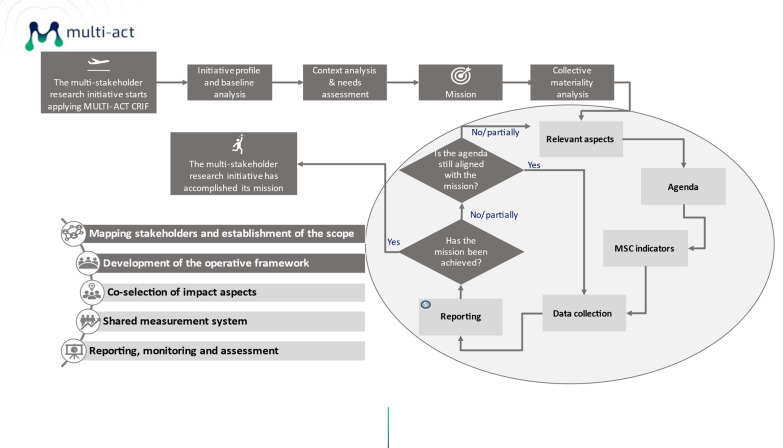
The need to more collaboratively measure the impact of health research and to do so from multidimensional perspectives has been acknowledged. A scorecard was developed as part of the Collective Research Impact Framework (CRIF), to engage stakeholders in the assessment of the impacts of health research and innovations. The purpose of this study was to describe the developmental process of the MULTI-ACT Master Scorecard (MSC) and how it can be used as a workable tool for collectively assessing future responsible research and innovation measures.
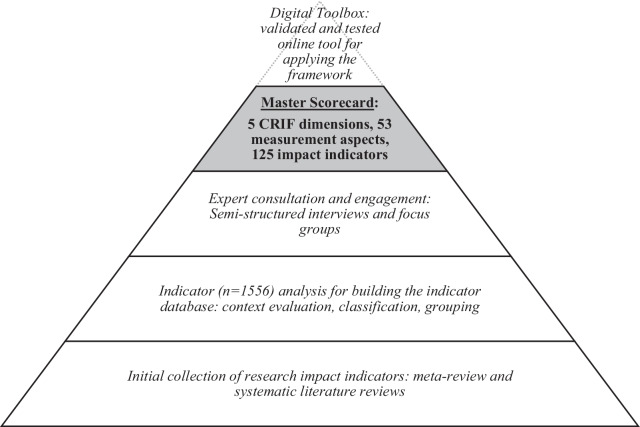
An extensive review of the health research impact literature and of multistakeholder initiatives resulted in a database of 1556 impact indicators. The MSC was then cocreated by engaging key stakeholders and conducting semi-structured interviews of experts in the field.
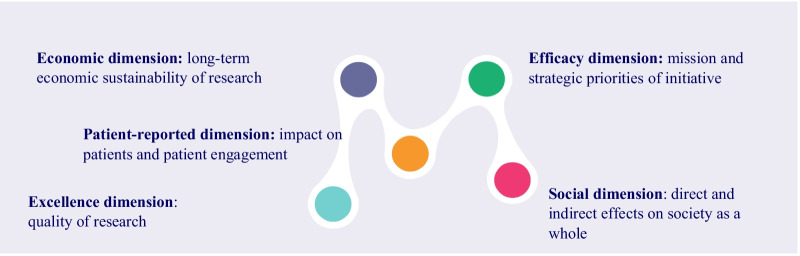
The MSC consists of five accountability dimensions: excellence, efficacy, economic, social and patient-reported outcomes. The tool contains 125 potential indicators, classified into 53 impact measurement aspects that are considered the most relevant topics for multistakeholder research and innovation initiatives when assessing their impact on the basis of their mission and their stakeholders' interests. The scorecard allows the strategic management of multistakeholder research initiatives to demonstrate their impact on people and society. The value of the tool is that it is comprehensive, customizable and easy to use.
The MSC is an example of how the views of society can be taken into account when research impacts are assessed in a more sustainable and balanced way. The engagement of patients and other stakeholders is an integral part of the CRIF, facilitating collaborative decision-making in the design of policies and research agendas. In policy making, the collective approach allows the evaluation perspective to be extended to the needs of society and towards responsible research and innovation. Multidimensionality makes research and innovations more responsive to systemic challenges, and developing more equitable and sustainable health services.
人们已经认识到,需要更具协作性地衡量健康研究的影响,并从多维角度来衡量。作为集体研究影响框架(CRIF)的一部分,制定了记分卡,以让利益相关者参与评估健康研究和创新的影响。本研究旨在描述多活动主记分卡(MSC)的开发过程,以及如何将其用作共同评估未来负责任的研究和创新措施的可行工具。
对健康研究影响文献和多利益攸关方举措进行广泛审查,生成了 1556 个影响指标数据库。然后,通过让关键利益攸关方参与并对该领域的专家进行半结构化访谈,共同创建了 MSC。
MSC 由五个问责维度组成:卓越、疗效、经济、社会和患者报告的结果。该工具包含 125 个潜在指标,分为 53 个影响衡量方面,当根据使命和利益相关者的利益评估对多利益攸关方研究和创新举措的影响时,这些方面被认为是最相关的主题。记分卡允许对多利益攸关方研究举措进行战略管理,以展示其对人民和社会的影响。该工具的价值在于它全面、可定制且易于使用。
MSC 是在更可持续和平衡的方式评估研究影响时如何考虑社会观点的一个例子。让患者和其他利益攸关方参与是 CRIF 的一个组成部分,有助于在政策和研究议程的设计中进行协作决策。在政策制定中,集体方法可以将评估视角扩展到社会的需求,并促进负责任的研究和创新。多维性使研究和创新更能应对系统性挑战,发展更公平和可持续的卫生服务。