Saito Taku
Sensory & Motor System Medicine, Graduate School of Medicine, The University of Tokyo, 7-3-1 Hongo, Bunkyo-ku, Tokyo, 113-8655, Japan.
Inflamm Regen. 2022 May 2;42(1):14. doi: 10.1186/s41232-022-00202-0.
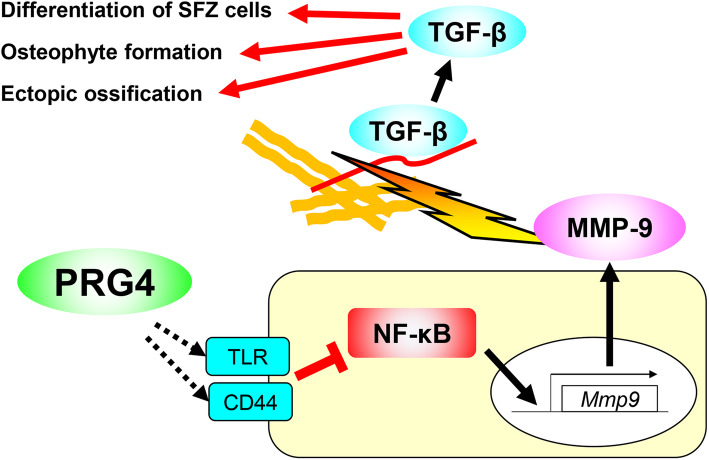
The superficial zone of articular cartilage contributes to smooth joint motion through the production of proteoglycan 4 (PRG4), also known as lubricin. Recent studies indicate novel effects of PRG4 as a signaling molecule, other than a simple extracellular matrix protein. Additionally, the accumulating evidence displays that various molecules and signaling pathways are involved in regulating the superficial zone and PRG4 expression. In addition, Prg4-expressing cells include a progenitor population of articular chondrocytes. Several non-clinical and clinical studies have shown that PRG4 and related molecules are promising candidates for disease-modifying drugs for treating osteoarthritis. Since PRG4 is also expressed in the synovium, tendons, and ligaments, further studies of PRG4-related pathways and PRG4-positive cells may elucidate the mechanisms underlying joint homeostasis.
关节软骨的表层区域通过产生蛋白聚糖4(PRG4,也称为润滑素)促进关节的平滑运动。最近的研究表明,PRG4除了作为一种简单的细胞外基质蛋白外,还具有作为信号分子的新作用。此外,越来越多的证据表明,各种分子和信号通路参与调节表层区域和PRG4的表达。此外,表达Prg4的细胞包括关节软骨细胞的祖细胞群体。多项非临床和临床研究表明,PRG4及相关分子有望成为治疗骨关节炎的疾病改善药物。由于PRG4也在滑膜、肌腱和韧带中表达,对PRG4相关通路和PRG4阳性细胞的进一步研究可能会阐明关节稳态的潜在机制。