Oleinikov Andrew V
Charles E. Schmidt College of Medicine, Florida Atlantic University, Boca Raton, FL 33428, USA.
Biochemistry (Mosc). 2022 Jan;87(Suppl 1):S192-S177. doi: 10.1134/S0006297922140152.
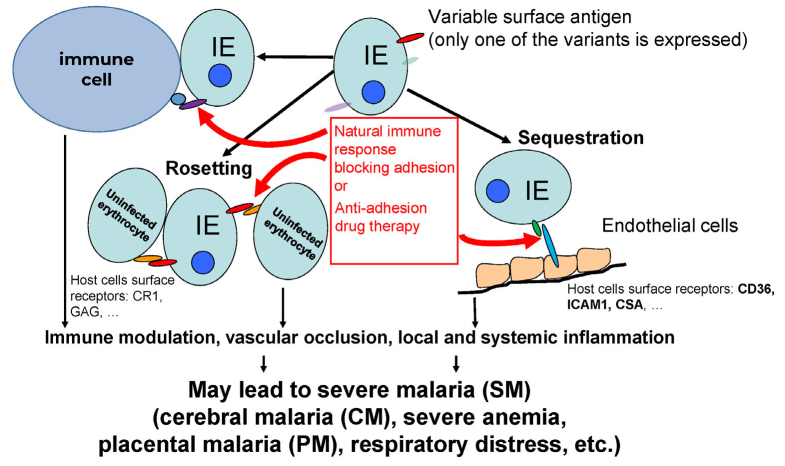
Specific adhesion (sequestration) of Plasmodium falciparum parasite-infected erythrocytes (IEs) in deep vascular beds can cause severe complications resulting in death. This review describes our work on the discovery, characterization, and optimization of novel inhibitors that specifically prevent adhesion of IEs to the host vasculature during severe malaria, especially its placental and cerebral forms. The main idea of using anti-adhesion drugs in severe malaria is to release sequestered parasites (or prevent additional sequestration) as quickly as possible. This may significantly improve the outcomes for patients with severe malaria by decreasing local and systemic inflammation associated with the disease and reestablishing the microvascular blood flow. To identify anti-malarial adhesion-inhibiting molecules, we have developed a high-throughput (HT) screening approach and found a number of promising leads that can be further developed into anti-adhesion drugs providing an efficient adjunct therapy against severe forms of malaria.
恶性疟原虫感染的红细胞(IEs)在深部血管床中的特异性黏附(滞留)可导致严重并发症,甚至死亡。本综述介绍了我们在发现、表征和优化新型抑制剂方面的工作,这些抑制剂可在重症疟疾,尤其是胎盘型和脑型疟疾期间特异性阻止IEs与宿主血管系统的黏附。在重症疟疾中使用抗黏附药物的主要目的是尽快释放滞留的寄生虫(或防止进一步滞留)。这可能通过减少与该疾病相关的局部和全身炎症并重建微血管血流,显著改善重症疟疾患者的治疗结果。为了鉴定抗疟疾黏附抑制分子,我们开发了一种高通量(HT)筛选方法,并发现了一些有前景的先导化合物,可进一步开发成抗黏附药物,为重症疟疾提供有效的辅助治疗。