Yang Yuqin, Miao Junjie, Yin Zhendong, Hao Weili, Shi Hongmei, Ma Ling, Shi Tiesheng
Hebei Key Laboratory of Environment and Human Health, School of Public Health, Hebei Medical University, Shijiazhuang 050017, Hebei, China.
Chemical Laboratory, Shijiazhuang Center for Disease Control and Prevention, Shijiazhuang 050011, Hebei, China.
Bioinorg Chem Appl. 2022 Apr 23;2022:6453609. doi: 10.1155/2022/6453609. eCollection 2022.
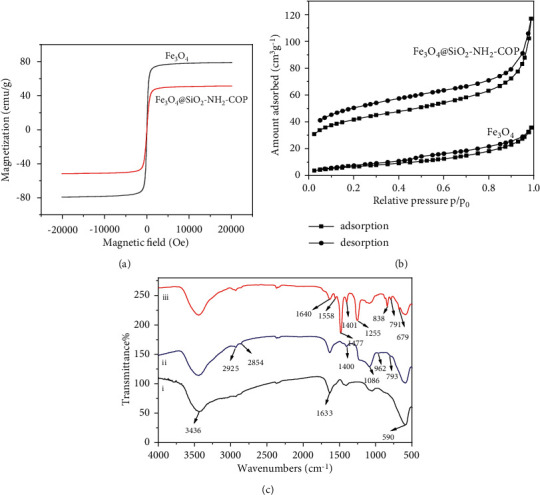
Efficient extractions of trace antibiotic residues in the environment are a key factor for accurate quantification of the residues. A new nanoporous material, namely, magnetically covalent organic polymer (MCOP, FeO@SiO-NH-COP) was synthesized in this work and was used for magnetic solid-phase extraction (MSPE). The combination of MSPE with high-performance liquid chromatography separation together with ultraviolet detection (HPLC-UV) was established as an effective method for the determination of four sulfonamide (SA) residues in surface water surrounding a cattle farm. The synthesized magnetic material was characterized by SEM, TEM, FT-IR, magnetic properties measurement system (MPMS), and nitrogen gas porosimetry. The material possessed many attractive features, such as a unique microporous structure, a larger specific surface area (137.93 m·g) than bare FeO (24.84 m·g), high saturation magnetization (50.5 emu·g), open adsorption sites, and high stability. The influencing parameters, including pH, the used amount of MCOPs, the type of eluent, adsorption solution, and desorption time, were optimized. Under the optimized conditions, the method conferred good linearity ranges ( ≥ 0.9990), low detection limits (/ = 3, LOD, 0.10-0.25 g·L), and satisfactory recoveries (79.7% to 92.2%). The enrichment factor (EF) for the four SAs was 34.13-38.86. The relative standard deviations of intraday ( = 5) and of interday ( = 3) were less than 4.8% and 8.9%, respectively. The equilibria between extraction and desorption for SAs could be reached within 150 s. The proposed method was sensitive and convenient for detecting SA residues in complex environmental matrices, and the successful application of the new MCOPs as an adsorbent was demonstrated.
高效提取环境中的痕量抗生素残留是准确定量这些残留的关键因素。本研究合成了一种新型纳米多孔材料,即磁性共价有机聚合物(MCOP,FeO@SiO-NH-COP),并将其用于磁性固相萃取(MSPE)。建立了MSPE与高效液相色谱分离及紫外检测(HPLC-UV)相结合的方法,用于测定奶牛场周边地表水中的四种磺胺类(SA)残留。通过扫描电子显微镜(SEM)、透射电子显微镜(TEM)、傅里叶变换红外光谱(FT-IR)、磁性测量系统(MPMS)和氮气孔隙率测定法对合成的磁性材料进行了表征。该材料具有许多吸引人的特性,如独特的微孔结构、比裸FeO(24.84 m²·g⁻¹)更大的比表面积(137.93 m²·g⁻¹)、高饱和磁化强度(50.5 emu·g⁻¹)、开放的吸附位点和高稳定性。对包括pH值、MCOPs用量、洗脱剂类型、吸附溶液和解吸时间在内的影响参数进行了优化。在优化条件下,该方法具有良好的线性范围(R²≥0.9990)、低检测限(S/N = 3,LOD,0.10 - 0.25 μg·L⁻¹)和令人满意的回收率(79.7%至92.2%)。四种SA的富集因子(EF)为34.13 - 38.86。日内(n = 5)和日间(n = 3)的相对标准偏差分别小于4.8%和8.9%。SA的萃取和解吸平衡可在150 s内达到。该方法灵敏且方便用于检测复杂环境基质中的SA残留,并证明了新型MCOPs作为吸附剂的成功应用。