
在英国,SARS-CoV-2 的 Delta 变异株迅速被奥密克戎(B.1.1.529)取代。
The rapid replacement of the SARS-CoV-2 Delta variant by Omicron (B.1.1.529) in England.
机构信息
Data Science and Analytics, U.K. Health Security Agency, Nobel House, London SW1P 3JR, UK.
出版信息
Sci Transl Med. 2022 Jul 6;14(652):eabo5395. doi: 10.1126/scitranslmed.abo5395.
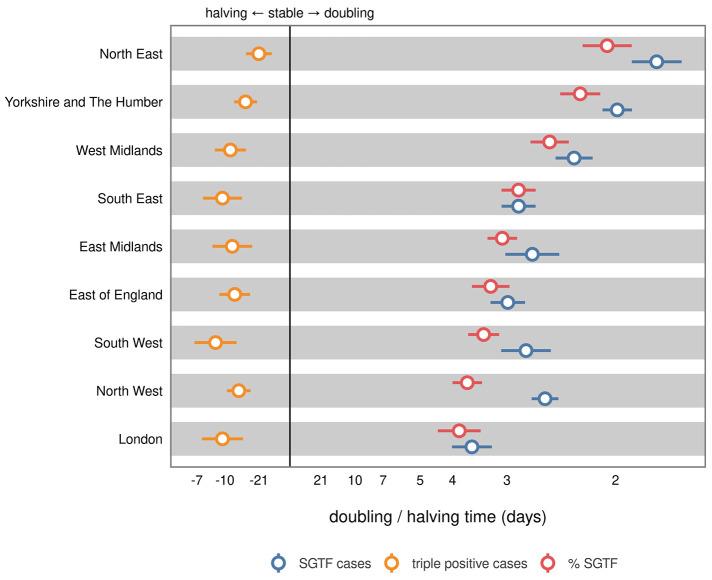
The emergence of the severe acute respiratory syndrome coronavirus 2 (SARS-CoV-2) B.1.1.529 (Omicron) variant caused international concern due to its rapid spread in Southern Africa. It was unknown whether this variant would replace or coexist with (either transiently or long term) the then-dominant Delta variant on its introduction to England. We developed a set of hierarchical logistic growth models to describe changes in the frequency of gene target failure (SGTF) PCR tests, a proxy for Omicron. The doubling time of SGTF cases peaked at 1.56 days (95% CI: 1.49 to 1.63) on 5 December, whereas triple-positive cases were halving every 5.82 days (95% CI: 5.11 to 6.67) going into Christmas 2021. We were unable to characterize the replacement of Delta by Omicron with a single rate. The replacement rate decreased by 53.56% (95% CrI: 45.38 to 61.01) between 14 and 15 December, meaning the competitive advantage of Omicron approximately halved. Preceding the changepoint, Omicron was replacing Delta 16.24% (95% CrI: 9.72 to 23.41) faster in those with two or more vaccine doses, indicative of vaccine escape being a substantial component of competitive advantage. Despite the slowdown, Delta was almost entirely replaced in England within a month of the first sequenced domestic case. The synchrony of changepoints across regions at various stages of Omicron epidemics suggests that the growth rate advantage was not attenuated because of biological mechanisms related to strain competition. The step change in replacement could have resulted from behavioral changes, potentially elicited by public health messaging or policies, that differentially affected Omicron.
严重急性呼吸综合征冠状病毒 2 (SARS-CoV-2) B.1.1.529 (Omicron) 变体的出现引起了国际关注,因为它在南非迅速传播。尚不清楚这种变体在引入英国时是否会取代或与(暂时或长期)当时占主导地位的 Delta 变体共存。我们开发了一套层次逻辑增长模型来描述基因靶标失败 (SGTF) PCR 检测频率的变化,这是 Omicron 的一个替代指标。SGTF 病例的倍增时间在 12 月 5 日达到峰值,为 1.56 天(95%CI:1.49 至 1.63),而三重阳性病例在 2021 年圣诞节进入时每 5.82 天(95%CI:5.11 至 6.67)减半。我们无法用单一速率来描述 Delta 被 Omicron 取代的情况。在 12 月 14 日至 15 日期间,Delta 被 Omicron 取代的替代率下降了 53.56%(95%CrI:45.38 至 61.01),这意味着 Omicron 的竞争优势大约减半。在转折点之前,对于接种两剂或更多疫苗的人来说,Omicron 取代 Delta 的速度快 16.24%(95% CrI:9.72 至 23.41),这表明疫苗逃逸是竞争优势的一个重要组成部分。尽管速度有所放缓,但在英国首次检测到本土病例后的一个月内,Delta 几乎完全被取代。在 Omicron 流行的各个阶段,不同地区的转折点同步表明,由于与菌株竞争相关的生物学机制,增长率优势并没有减弱。替代率的阶跃变化可能是由于公共卫生信息或政策引起的行为变化,这些变化可能对 Omicron 产生不同的影响。




 Zotero 插件