Fraser Hamish S F, Mugisha Michael, Remera Eric, Ngenzi Joseph Lune, Richards Janise, Santas Xenophon, Naidoo Wayne, Seebregts Christopher, Condo Jeanine, Umubyeyi Aline
Brown Center for Biomedical Informatics, Brown University, Providence, RI, United States.
School of Public Health, University of Rwanda, Kigali, Rwanda.
JMIR Med Inform. 2022 May 3;10(5):e32305. doi: 10.2196/32305.
Electronic health records (EHRs) have been implemented in many low-resource settings but lack strong evidence for usability, use, user confidence, scalability, and sustainability.
This study aimed to evaluate staff use and perceptions of an EHR widely used for HIV care in >300 health facilities in Rwanda, providing evidence on factors influencing current performance, scalability, and sustainability.
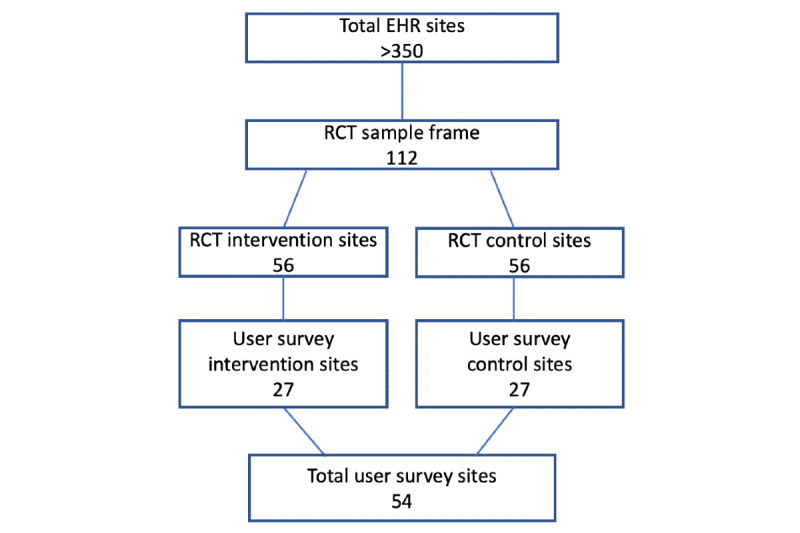
A randomized, cross-sectional, structured interview survey of health center staff was designed to assess functionality, use, and attitudes toward the EHR and clinical alerts. This study used the associated randomized clinical trial study sample (56/112, 50% sites received an enhanced EHR), pulling 27 (50%) sites from each group. Free-text comments were analyzed thematically using inductive coding.
Of the 100 participants, 90 (90% response rate) were interviewed at 54 health centers: 44 (49%) participants were clinical and 46 (51%) were technical. The EHR top uses were to access client data easily or quickly (62/90, 69%), update patient records (56/89, 63%), create new patient records (49/88, 56%), generate various reports (38/85, 45%), and review previous records (43/89, 48%). In addition, >90% (81/90) of respondents agreed that the EHR made it easier to make informed decisions, was worth using, and has improved patient information quality. Regarding availability, (66/88) 75% said they could always or almost always count on the EHR being available, whereas (6/88) 7% said never/almost never. In intervention sites, staff were significantly more likely to update existing records (P=.04), generate summaries before (P<.001) or during visits (P=.01), and agree that "the EHR provides useful alerts, and reminders" (P<.01).
Most users perceived the EHR as well accepted, appropriate, and effective for use in low-resource settings despite infrastructure limitation in 25% (22/88) of the sites. The implementation of EHR enhancements can improve the perceived usefulness and use of key functions. Successful scale-up and use of EHRs in small health facilities could improve clinical documentation, care, reporting, and disease surveillance in low- and middle-income countries.
电子健康记录(EHRs)已在许多资源匮乏地区实施,但在可用性、使用情况、用户信心、可扩展性和可持续性方面缺乏有力证据。
本研究旨在评估卢旺达300多家医疗机构广泛用于艾滋病毒护理的电子健康记录的工作人员使用情况和看法,为影响当前绩效、可扩展性和可持续性的因素提供证据。
设计了一项针对健康中心工作人员的随机、横断面、结构化访谈调查,以评估对电子健康记录和临床警报的功能、使用情况及态度。本研究使用了相关随机临床试验研究样本(56/112,50%的站点接受了增强型电子健康记录),从每组中抽取27个(50%)站点。使用归纳编码对自由文本评论进行主题分析。
在100名参与者中,90名(90%的回复率)在54家健康中心接受了访谈:44名(49%)参与者是临床人员,46名(51%)是技术人员。电子健康记录的主要用途是轻松或快速访问客户数据(62/90,69%)、更新患者记录(56/89,63%)、创建新患者记录(49/88,56%)、生成各种报告(38/85,45%)以及查看以前的记录(43/89,48%)。此外,超过90%(81/90)的受访者同意电子健康记录使做出明智决策更容易,并值得使用,且提高了患者信息质量。关于可用性,75%(66/88)的人表示他们总是或几乎总是可以指望电子健康记录可用,而7%(6/88)的人表示从不/几乎从不。在干预站点,工作人员更有可能更新现有记录(P = 0.04),在就诊前(P < 0.001)或就诊期间(P = 0.01)生成摘要,并同意 “电子健康记录提供有用的警报和提醒”(P < 0.01)。
尽管25%(22/88)的站点存在基础设施限制,但大多数用户认为电子健康记录在资源匮乏地区易于接受、适用且有效。增强电子健康记录的实施可以提高关键功能的感知有用性和使用率。在小型医疗机构成功扩大电子健康记录的规模并加以使用,可以改善低收入和中等收入国家的临床记录、护理、报告和疾病监测。