Department of Large and Small Animal Clinical Sciences, College of Veterinary Medicine, Institute of Food and Agricultural Science, University of Florida, Gainesville, FL, 32611, USA.
Department of Microbiology and Cell Science, College of Agricultural and Life Sciences, University of Florida, Museum Road Building 981, PO Box 110700, Gainesville, USA.
Sci Rep. 2022 May 3;12(1):7177. doi: 10.1038/s41598-022-11338-x.
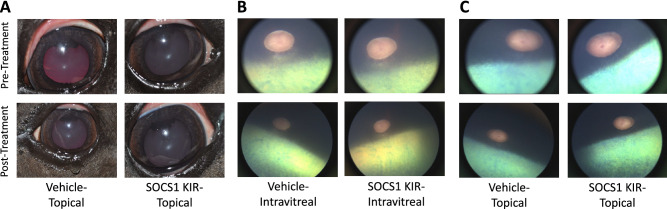
Equine recurrent uveitis (ERU) is a painful and debilitating autoimmune disease and represents the only spontaneous model of human recurrent uveitis (RU). Despite the efficacy of existing treatments, RU remains a leading cause of visual handicap in horses and humans. Cytokines, which utilize Janus kinase 2 (Jak2) for signaling, drive the inflammatory processes in ERU that promote blindness. Notably, suppressor of cytokine signaling 1 (SOCS1), which naturally limits the activation of Jak2 through binding interactions, is often deficient in autoimmune disease patients. Significantly, we previously showed that topical administration of a SOCS1 peptide mimic (SOCS1-KIR) mitigated induced rodent uveitis. In this pilot study, we test the potential to translate the therapeutic efficacy observed in experimental rodent uveitis to equine patient disease. Through bioinformatics and peptide binding assays we demonstrate putative binding of the SOCS1-KIR peptide to equine Jak2. We also show that topical, or intravitreal injection of SOCS1-KIR was well tolerated within the equine eye through physical and ophthalmic examinations. Finally, we show that topical SOCS1-KIR administration was associated with significant clinical ERU improvement. Together, these results provide a scientific rationale, and supporting experimental evidence for the therapeutic use of a SOCS1 mimetic peptide in RU.
马属复发性葡萄膜炎(ERU)是一种痛苦且使人虚弱的自身免疫性疾病,是唯一可自发产生的人类复发性葡萄膜炎(RU)的动物模型。尽管现有治疗方法有效,但 RU 仍是导致马和人类视力障碍的主要原因。细胞因子通过 Janus 激酶 2(Jak2)进行信号转导,推动 ERU 中的炎症过程,导致失明。值得注意的是,细胞因子信号转导抑制因子 1(SOCS1)通过结合相互作用自然限制 Jak2 的激活,在自身免疫性疾病患者中通常缺乏。重要的是,我们之前表明,局部施用 SOCS1 肽模拟物(SOCS1-KIR)可减轻诱导的啮齿动物葡萄膜炎。在这项初步研究中,我们测试了将在实验性啮齿动物葡萄膜炎中观察到的治疗功效转化为马属动物患者疾病的潜力。通过生物信息学和肽结合测定,我们证明了 SOCS1-KIR 肽与马 Jak2 的假定结合。我们还表明,SOCS1-KIR 的局部或玻璃体内注射通过物理和眼科检查在马眼中具有良好的耐受性。最后,我们表明局部 SOCS1-KIR 给药与 ERU 的显著临床改善相关。总之,这些结果为 RU 中使用 SOCS1 模拟肽的治疗提供了科学依据和实验证据支持。