Department of Pharmacology & Toxicology, College of Pharmacy, University of Arizona, Tucson, Arizona, USA.
Department of Physiology, College of Medicine, University of Arizona, Tucson, Arizona, USA.
Clin Transl Sci. 2022 Jul;15(7):1599-1605. doi: 10.1111/cts.13292. Epub 2022 May 16.
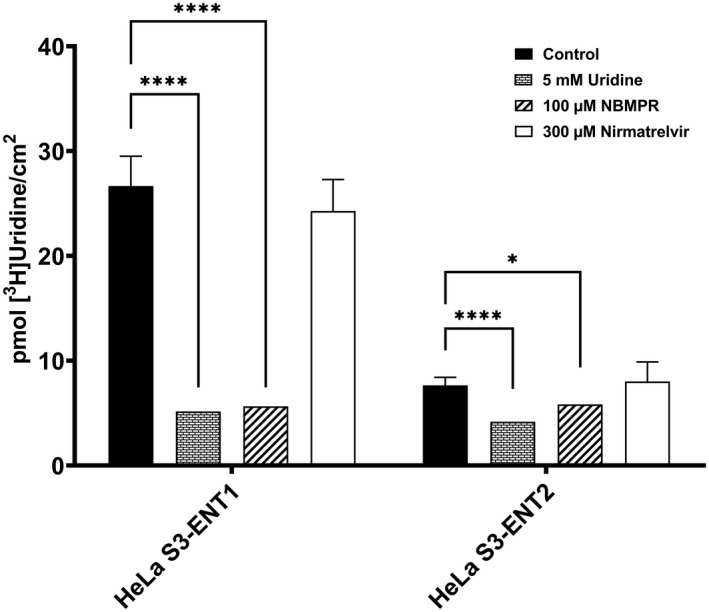
The ongoing pandemic of severe acute respiratory syndrome-coronavirus 2 (SARS-CoV-2) and subsequently, coronavirus disease 2019 (COVID-19), has led to the deaths of over 6.1 million people and sparked a greater interest in virology to expedite the development process for antivirals. The US Food and Drug Administration (FDA) granted emergency use authorization for three antivirals: remdesivir, molnupiravir, and nirmatrelvir. Remdesivir and molnupiravir are nucleoside analogs that undergo biotransformation to form active metabolites that incorporate into new viral RNA to stall replication. Unlike remdesivir or molnupiravir, nirmatrelvir is a protease inhibitor that covalently binds to the SARS-CoV-2 3C-like protease to interrupt the viral replication cycle. A recent study identified that remdesivir and the active metabolite of molnupiravir, EIDD-1931, are substrates of equilibrative nucleoside transporters 1 and 2 (ENT1 and 2). Despite the ubiquitous expression of the ENTs, the preclinical efficacy of remdesivir and molnupiravir is not reflected in wide-scale SARS-CoV-2 clinical trials. Interestingly, downregulation of ENT1 and ENT2 expression has been shown in lung epithelial and endothelial cells in response to hypoxia and acute lung injury, although it has not been directly studied in patients with COVID-19. It is possible that the poor efficacy of remdesivir and molnupiravir in these patients may be partially attributed to the repression of ENTs in the lungs, but further studies are warranted. This study investigated the interaction between nirmatrelvir and the ENTs and found that it was a poor inhibitor of ENT-mediated [ H]uridine uptake at 300 μM. Unlike for remdesivir or EIDD-1931, ENT activity is unlikely to be a factor for nirmatrelvir disposition in humans; however, whether this contributes to the similar in vitro and clinical efficacy will require further mechanistic studies.
持续的严重急性呼吸系统综合征冠状病毒 2 (SARS-CoV-2) 大流行,随后出现的 2019 年冠状病毒病 (COVID-19),导致超过 610 万人死亡,并激发了人们对病毒学的更大兴趣,以加速抗病毒药物的开发进程。美国食品和药物管理局 (FDA) 紧急批准了三种抗病毒药物:瑞德西韦、莫努匹韦和奈玛特韦。瑞德西韦和莫努匹韦是核苷类似物,经生物转化形成活性代谢物,掺入新的病毒 RNA 中以阻止复制。与瑞德西韦或莫努匹韦不同,奈玛特韦是一种蛋白酶抑制剂,它与 SARS-CoV-2 3C 样蛋白酶共价结合,从而中断病毒复制周期。最近的一项研究表明,瑞德西韦和莫努匹韦的活性代谢物 EIDD-1931 是平衡核苷转运蛋白 1 和 2 (ENT1 和 2) 的底物。尽管 ENTs 广泛表达,但瑞德西韦和莫努匹韦的临床前疗效并未在广泛的 SARS-CoV-2 临床试验中得到体现。有趣的是,在低氧和急性肺损伤时,肺上皮细胞和内皮细胞中已显示 ENT1 和 ENT2 表达下调,尽管尚未直接在 COVID-19 患者中进行研究。在这些患者中,瑞德西韦和莫努匹韦疗效不佳,可能部分归因于肺部 ENT 的抑制,但需要进一步的研究。本研究调查了奈玛特韦与 ENTs 的相互作用,发现它在 300μM 时对 ENT 介导的 [ H]尿苷摄取的抑制作用较差。与瑞德西韦或 EIDD-1931 不同,ENT 活性不太可能是奈玛特韦在人体内处置的一个因素;然而,这是否有助于类似的体外和临床疗效,还需要进一步的机制研究。