Department of Microbiology, Chungbuk National University College of Medicine and Medical Research Institute, Cheongju, Chungbuk, 28644, South Korea.
Department of Pathology, Chungbuk National University Hospital, Cheongju, South Korea.
Antiviral Res. 2022 Dec;208:105430. doi: 10.1016/j.antiviral.2022.105430. Epub 2022 Oct 6.
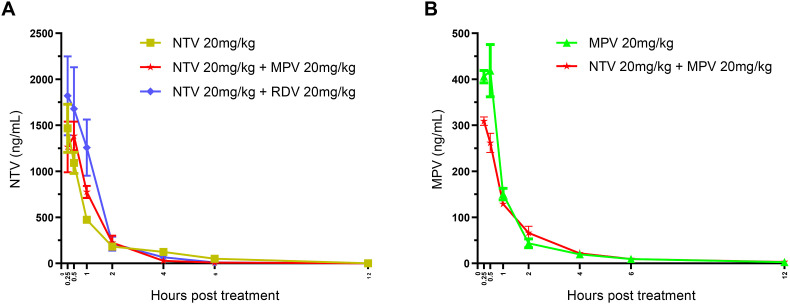
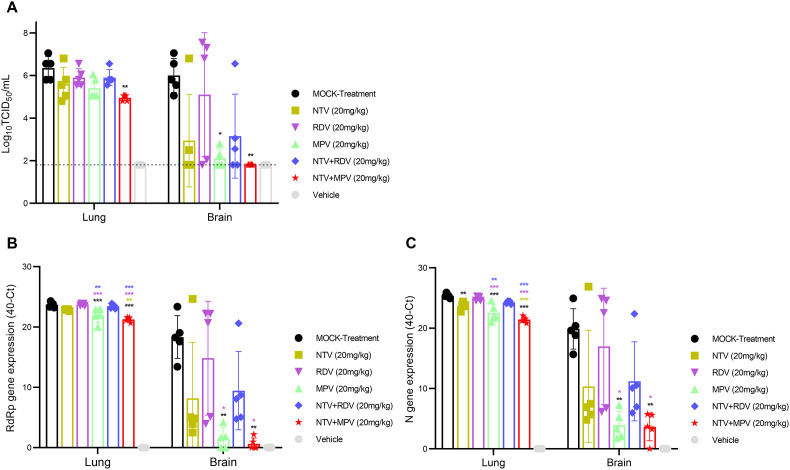
As the SARS-CoV-2 pandemic remains uncontrolled owing to the continuous emergence of variants of concern, there is an immediate need to implement the most effective antiviral treatment strategies, especially for risk groups. Here, we evaluated the therapeutic potency of nirmatrelvir, remdesivir and molnupiravir, and their combinations in SARS-CoV-2 infected K18-hACE2 transgenic mice. Systemic treatment of mice with each drug (20 mg/kg) resulted in slightly enhanced antiviral efficacy and yielded an increased life expectancy of only about 20-40% survival. However, combination therapy with nirmatrelvir (20 mg/kg) and molnupiravir (20 mg/kg) in lethally infected mice showed profound inhibition of SARS-CoV-2 replication in both the lung and brain and synergistically improved survival rates up to 80% compared to those with nirmatrelvir (36%, P < 0.001) and molnupiravir (43%, P < 0.001) administered alone. This combination therapy effectively reduced clinical severity score, virus-induced tissue damage, and viral distribution compared to those in animals treated with these monotherapies. Furthermore, all these assessments associated with this combination were also significantly higher than that of mice receiving remdesivir monotherapy (P < 0.001) and the nirmatrelvir (20 mg/kg) and remdesivir (20 mg/kg) combination (P < 0.001), underscored the clinical significance of this combination. By contrast, the nirmatrelvir and remdesivir combination showed less antiviral efficacy, with lower survival compared to nirmatrelvir monotherapy due to the insufficient plasma exposure of the remdesivir, demonstrating the inefficient therapeutic effect of this combination in the mouse model. The combination therapy with nirmatrelvir and molnupiravir contributes to alleviated morbidity and mortality, which can serve as a basis for the design of clinical studies of this combination in the treatment of COVID-19 patients.
由于不断出现令人关注的变异株,SARS-CoV-2 大流行仍未得到控制,因此急需实施最有效的抗病毒治疗策略,特别是针对高危人群。在这里,我们评估了尼马曲韦、瑞德西韦和莫努匹韦及其组合在感染 SARS-CoV-2 的 K18-hACE2 转基因小鼠中的治疗效果。每种药物(20mg/kg)全身治疗小鼠后,抗病毒效果略有增强,仅使预期寿命延长约 20-40%。然而,在致死性感染的小鼠中,尼马曲韦(20mg/kg)和莫努匹韦(20mg/kg)联合治疗可显著抑制 SARS-CoV-2 在肺部和脑部的复制,并协同提高生存率,达到 80%,与单独使用尼马曲韦(36%,P<0.001)和莫努匹韦(43%,P<0.001)相比。与单独使用这些单药治疗的动物相比,这种联合治疗可有效降低临床严重程度评分、病毒引起的组织损伤和病毒分布。此外,与接受瑞德西韦单药治疗的小鼠相比(P<0.001),以及与接受尼马曲韦(20mg/kg)和瑞德西韦(20mg/kg)联合治疗的小鼠相比(P<0.001),所有这些评估与这种联合治疗相关的指标都显著更高,突出了这种联合治疗的临床意义。相比之下,由于瑞德西韦的血浆暴露不足,尼马曲韦和瑞德西韦联合治疗的抗病毒效果较差,生存率也低于尼马曲韦单药治疗,表明这种联合治疗在小鼠模型中的治疗效果不佳。尼马曲韦和莫努匹韦联合治疗可减轻发病率和死亡率,可为设计 COVID-19 患者治疗的这种联合治疗的临床研究提供依据。