Song Hailiang, Hu Hongxia
Beijing Fisheries Research Institute & Beijing Key Laboratory of Fishery Biotechnology Beijing China.
Evol Appl. 2021 Jul 17;15(4):578-590. doi: 10.1111/eva.13262. eCollection 2022 Apr.
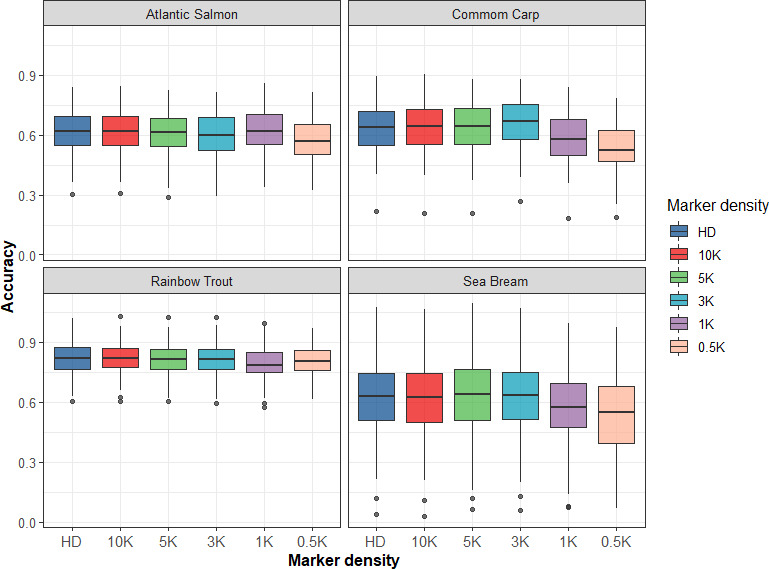
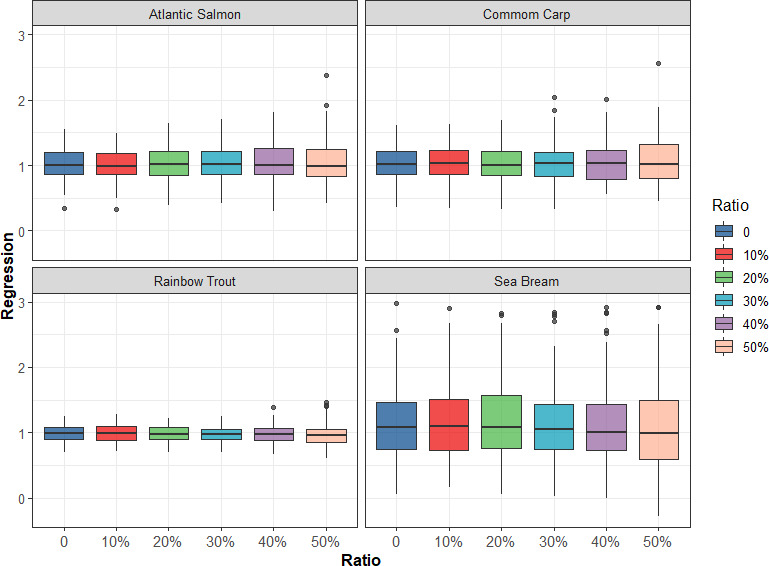
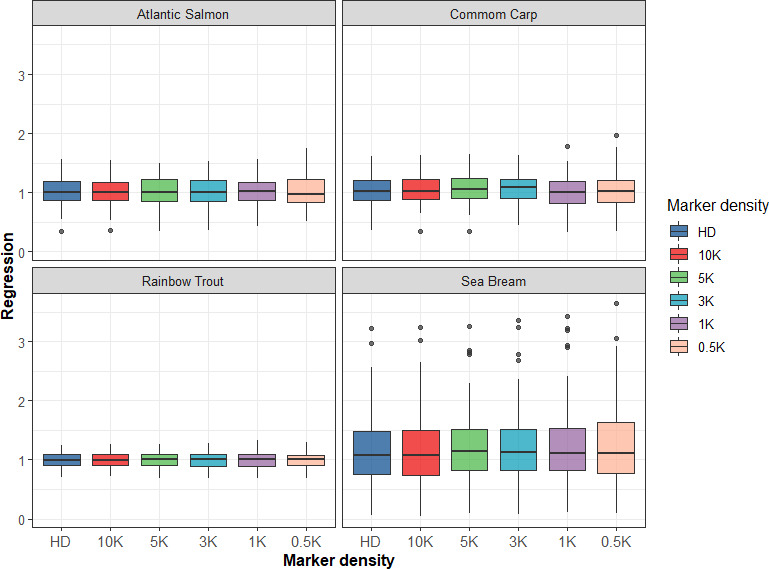
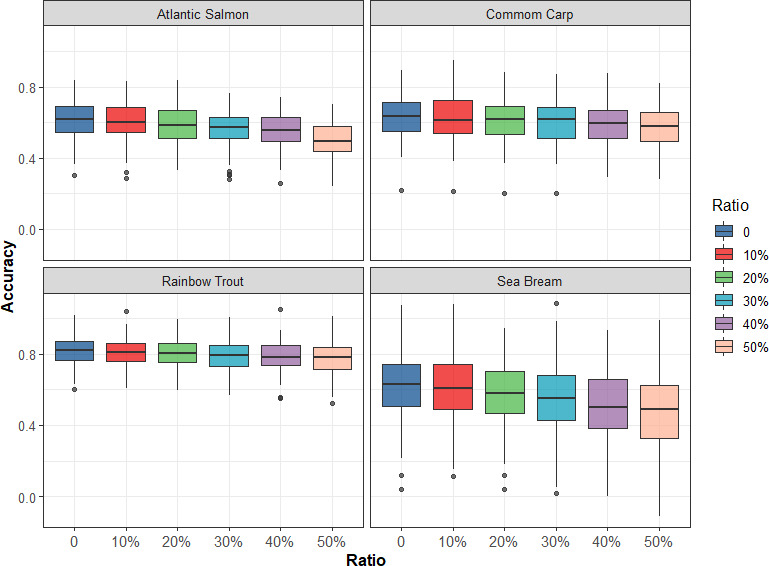
Genomic selection (GS) has great potential to increase genetic gain in aquaculture breeding; however, its implementation is hindered owing to high genotyping cost and the large number of individuals to genotype. This study investigated the efficiency of genomic prediction in four aquaculture species. In total, 749 to 1481 individuals with records for disease resistance and growth traits were genotyped using SNP arrays ranging from 12K to 40K. We compared the prediction accuracies and bias of breeding values obtained from BLUP, genomic BLUP (GBLUP), Bayesian mixture (BayesR), weighted GBLUP (WGBLUP), and genomic feature BLUP (GFBLUP). For GFBLUP, the genomic feature matrix was constructed based on prior information from genome-wide association studies. Fivefold cross-validation was performed with 20 replicates. Moreover, to reduce the cost of GS, we reduced the SNP density based on linkage disequilibrium as well as the reference population size. The results showed that the methods with marker information produced more accurate predictions than the pedigree-based BLUP method. For the genomic model, BayesR performed prediction with a similar or higher accuracy compared to GBLUP. For the four traits, WGBLUP yielded an average of 1.5% higher accuracy than GBLUP. However, the accuracy of genomic prediction decreased by an average of 6.2% for GFBLUP compared to GBLUP. When the density of SNP panels was reduced to 3K, which was sufficient to obtain accuracies similar to those using the whole dataset in the four species, the cost of GS was estimated to be 50% lower than that of genotyping all animals with high-density panels. In addition, when the reference population size was reduced by 10%, evenly from full-sib family, the accuracy of genomic prediction was almost unchanged, and the cost reduction was 8% in the four populations. Our results have important implications for translating the benefits of GS to most aquaculture species.
基因组选择(GS)在提高水产养殖育种中的遗传增益方面具有巨大潜力;然而,由于基因分型成本高昂以及需要进行基因分型的个体数量众多,其应用受到了阻碍。本研究调查了四种水产养殖物种的基因组预测效率。总共对749至1481个具有抗病性和生长性状记录的个体使用了从12K到40K的SNP芯片进行基因分型。我们比较了从BLUP、基因组BLUP(GBLUP)、贝叶斯混合模型(BayesR)、加权GBLUP(WGBLUP)和基因组特征BLUP(GFBLUP)获得的育种值的预测准确性和偏差。对于GFBLUP,基因组特征矩阵是基于全基因组关联研究的先验信息构建的。进行了20次重复的五倍交叉验证。此外,为了降低GS的成本,我们基于连锁不平衡以及参考群体大小降低了SNP密度。结果表明,与基于系谱的BLUP方法相比,具有标记信息的方法产生了更准确的预测。对于基因组模型,BayesR与GBLUP相比,预测准确性相似或更高。对于这四个性状,WGBLUP的平均准确性比GBLUP高1.5%。然而,与GBLUP相比,GFBLUP的基因组预测准确性平均降低了6.2%。当SNP芯片密度降低到3K时,这足以在这四个物种中获得与使用整个数据集相似的准确性,GS的成本估计比使用高密度芯片对所有动物进行基因分型的成本低50%。此外,当参考群体大小从全同胞家系均匀减少10%时,基因组预测的准确性几乎没有变化,四个群体的成本降低了8%。我们的结果对于将GS的益处应用于大多数水产养殖物种具有重要意义。