Department of Radiology, Breast Imaging Service, Memorial Sloan Kettering Cancer Center, 300 E 66th Street, New York, NY, 10065, USA.
Department of Epidemiology and Biostatistics, Memorial Sloan Kettering Cancer Center, 485 Lexington Ave, NY, New York, 10017, USA.
Eur Radiol. 2022 Oct;32(10):6588-6597. doi: 10.1007/s00330-022-08833-0. Epub 2022 May 4.
To perform a survey among all European Society of Breast Imaging (EUSOBI) radiologist members to gather representative data regarding the clinical use of breast DWI.
An online questionnaire was developed by two board-certified radiologists, reviewed by the EUSOBI board and committees, and finally distributed among EUSOBI active and associated (not based in Europe) radiologist members. The questionnaire included 20 questions pertaining to technical preferences (acquisition time, magnet strength, breast coils, number of b values), clinical indications, imaging evaluation, and reporting. Data were analyzed using descriptive statistics, the Chi-square test of independence, and Fisher's exact test.
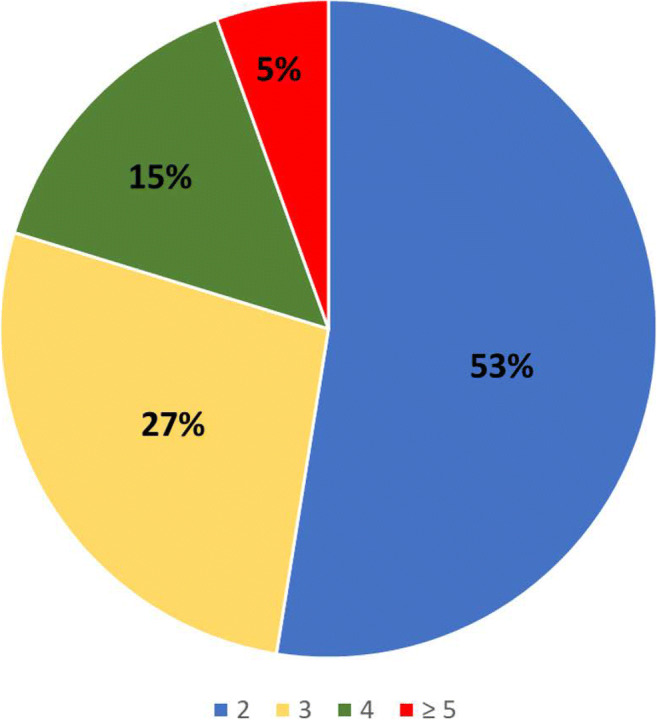
Of 1411 EUSOBI radiologist members, 275/1411 (19.5%) responded. Most (222/275, 81%) reported using DWI as part of their routine protocol. Common indications for DWI include lesion characterization (using an ADC threshold of 1.2-1.3 × 10 mm/s) and prediction of response to chemotherapy. Members most commonly acquire two separate b values (114/217, 53%), with b value = 800 s/mm being the preferred value for appraisal among those acquiring more than two b values (71/171, 42%). Most did not use synthetic b values (169/217, 78%). While most mention hindered diffusion in the MRI report (161/213, 76%), only 142/217 (57%) report ADC values.
The utilization of DWI in clinical practice among EUSOBI radiologists who responded to the survey is generally in line with international recommendations, with the main application being the differentiation of benign and malignant enhancing lesions, treatment response assessment, and prediction of response to chemotherapy. Report integration of qualitative and quantitative DWI data is not uniform.
• Clinical performance of breast DWI is in good agreement with the current recommendations of the EUSOBI International Breast DWI working group. • Breast DWI applications in clinical practice include the differentiation of benign and malignant enhancing, treatment response assessment, and prediction of response to chemotherapy. • Report integration of DWI results is not uniform.
对所有欧洲乳腺影像学会(EUSOBI)放射科医师成员进行调查,以收集关于乳腺 DWI 临床应用的代表性数据。
由两名经过董事会认证的放射科医师开发在线问卷,由 EUSOBI 董事会和委员会进行审查,最后分发给 EUSOBI 活跃成员和相关(不在欧洲的)成员。问卷包括 20 个问题,涉及技术偏好(采集时间、磁场强度、乳腺线圈、b 值数量)、临床指征、成像评估和报告。使用描述性统计、独立性卡方检验和 Fisher 精确检验进行数据分析。
在 1411 名 EUSOBI 放射科医师成员中,有 275/1411(19.5%)做出回应。大多数(222/275,81%)报告将 DWI 作为其常规方案的一部分。DWI 的常见指征包括病变特征(使用 1.2-1.3×10 mm/s 的 ADC 阈值)和预测化疗反应。成员最常获取两个单独的 b 值(114/217,53%),在获取两个以上 b 值的情况下,b 值=800 s/mm 是最受欢迎的评估值(71/171,42%)。大多数人不使用合成 b 值(169/217,78%)。虽然大多数人在 MRI 报告中提到扩散受限(161/213,76%),但只有 142/217(57%)报告 ADC 值。
在回应调查的 EUSOBI 放射科医师中,DWI 在临床实践中的应用通常符合国际建议,主要应用是区分良性和恶性强化病变、治疗反应评估和预测化疗反应。定性和定量 DWI 数据的报告整合并不统一。
乳腺 DWI 的临床性能与 EUSOBI 国际乳腺 DWI 工作组的现行建议基本一致。
乳腺 DWI 在临床实践中的应用包括良性和恶性强化病变的鉴别、治疗反应评估和预测化疗反应。
DWI 结果的报告整合并不统一。