Hiroshima University, Graduate School of Biomedical and Health Sciences, Department of Oral and Maxillofacial Surgery, Hiroshima, Japan.
Hiroshima University, Graduate School of Biomedical and Health Sciences, Program of Oral Health Sciences, Department of Public Oral Health, Hiroshima, Japan.
J Appl Oral Sci. 2022 Apr 29;30:e20210321. doi: 10.1590/1678-7757-2021-0321. eCollection 2022.
Although oral fibroblasts are thought to have the potential to enhance host defenses against Candida albicans , it is unknown whether they are able to recognize Candida cell components to increase the expression of antifungal peptides, such as defensin factors, against Candida infection.
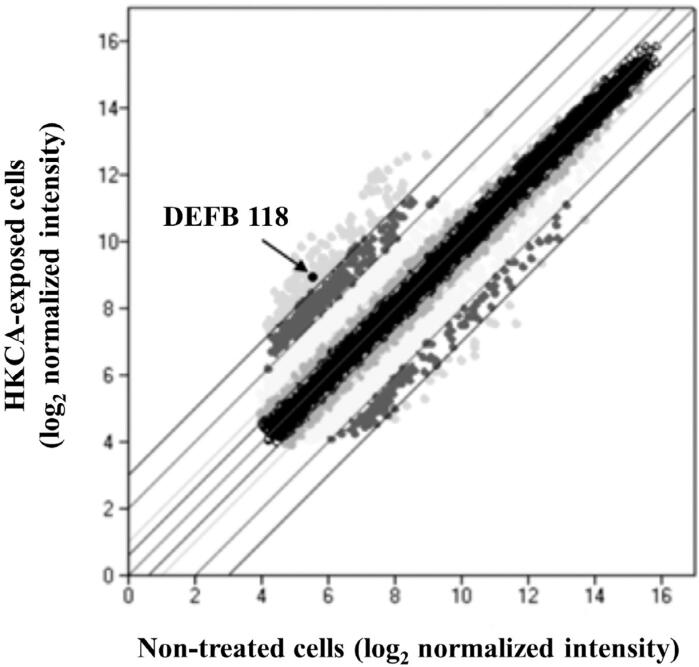
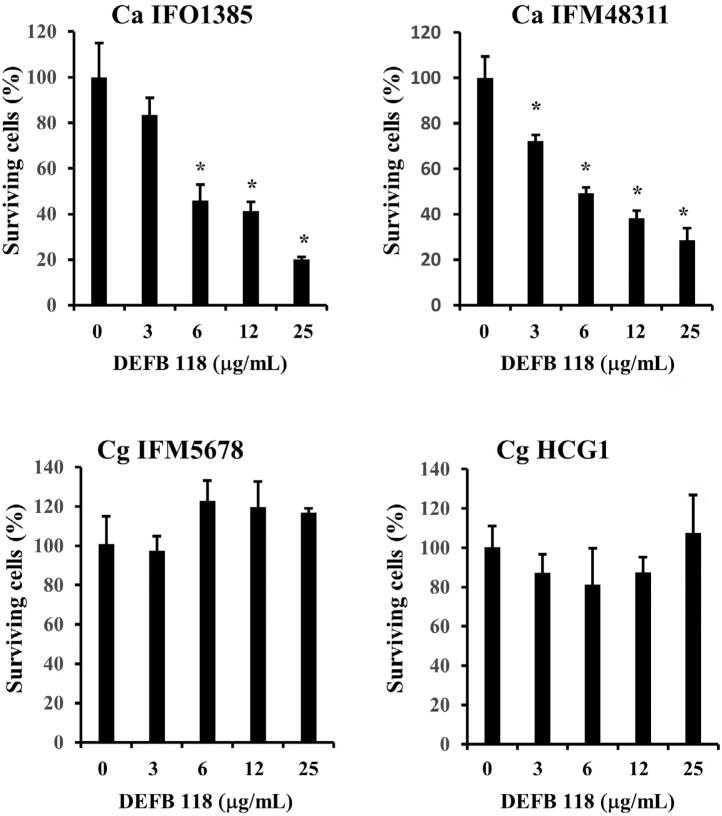
We performed expression profiles of defensin genes induced by heat-killed C. albicans in oral immortalized fibroblasts (GT1) using cDNA microarray analysis. From those results, quantitative RT-PCR was used to examine the effects of Candida β-glucan-containing particles (β-GPs) on β-Defensin 118 (DEFB 118) expression in oral mucosal cells. Furthermore, the antifungal activities of recombinant DEFB 118 against C. albicans and C. glabrata were investigated using fungicidal assays.
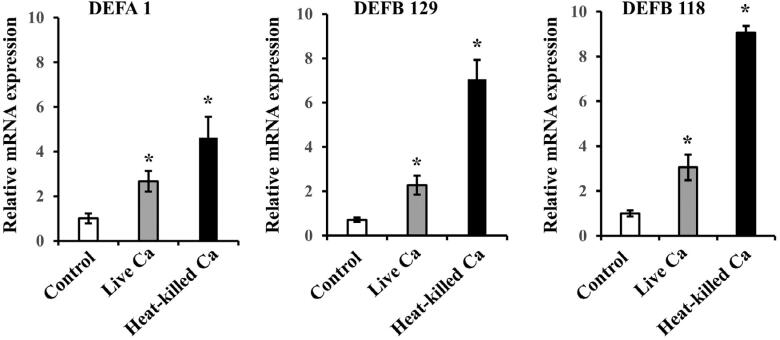
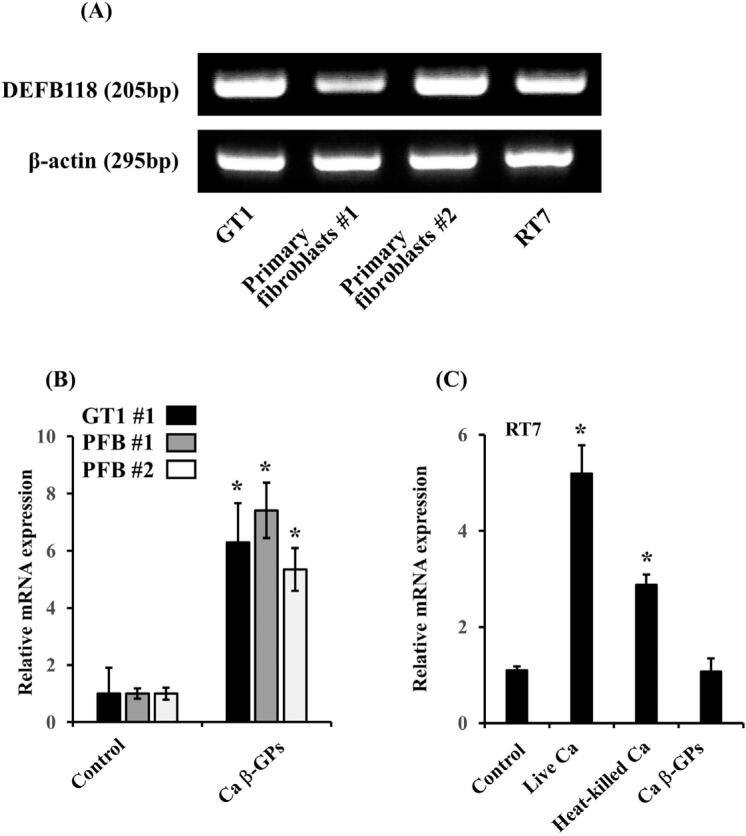
Microarray analysis showed that DEFB118, β-Defensin 129 (DEFB129), and α-Defensin 1 (DEFA1) genes were induced by heat-killed C. albicans and that their mRNA expressions were also significantly increased by live as well as heat-killed C. albicans . Next, we focused on DEFB118, and found that GT1, primary fibroblasts, and RT7 (oral immortalized keratinocytes) constitutively expressed DEFB118 mRNA expression in RT-PCR. Furthermore, C. albicans β-GPs significantly increased the expression of DEFB118 mRNA in GT1 and primary fibroblasts. Although DEFB118 mRNA expression in RT7 was significantly induced by both live and heat-killed C. albicans, C. albicans β-GPs failed to have an effect on that expression. Finally, recombinant DEFB118 significantly decreased the survival of both strains of C. albicans in a dose-dependent manner, whereas no effects were seen for both C. glabrata strains.
DEFB118, induced by C. albicans β-GPs from oral fibroblasts, may play an important role in oral immune responses against C. albicans infection.
虽然口腔成纤维细胞被认为具有增强宿主对白念珠菌防御能力的潜力,但尚不清楚它们是否能够识别念珠菌细胞成分,以增加防御素等抗真菌肽的表达,从而抵抗念珠菌感染。
我们使用 cDNA 微阵列分析,研究了热灭活白念珠菌诱导的口腔永生化成纤维细胞(GT1)中防御素基因的表达谱。根据这些结果,使用定量 RT-PCR 检测了含β-葡聚糖的念珠菌颗粒(β-GPs)对口腔黏膜细胞中β-防御素 118(DEFB 118)表达的影响。此外,还使用杀菌试验研究了重组 DEFB 118 对白色念珠菌和光滑念珠菌的抗真菌活性。
微阵列分析显示,DEFB118、β-防御素 129(DEFB129)和α-防御素 1(DEFA1)基因被热灭活的白念珠菌诱导,其 mRNA 表达也被活的和热灭活的白念珠菌显著增加。接下来,我们集中研究了 DEFB118,发现 GT1、原代成纤维细胞和 RT7(口腔永生化角质形成细胞)在 RT-PCR 中均有 DEFB118mRNA 表达。此外,白念珠菌β-GPs 显著增加了 GT1 和原代成纤维细胞中 DEFB118mRNA 的表达。虽然活的和热灭活的白念珠菌均显著诱导了 RT7 中 DEFB118mRNA 的表达,但白念珠菌β-GPs 对其表达没有影响。最后,重组 DEFB118 以剂量依赖性方式显著降低了两种白色念珠菌菌株的存活,而对两种光滑念珠菌菌株均无影响。
口腔成纤维细胞受白念珠菌β-GPs 诱导产生的 DEFB118,可能在口腔对白念珠菌感染的免疫反应中发挥重要作用。