Department of Psychiatry, The First Affiliated Hospital of Chongqing Medical University, Chongqing, China.
The First Clinical College of Chongqing Medical University, Chongqing, China.
Transl Psychiatry. 2022 May 4;12(1):183. doi: 10.1038/s41398-022-01951-9.
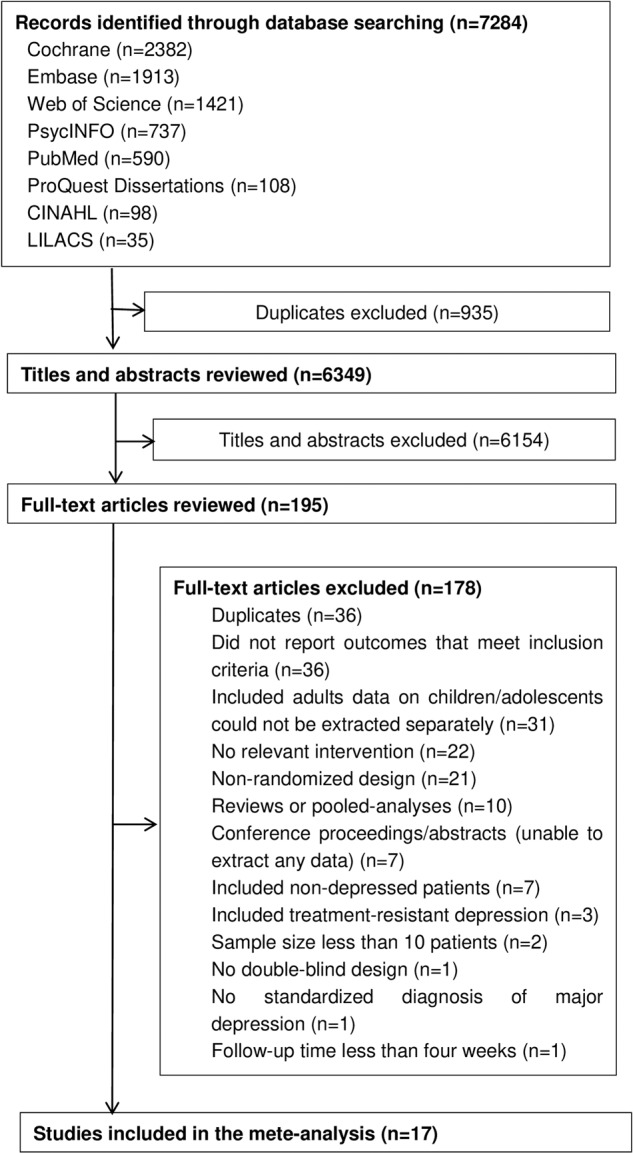
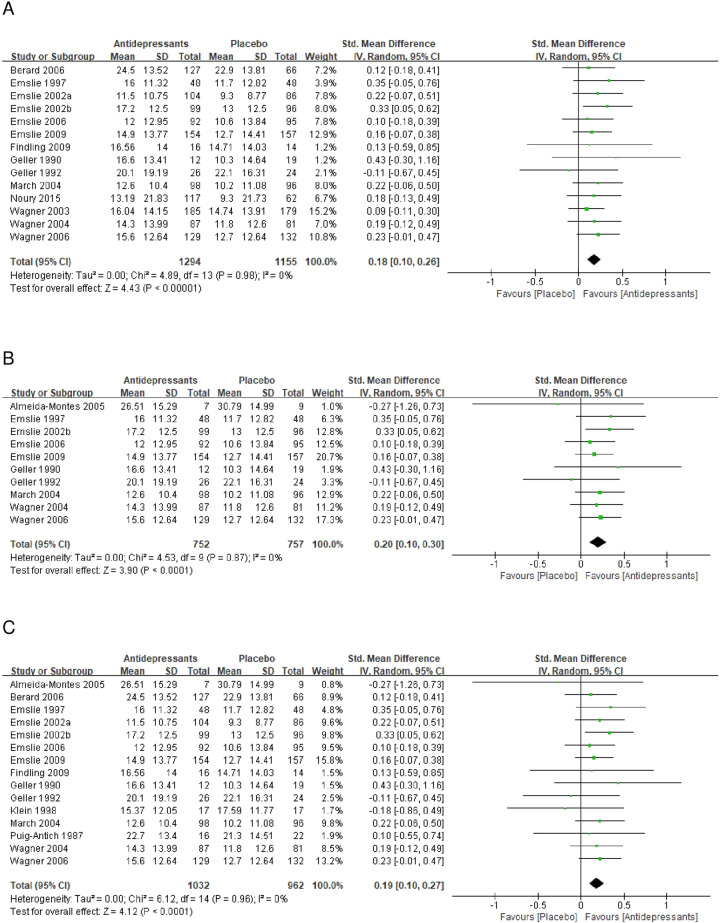
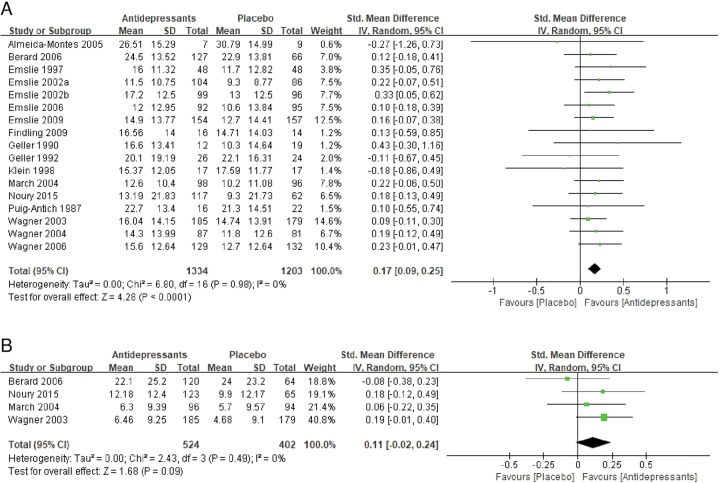
Functioning and quality of life (QOL) are typical outcomes assessed in children and adolescents with major depressive disorder (MDD); however, meta-analytical evidence remains scarce. The aim of this meta-analysis was to assess functioning and QOL antidepressant outcomes in this population. Eight electronic databases (PubMed, Cochrane Library, Web of Science, Embase, CINAHL, PsycINFO, LILACS, and ProQuest Dissertation Abstracts) were searched for double-blind randomized controlled trials (RCTs) up to July 31, 2020. RCTs that compared antidepressants with placebo for treating functioning and QOL in children and adolescents with MDD were included. Primary outcomes were mean change scores of functioning and QOL scales from baseline to post-treatment. Subgroup and sensitivity analyses were conducted to examine whether results were affected by moderator variables (e.g., medication type, age, sample size, and treatment duration). From 7284 publications, we included 17 RCTs (all 17 assessed functioning and 4 assessed QOL outcomes) including 2537 participants. Antidepressants showed significant positive effects on functioning (standardized mean difference [SMD] = 0.17, 95% confidence interval [CI] = 0.09-0.25, p < 0.0001) but not on QOL (SMD = 0.11, 95% CI = -0.02 to 0.24, p = 0.093), with no significant heterogeneity. The subgroup analysis showed that second-generation antidepressants (especially fluoxetine, escitalopram, and nefazodone), but not first-generation antidepressants, led to significant improvements in functioning. Antidepressants (especially second generation) improve functioning but not QOL in children and adolescents with MDD. However, well-designed clinical studies using large samples are needed to confirm these findings.
功能和生活质量(QOL)是评估患有重度抑郁症(MDD)的儿童和青少年的典型结果;然而,元分析证据仍然很少。本荟萃分析的目的是评估该人群抗抑郁药治疗的功能和 QOL 结果。截至 2020 年 7 月 31 日,我们在 8 个电子数据库(PubMed、Cochrane Library、Web of Science、Embase、CINAHL、PsycINFO、LILACS 和 ProQuest Dissertation Abstracts)中搜索了双盲随机对照试验(RCT)。纳入了比较抗抑郁药与安慰剂治疗 MDD 儿童和青少年功能和 QOL 的 RCT。主要结局是从基线到治疗后功能和 QOL 量表的平均变化分数。进行了亚组和敏感性分析,以检查结果是否受调节变量(例如,药物类型、年龄、样本量和治疗持续时间)的影响。从 7284 篇文献中,我们纳入了 17 项 RCT(全部 17 项评估了功能,4 项评估了 QOL 结果),包括 2537 名参与者。抗抑郁药对功能有显著的积极影响(标准化均数差 [SMD] = 0.17,95%置信区间 [CI] = 0.09-0.25,p < 0.0001),但对 QOL 没有影响(SMD = 0.11,95%CI = -0.02 至 0.24,p = 0.093),异质性不显著。亚组分析表明,第二代抗抑郁药(尤其是氟西汀、依地普仑和奈法唑酮),而不是第一代抗抑郁药,导致功能显著改善。抗抑郁药(尤其是第二代)可改善 MDD 儿童和青少年的功能,但不能改善 QOL。然而,需要使用大样本进行精心设计的临床研究来证实这些发现。