Department of Physical Therapy, Faculty of Rehabilitation, Kobe Gakuin University, 518 Ikawadanicho, Arise, Nishi-ku, Kobe, Hyogo, 651-2180, Japan.
Faculty of Rehabilitation, Kansai Medical University, 18-89 Uyamahigashicho, Hirakata, Osaka, 573-1136, Japan.
BMC Geriatr. 2022 May 5;22(1):393. doi: 10.1186/s12877-022-03018-2.
Both multiple fall experiences and fear of falling (FoF) would make people susceptible to another fall; however, the associations are unknown. This study investigates the association of FoF with fall occurrence among older adults according to their fall history.
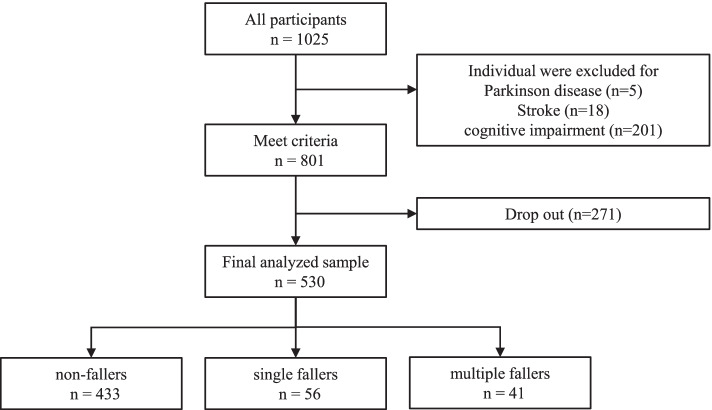
In this study, we adopted a longitudinal observational design. We visited 20 community centers to recruit 1,025 older adults (aged 65 years or older). At baseline, FoF was assessed using a single-item questionnaire. The number of falls in the past year was obtained via a self-questionnaire and participants were classified into three fall history groups (0: non-faller, 1: single faller, 2 or more: multiple faller). After a year of following-up, the number of falls during the year was considered as the main outcome. Poisson regression models clarified the influence of FoF on fall occurrence during the one-year follow-up, according to the participants' fall history.
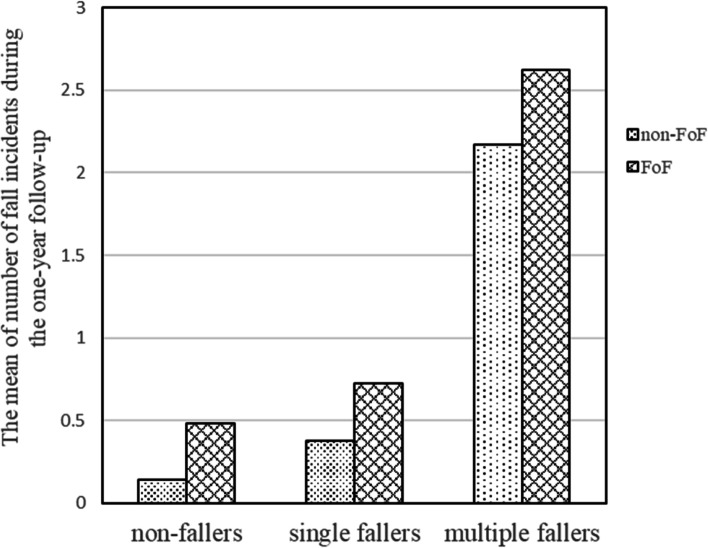
The final sample comprised 530 individuals (follow-up rate: 530/801, 66.4%). Fall history, FoF, and interaction between multiple fallers and FoF were significant in the adjusted statistical model (rate ratio [95% confidence interval]: single faller = 2.81 [1.06, 6.30], multiple faller = 13.60 [8.00, 23.04], FoF = 3.70 [2.48, 5.67], multiple faller*FoF = 0.37 [0.20, 0.68]).
We found that FoF was associated with the occurrence of falls in community-dwelling older adults. However, its association was lower in multiple fallers.
多次跌倒经历和对跌倒的恐惧都会使人容易再次跌倒;然而,这种关联尚不清楚。本研究根据老年人的跌倒史,调查了对跌倒恐惧与跌倒发生之间的关系。
在这项研究中,我们采用了纵向观察设计。我们访问了 20 个社区中心,招募了 1025 名老年人(年龄在 65 岁或以上)。在基线时,使用单项问卷评估对跌倒的恐惧。通过自我问卷获得过去一年的跌倒次数,并将参与者分为三组跌倒史(0:非跌倒者、1:单次跌倒者、2 次或更多:多次跌倒者)。在一年的随访后,将一年内的跌倒次数视为主要结果。根据参与者的跌倒史,泊松回归模型明确了对跌倒恐惧对一年随访期间跌倒发生的影响。
最终样本包括 530 人(随访率:530/801,66.4%)。在调整后的统计模型中,跌倒史、对跌倒的恐惧以及多次跌倒者和对跌倒的恐惧之间的相互作用具有统计学意义(调整后比率[95%置信区间]:单次跌倒者=2.81[1.06,6.30],多次跌倒者=13.60[8.00,23.04],对跌倒的恐惧=3.70[2.48,5.67],多次跌倒者*对跌倒的恐惧=0.37[0.20,0.68])。
我们发现,对跌倒的恐惧与社区居住的老年人跌倒的发生有关。然而,在多次跌倒者中,这种关联较低。