Department of Medical Oncology, Affiliated Hospital of Hebei University, Hebei Key Laboratory of Cancer Radiotherapy and Chemotherapy, Baoding, Hebei 071000, China.
Department of Nursing, The Sixth People's Hospital of Hebei Province, 572 Dongfeng East Road, Baoding, 071000 Hebei, China.
Comput Math Methods Med. 2022 Apr 25;2022:4820090. doi: 10.1155/2022/4820090. eCollection 2022.
To analyze the transmission and blocking intervention scheme of emotional disorders between cancer patients and their families.
About 150 patients with cancer and 150 family members with mood disorders treated in a tertiary hospital in North China from March 2021 to Octobor2021 were enrolled. The patients were randomly assigned into control group and study group. The control group received routine intervention, and the study group received the diagnosis, intervention, and treatment strategies of doctor-patient-affective disorder. The factors related to the transmission of emotional disorders between cancer patients and their families were analyzed, and the alterations of anxiety, depression, social support, and satisfaction of the two groups were compared under different blocking intervention schemes.
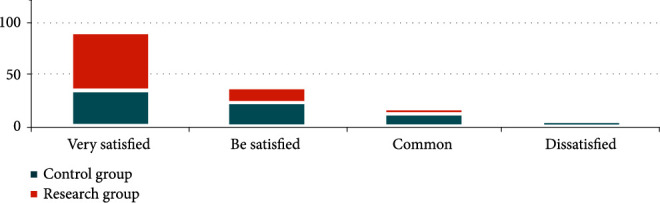
(1) Univariate analysis indicated that there were significant differences in family age, family income, sex, location of tumor, course of disease, TNM stage, somatic symptoms, and the incidence of anxiety and depression. There exhibited no significant difference between the gender of the family, the years of education of the family, the occupational status of the family, the relationship between the family and the patient, the mode of payment of the patient's medical expenses, the age of the patient, the mode of treatment of the patient, the degree of knowledge of the disease, and the incidence of anxiety and depression ( > 0.05). The anxiety and depression status of relatives were taken as dependent variables, and the age of family members, family income status, sex of patients, location of tumor, course of disease, TNM stage, and physical symptoms of patients were taken as independent variables, and the data were analyzed by Logistic regression analysis. Logistic regression analysis indicated that family income, tumor location, disease course, TNM stage, and somatic symptoms were the risk factors of anxiety and depression in relatives. (2) Comparison of social support status and intergroup, the objective support, subjective support, support utilization, and total score of social support in the study group were higher compared to the control group. In terms of the depression score before intervention, there exhibited no significant difference ( > 0.05), but after intervention, the depression score of the two groups decreased, and the depression score of the study group was lower compared to the control group before intervention, 1 week, 2 weeks, 3 weeks, and 4 weeks after intervention ( < 0.05). In terms of the anxiety score before intervention, there exhibited no significant difference ( > 0.05), but after intervention, the anxiety score of the two groups decreased, and the anxiety score of the study group was lower compared to the control group before intervention, 1 week, 2 weeks, 3 weeks, and 4 weeks after intervention ( < 0.05). Comparison of the satisfaction between the two groups and the study group was very satisfied in 56 cases, satisfactory in 14 cases, and general in 5 cases, and the satisfaction rate was 100.00%. The control group was very satisfied in 35 cases, satisfactory in 23 cases, general in 12 cases, and dissatisfied in 5 cases, and the satisfaction rate was 93.33%. The satisfaction of the study group was higher compared to the control group ( < 0.05).
Family income, tumor location, course of disease, TNM stage, and somatic symptoms are the risk factors of anxiety and depression in relatives. After establishing the diagnosis, intervention and treatment strategies of doctor-patient-affective disorder, the emotional disorder of family members of cancer patients, is significantly promoted, and the intervention satisfaction is high, so the scheme is worth promoting.
分析癌症患者及其家属之间情绪障碍的传播和阻断干预方案。
选取 2021 年 3 月至 2021 年 10 月在华北某三甲医院治疗的癌症患者及其情绪障碍家属各 150 例,采用随机数字表法分为对照组和研究组。对照组给予常规干预,研究组采用医患情感障碍的诊断、干预和治疗策略。分析癌症患者及其家属情绪障碍传播的相关因素,并比较不同阻断干预方案下两组焦虑、抑郁、社会支持和满意度的变化。
(1)单因素分析结果显示,家庭年龄、家庭收入、性别、肿瘤部位、病程、TNM 分期、躯体症状、焦虑和抑郁的发生率差异有统计学意义(>0.05);家庭性别、家庭文化程度、家庭职业状况、与患者关系、患者医疗费用支付方式、患者年龄、患者治疗方式、疾病知识知晓程度、焦虑和抑郁发生率差异无统计学意义(>0.05)。以亲属焦虑和抑郁状况为因变量,家庭年龄、家庭收入状况、患者性别、肿瘤部位、病程、TNM 分期、患者躯体症状为自变量,行 Logistic 回归分析。Logistic 回归分析结果显示,家庭收入、肿瘤部位、病程、TNM 分期、躯体症状是亲属焦虑和抑郁的危险因素(>0.05)。(2)社会支持状况比较及组间比较,研究组客观支持、主观支持、支持利用度和社会支持总分均高于对照组。干预前抑郁评分差异无统计学意义(>0.05),干预后两组抑郁评分均下降,研究组干预前、1 周、2 周、3 周、4 周后抑郁评分均低于对照组(<0.05)。干预前焦虑评分差异无统计学意义(>0.05),干预后两组焦虑评分均下降,研究组干预前、1 周、2 周、3 周、4 周后焦虑评分均低于对照组(<0.05)。两组满意度比较,研究组非常满意 56 例,满意 14 例,一般 5 例,满意度为 100.00%;对照组非常满意 35 例,满意 23 例,一般 12 例,不满意 5 例,满意度为 93.33%。研究组满意度高于对照组(<0.05)。
家庭收入、肿瘤部位、病程、TNM 分期和躯体症状是亲属焦虑和抑郁的危险因素。建立医患情感障碍的诊断、干预和治疗策略后,癌症患者家属的情绪障碍明显改善,干预满意度高,方案值得推广。
